Here's something that surprises most people: shell companies aren't illegal. In fact, you could form one this afternoon if you wanted to. The real question isn't whether these entities are allowed—it's what you plan to do with them once they exist.
Think of a shell company like a safe. You can buy one, install it in your home, and use it to protect valuable documents or heirlooms. That's perfectly fine. But if you stuff it with stolen cash or use it to hide assets during a divorce, you've crossed into criminal territory. The safe didn't commit the crime—you did.
American law treats shell companies the same way. These paper entities play important roles in legitimate business deals, real estate holdings, and corporate reorganizations. But they've also become tools for money launderers, tax cheats, and fraudsters. Recent federal laws have cracked down hard on anonymity, forcing most shell company owners to reveal themselves to government authorities.
What Is a Shell Company and How Does It Work
Picture a business with no employees, no office, no products, and no customers. That's a shell company. It exists solely as a legal entity—a name on state registration documents and a file folder in someone's office.
Here's how the typical formation process unfolds. Let's say you want to create a Delaware LLC. You'd prepare articles of organization listing the company name, registered agent, and basic management structure. These documents go to Delaware's Division of Corporations along with a filing fee (currently $90). Within a few business days, your LLC exists. You'll request an EIN from the IRS using Form SS-4, which takes about 15 minutes online. Now your shell company can open bank accounts and sign contracts.
What happens next? Usually not much. The entity sits there, holding whatever you put into it. Maybe you transfer a rental property into the LLC's name. Maybe you deposit some cash and wait to use the company for a future transaction. Maybe it just exists as an empty placeholder. You'll file an annual report with Delaware each year (another $300) to keep the entity active, but there's no requirement to conduct actual business operations.
Maintenance costs stay minimal—a registered agent fee (around $50-300 annually), the state's annual report fee, and perhaps a small amount in accounting costs if you file tax returns. Some shell companies hold millions in real estate or investments. Others maintain bank accounts with a few hundred dollars, just enough to keep the account open.
The formation jurisdiction matters more than you'd think. Delaware processes corporate filings efficiently and has business-friendly courts with deep expertise in corporate law. Nevada doesn't impose state corporate income tax and historically offered strong privacy protections. Wyoming combines low fees with minimal annual requirements. Before 2024, these states let you form entities without publicly disclosing who actually owned them—you'd just list a commercial registered agent's address, and that was enough.
Author: Andrew Bellamy;
Source: craftydeb.com
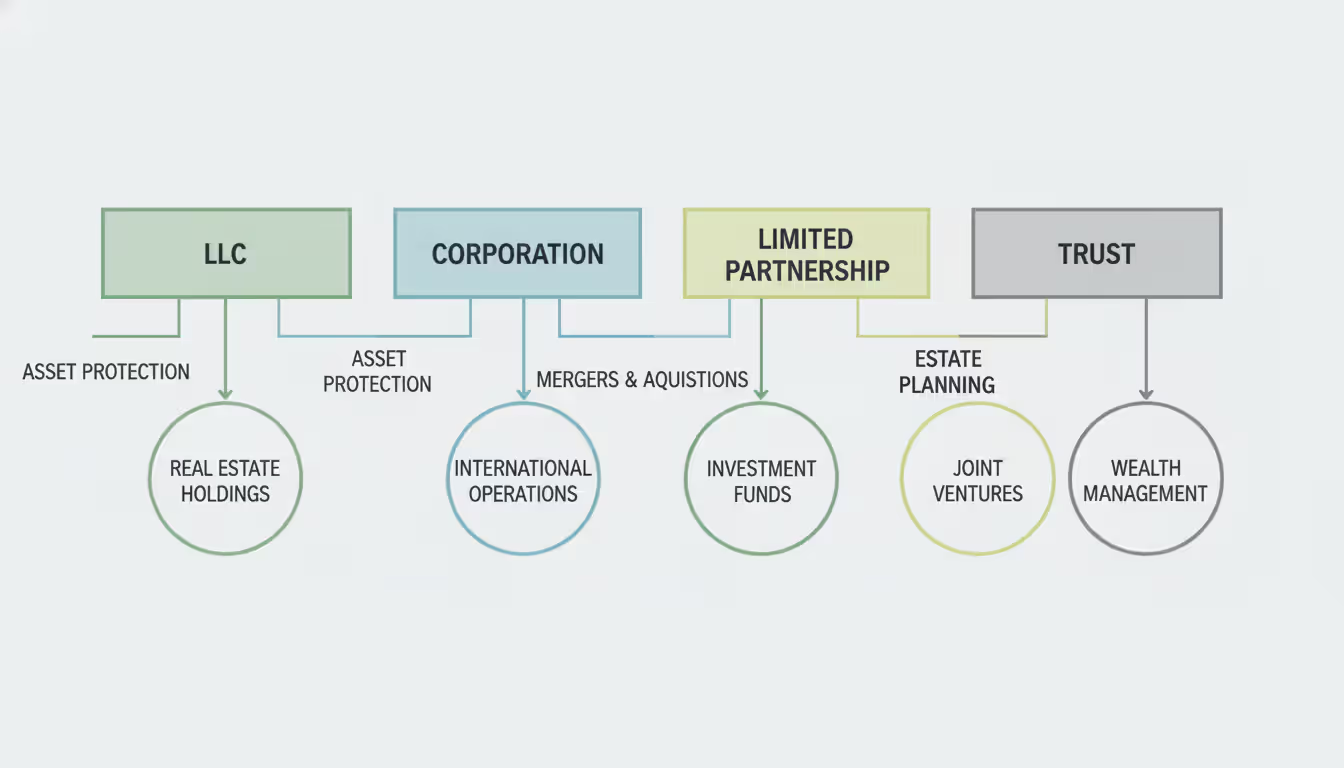
Shell companies take different legal forms depending on what you need. An LLC works well for real estate because of liability protection and pass-through taxation (the LLC itself doesn't pay federal income tax—profits and losses flow to the members' personal returns). A corporation might make sense if you're planning international operations or want to issue stock eventually. Limited partnerships show up in investment fund structures. Trusts serve estate planning purposes.
Legal Uses of Shell Companies in Business
Walk into any commercial real estate attorney's office, and you'll find dozens of shell companies in their client files. These structures solve practical problems that have nothing to do with hiding money.
Take Jerry, who owns eight apartment buildings in Atlanta. He puts each property in a separate LLC. Why? If a tenant gets hurt at one building and sues, they can only reach the assets in that particular LLC—not Jerry's other properties or personal savings. This strategy (called "asset compartmentalization") is standard practice in real estate investing. Jerry's not hiding anything—the ownership records sit in Georgia's Secretary of State database. He's just building legal firewalls between his properties.
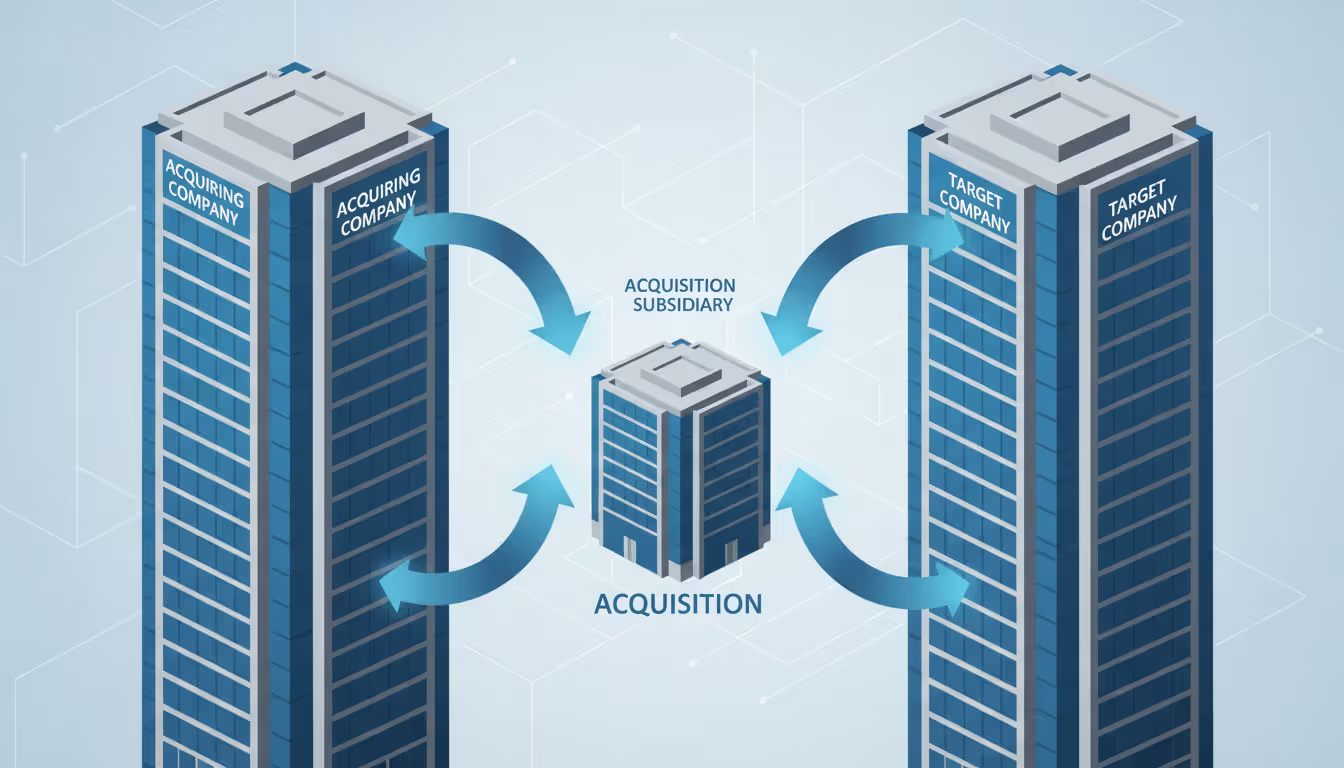
Corporate acquisitions generate massive shell company activity. When Microsoft wanted to buy Activision Blizzard for $69 billion, did Microsoft's main entity directly purchase all those shares? No. The deal involved multiple acquisition subsidiaries—shell companies created specifically to hold Activision stock during the transaction process. This structure simplified regulatory approvals, managed tax implications, and kept the mechanics separate from Microsoft's ongoing operations. Once the deal closed, these acquisition vehicles served their purpose and either dissolved or merged into the parent company.
Intellectual property gets expensive to protect. Pharmaceutical companies, software developers, and manufacturers with valuable patents often transfer those assets into dedicated holding entities. The shell company owns the patents and licenses them back to the operating companies that actually make products. If the operating company faces a lawsuit over product liability, the plaintiff can't seize the patents—those sit safely in a separate entity. Plus, this arrangement can create tax benefits when structured properly (though you need good lawyers and accountants to avoid IRS scrutiny).
Companies expanding into new markets routinely use shell entities as beachheads. A Japanese manufacturer planning to build a factory in Texas might establish a Texas LLC first. The shell company signs the property lease, obtains building permits, opens bank accounts, and hires initial staff—all while the Japanese parent company figures out operational details. This approach satisfies local legal requirements without immediately committing massive resources.
Wealthy families use shell companies constantly in estate planning. Maybe the Chen family owns a vacation home in Aspen worth $8 million. Transferring that property directly to their kids would trigger gift tax issues. Instead, they put it in an LLC, then gradually gift LLC membership interests to the children over several years, staying within annual gift tax exclusions. The shell company continues owning the house, but ownership interests shift gradually to the next generation. Nothing shady—just sophisticated estate planning that wealthy families have done for decades.
Author: Andrew Bellamy;
Source: craftydeb.com
Shell Company vs Holding Company
People confuse these terms constantly, but they describe genuinely different animals.
Warren Buffett's Berkshire Hathaway is a holding company. It owns GEICO, Dairy Queen, Duracell, and pieces of Apple, Bank of America, and Coca-Cola. Berkshire employs thousands of people at its headquarters in Omaha. The company generates billions in revenue, files extensive reports with the SEC, and actively manages its portfolio of businesses. That's a holding company—it exists to own and manage other companies, and it conducts substantial operations in doing so.
Now picture a Delaware LLC that owns a single patent for a manufacturing process. The LLC has no employees. It licenses the patent to three different factories, collects royalty checks, and that's it. One person manages the LLC from their laptop, reviewing license agreements and depositing checks twice a year. That's a shell company—it owns something valuable but conducts minimal operations itself.
The distinction gets blurry sometimes. A family office might own dozens of properties and investment accounts through a holding company structure, but if it has only two employees and doesn't actively manage businesses, does it function more like a sophisticated shell? Regulators care about this distinction because reporting requirements differ. Publicly traded holding companies file quarterly reports, audited financials, and detailed disclosures. Small shell companies (until recently) filed basically nothing beyond state annual reports.
When Shell Companies Cross Into Illegal Territory
The shell company sitting in your file cabinet isn't illegal. But using it to commit crimes? That'll land you in federal prison.
Money laundering represents the classic illegal use case. Here's how it typically works: A fentanyl trafficking ring generates $50,000 weekly in cash. You can't just deposit that in a personal bank account—banks report large cash deposits, and the IRS wants to know where money comes from. So the traffickers create "Quick Clean Laundromat LLC" and claim it operates coin laundries in three cities. They deposit drug cash as if it were quarters from washing machines. The shell company files tax returns reporting laundromat income, pays taxes on it, and suddenly dirty money looks clean. Of course, federal agents investigating drug trafficking will trace those cash flows, discover the laundromats don't actually exist, and charge everyone involved under 18 USC § 1956 (the federal money laundering statute). Convictions carry 20-year prison sentences.
Tax fraud schemes take countless forms. A construction contractor might create shell companies that supposedly provide subcontracting services. The contractor's real business pays these shells for work they never performed, creating fake expenses that reduce taxable income. The shell companies exist only on paper—no employees, no equipment, no actual construction work. The contractor pockets the money that supposedly went to these phantom subcontractors while reporting much lower profits to the IRS. When the IRS audits and discovers the scheme, criminal prosecution for tax evasion follows. The penalty? Up to five years in federal prison plus fines up to $250,000.
Securities fraud often involves shell companies designed to deceive investors. Remember Theranos? While that case had many layers, shell company structures helped hide the fact that the technology didn't work as claimed. More typically, someone might create shell companies that pretend to purchase products from a struggling public company, artificially inflating revenue figures. Investors see growing sales and buy stock, driving up the price. The fraudster sells their shares at a profit before the scheme collapses. The SEC prosecutes these cases aggressively, and prison time usually follows.
Sanctions evasion has become a huge enforcement priority. Russian oligarchs facing sanctions after the Ukraine invasion have used shell companies trying to buy US real estate, access American banks, and move money through the financial system. The Treasury Department's Office of Foreign Assets Control tracks these schemes obsessively. A sanctioned individual who uses a shell company to purchase a Miami condo faces criminal prosecution, asset forfeiture, and penalties reaching millions of dollars.
What separates legal from illegal isn't the corporate structure—it's what you're trying to accomplish. Using an LLC to hold rental property? Fine. Using that same LLC to hide rental income from the IRS? Federal crime. The entity itself stays neutral; your intentions and actions determine legality.
US Laws Governing Shell Company Formation and Use
A legal earthquake hit shell companies in 2024. Rules that governed these entities for decades got torn up and replaced with a comprehensive federal transparency regime.
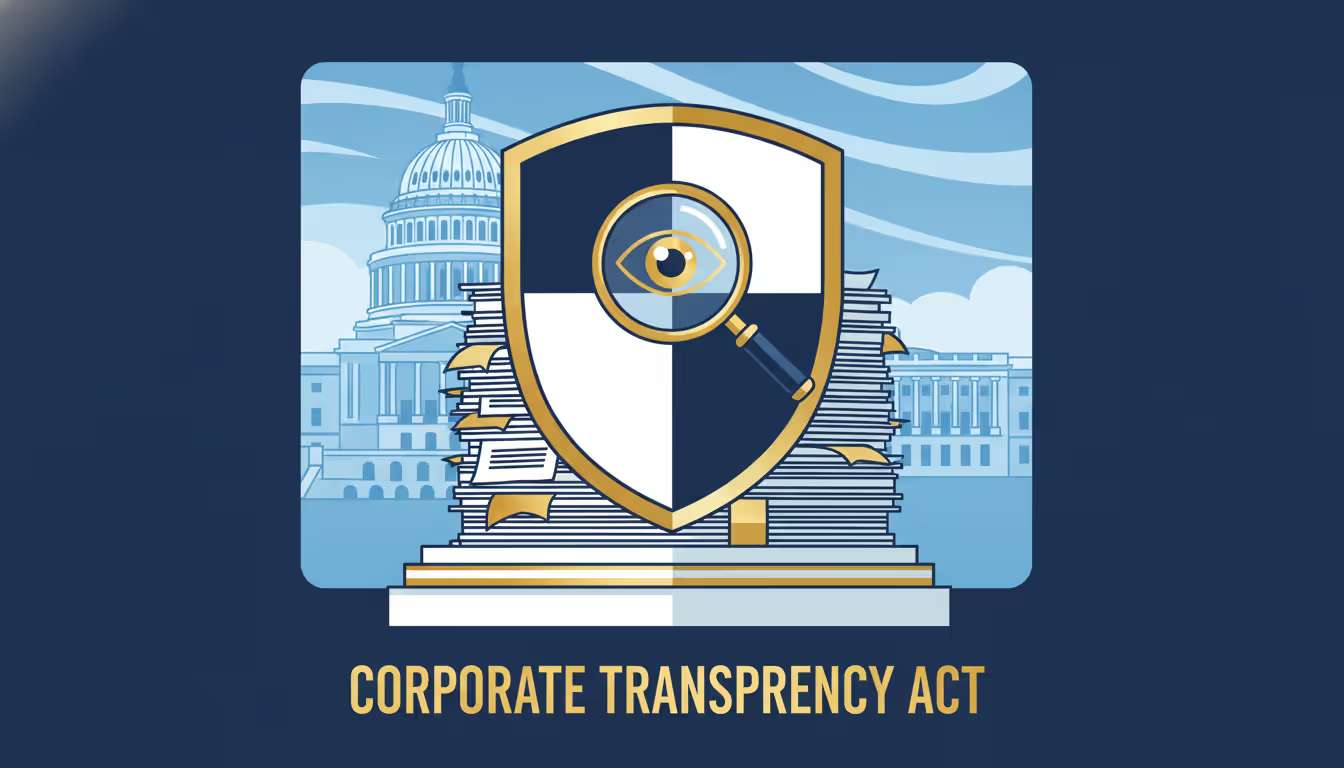
The Corporate Transparency Act changed everything. Congress passed it in 2021 as part of the National Defense Authorization Act (tucked into a defense spending bill—that's how controversial financial regulations often become law). The legislation aimed to solve a glaring problem: the United States had become one of the easiest places on Earth to create anonymous companies. Drug cartels, corrupt foreign officials, and sanctions targets exploited this gap. International anti-money laundering organizations repeatedly criticized American corporate secrecy.
Starting January 1, 2024, the Financial Crimes Enforcement Network (FinCEN—the Treasury Department bureau that tracks financial crime) began accepting beneficial ownership reports. Most companies formed in the US now must disclose who really owns and controls them. This information goes into a federal database that law enforcement agencies can access. It's not publicly available, but anonymity is gone.
State registration processes haven't changed much. You still file articles of incorporation or organization with your chosen state, pay the filing fee, and designate a registered agent. Delaware still processes corporate filings quickly. Nevada still attracts entities seeking favorable tax treatment. But state-level privacy protections no longer matter much because federal reporting requirements override them.
Banks enforce anti-money laundering rules that affect shell companies directly. When you try opening a business bank account, you'll answer detailed questions about the company's purpose, expected transaction volume, and ownership structure. Banks must verify your identity, understand why the business exists, and file suspicious activity reports when transactions don't make sense. A shell company with no apparent business purpose trying to receive large wire transfers from foreign countries will trigger immediate scrutiny and probable account closure.
The Bank Secrecy Act (passed in 1970) requires financial institutions to maintain records and report transactions that might signal money laundering or other crimes. Currency Transaction Reports go to FinCEN for any cash transaction exceeding $10,000. Suspicious Activity Reports flag transactions that seem designed to evade reporting requirements or that lack obvious legitimate purposes. These requirements create a paper trail that investigators can follow when shell companies get used for illicit purposes.
Tax reporting obligations run parallel to corporate transparency requirements. Your shell company needs an EIN from the IRS. If it generates any income, it files tax returns—Form 1065 for partnerships and multi-member LLCs, Form 1120 for corporations, or Schedule C on your personal return for single-member LLCs treated as disregarded entities. The Foreign Account Tax Compliance Act forces foreign banks to report accounts held by US persons, making offshore shell companies much harder to hide from the IRS.
Beneficial Ownership Information Reporting Requirements
FinCEN's beneficial ownership reporting system works like this: You identify everyone who qualifies as a "beneficial owner"—anyone owning 25% or more of the company OR anyone exercising substantial control over it (senior officers, people with authority to make major decisions, etc.). For each beneficial owner, you report their full legal name, birthdate, residential address, and an identifying number from a driver's license or passport. You upload an image of that ID document.
Deadlines depend on when your company formed. Entities created before 2024 had until December 31, 2024, to file initial reports. Companies formed during 2024 got 90 calendar days from formation. Starting in 2025, newly formed companies have just 30 days to report beneficial ownership information. Miss these deadlines and you're out of compliance.
The reporting obligation continues indefinitely. Any change in beneficial ownership—someone buys out a partner, a new member joins, an owner moves to a different address—must be reported within 30 days. FinCEN expects you to keep this information current.
Penalties bite hard. Civil fines reach $500 per day while violations continue. Willful failure to report or deliberately providing false information becomes a criminal offense punishable by fines up to $10,000 and imprisonment up to two years. "Willful" means you knew about the requirement and ignored it or you intentionally lied—honest mistakes generally don't trigger criminal prosecution, but the civil penalties still apply.
Some entities escape these requirements entirely. Companies that are already heavily regulated don't have to file—banks, credit unions, insurance companies, registered broker-dealers, public accounting firms, and public utilities are exempt. Publicly traded companies don't report because their ownership information is already public through SEC filings. Large operating companies (more than 20 full-time US employees, a physical office in the US, and over $5 million in gross receipts reported on the previous year's tax return) also qualify for an exemption.
Most shell companies don't meet any exemption criteria. That empty LLC holding your rental property? Not exempt—you must file. The Delaware corporation you created for a future business venture? Not exempt—you must file. The only common exception that catches shell companies is when they're owned by an exempt entity (if a bank owns a subsidiary shell company, that subsidiary doesn't have to file its own report).
The beneficial ownership database isn't available to the public. Only federal law enforcement agencies, state and local law enforcement with court authorization, federal regulators supervising financial institutions, and Treasury officials can access it. Financial institutions can request access with customer consent when conducting due diligence. Foreign law enforcement can access the database through official channels when investigating serious crimes. This limited access tries to balance transparency for law enforcement against privacy concerns for legitimate businesses.
Anonymous LLC Rules by State
Before 2024, Delaware made it absurdly easy to form an anonymous LLC. The formation documents required a company name, registered agent address, and organizer signature. The organizer could be anyone—commonly a paralegal at the formation service who'd sign as organizer for 50 LLCs that same day. Member names didn't appear anywhere in the public filing. If you wanted complete anonymity, you'd use a registered agent service as organizer, list that service's address, and your name would appear nowhere in Delaware's public records.
Nevada and Wyoming offered similar anonymity with additional perks. Nevada doesn't impose state corporate income tax, and Wyoming combined low fees ($100 to form an LLC) with minimal annual requirements. New Mexico went even further—it didn't require annual reports at all, so once you formed an entity, you could ignore it completely and it would stay active indefinitely.
Those days are over. State laws still don't require beneficial owner disclosure in public formation documents in most jurisdictions. You can still file Delaware articles of organization listing only a registered agent. But federal law now mandates reporting that same ownership information to FinCEN. The practical effect: anonymity shifted from "nobody knows who owns this" to "the government knows but the public doesn't."
Several states implemented their own transparency reforms before federal law took effect. New York passed legislation requiring LLCs to identify beneficial owners when filing formation documents or within certain timeframes for existing entities. California enacted similar requirements. These state-level rules remain in force alongside federal reporting obligations—if you form an LLC in New York, you might need to disclose ownership to both the state and to FinCEN.
The registered agent industry adapted quickly. Services that once advertised "complete anonymity" and "total privacy" now promote "compliance solutions" and "beneficial ownership reporting assistance." They'll still serve as your registered agent and provide a formation address, but they've dropped promises of anonymity that are no longer legally possible.
Offshore Shell Companies and US Legal Compliance
Author: Andrew Bellamy;
Source: craftydeb.com
American citizens and residents face a blizzard of reporting requirements when they own foreign entities. The IRS doesn't prohibit offshore shell companies, but it demands extensive disclosure about them.
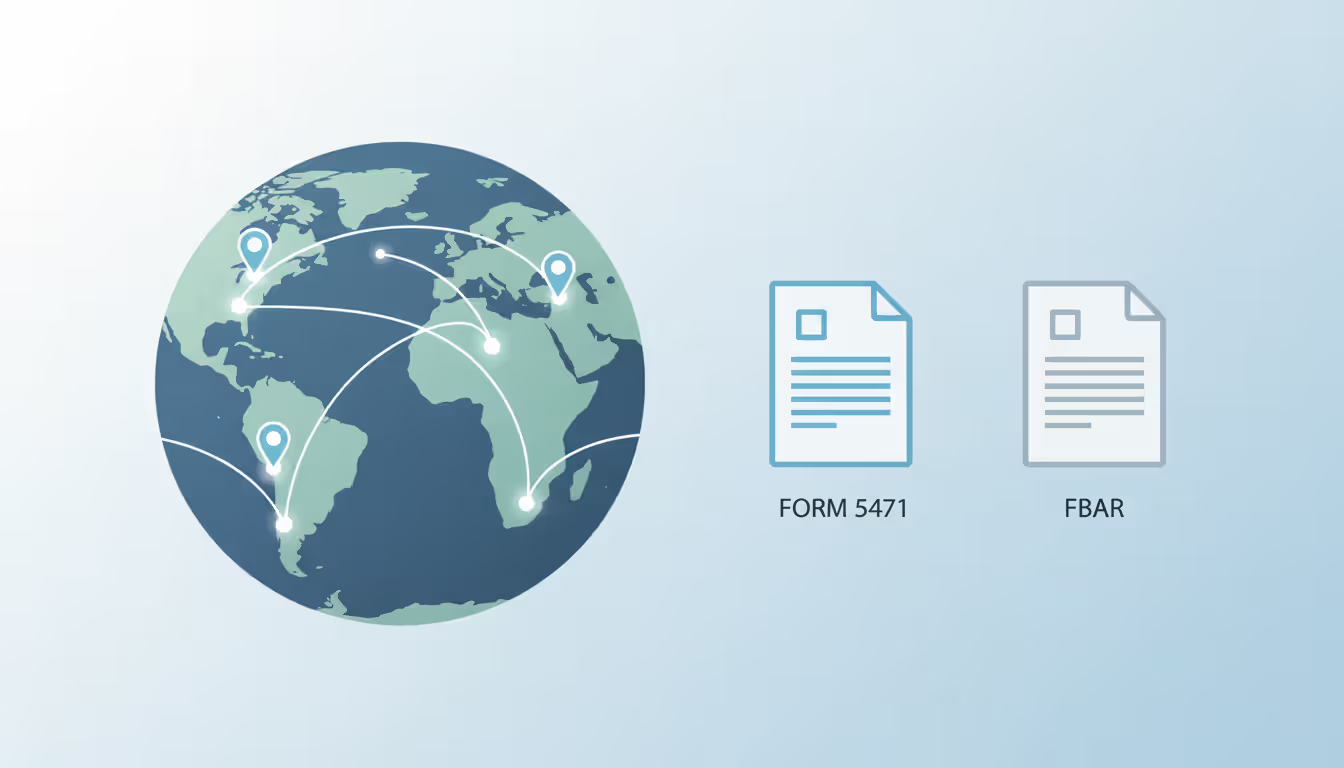
Form 5471 catches most US persons with ownership in foreign corporations. If you own 10% or more of a foreign corporation, or if you're an officer or director of a foreign corporation with at least one US shareholder, you probably need to file Form 5471 with your tax return. This form requires detailed information—the corporation's balance sheet, income statement, ownership structure, transactions with related parties, and more. Penalties for failing to file? The IRS assesses $10,000 per form for each year you don't file. Continued failure after the IRS notifies you raises penalties to $60,000 per form. These penalties apply even if you owe no additional tax.
The Report of Foreign Bank and Financial Accounts (FBAR) creates a separate disclosure obligation. US persons with signature authority over or financial interest in foreign financial accounts exceeding $10,000 in aggregate at any point during the year must file FinCEN Form 114 by April 15 (with automatic extension to October 15). Offshore shell companies typically maintain foreign bank accounts, triggering FBAR requirements for the US beneficial owners. Willful violations carry penalties reaching the greater of $100,000 or half the account balance—per violation, per year. Criminal prosecution is possible for egregious cases.
FATCA (Foreign Account Tax Compliance Act) approaches the problem from the other direction. Instead of just requiring US taxpayers to report foreign accounts, FATCA forces foreign financial institutions to report accounts held by US persons directly to the IRS or face 30% withholding on certain US-source payments. This regime makes it extremely difficult for Americans to hide offshore accounts. Foreign banks ask every customer if they're a US person, and they have powerful incentives to identify and report Americans. If you own a shell company in the Cayman Islands with a Cayman bank account, that bank will probably report the account to the IRS.
Legitimate reasons for offshore shell companies absolutely exist. You might be a US citizen doing business in Singapore who forms a Singapore company to hold local real estate and comply with Singapore regulations. You might have family connections in Ireland and use an Irish entity in estate planning. You might operate a business with European customers and form a Netherlands company for legitimate tax planning and operational purposes. None of this is illegal if you file all required US tax forms and report the structures accurately.
The problems arise from failure to disclose. The IRS estimates that tens of thousands of Americans held undisclosed offshore accounts through shell companies before enforcement intensified. The Offshore Voluntary Disclosure Program let taxpayers come forward, report previously hidden accounts, pay back taxes and penalties, and avoid criminal prosecution. Thousands participated, paying billions in back taxes and penalties.
Enforcement trends have moved sharply toward aggressive prosecution. The Justice Department's Tax Division routinely brings criminal cases against Americans who used offshore shell companies to evade taxes. Recent cases have involved Swiss banks, Caribbean financial centers, and even accounts in Israel and India. Prosecutors secure long prison sentences and force defendants to forfeit hidden assets. The days of assuming offshore accounts would never be discovered are decisively over.
Shell Company Transparency Laws and Recent Reforms
People misunderstand what shell companies are and why they matter.These structures aren't inherently good or bad—they're tools that serve real purposes in legitimate business transactions. I help clients set up shell companies constantly for things like real estate holdings, merger transactions, and intellectual property management. The problem was never the entity itself. The problem was anonymity that let criminals and corrupt officials hide behind these structures. The Corporate Transparency Act fixed that gap by requiring disclosure to law enforcement while still protecting legitimate privacy interests. My clients who use shell companies for lawful purposes can keep doing exactly what they've always done—they just need to file a form with FinCEN disclosing who owns the entity. That's a reasonable price for the public benefit of preventing money laundering and financial crime
— Jennifer Martinez
The Corporate Transparency Act represents the culmination of a decade-long push for reform. International pressure had been building for years—the Financial Action Task Force (an international organization setting anti-money laundering standards) repeatedly criticized the United States for corporate secrecy that lagged behind European and other developed countries.
High-profile scandals accelerated legislative action. The Panama Papers leak in 2016 exposed how offshore shell companies facilitated tax evasion, corruption, and sanctions violations. Investigations revealed that anonymous US shell companies played significant roles in money laundering schemes. Law enforcement officials testified before Congress about investigations stymied by their inability to identify shell company owners. National security officials warned that foreign adversaries and terrorist organizations exploited American corporate secrecy.
Congress debated transparency legislation for years before finally passing the Corporate Transparency Act as part of the 2021 National Defense Authorization Act. Implementation took several years—FinCEN had to write detailed regulations, build the reporting database system, and develop processes for accepting and securing beneficial ownership information. The system went live January 1, 2024.
Early implementation saw strong compliance from law firms, accounting firms, and formation services that guided clients through the new requirements. FinCEN conducted extensive outreach, publishing guides and hosting webinars. By mid-2024, millions of companies had filed beneficial ownership reports. Enforcement started slowly, with FinCEN focusing on willful non-compliance rather than good-faith mistakes.
State-level reforms proceeded independently. Delaware amended its LLC statute to improve transparency, though still not requiring beneficial owner disclosure in public filings. California strengthened reporting requirements and increased penalties for fraudulent filings. Several states enhanced their registered agent regulations, requiring formation services to verify customer identities and maintain records.
International coordination improved dramatically. US law enforcement agencies increased information sharing with foreign counterparts investigating money laundering and corruption. The automatic exchange of tax information under FATCA (and other countries' participation in the Common Reporting Standard) made it harder to hide assets across borders. Countries began harmonizing beneficial ownership reporting standards, making it more difficult to exploit gaps between jurisdictions.
Author: Andrew Bellamy;
Source: craftydeb.com
Future regulatory direction seems focused on refinement and enforcement rather than major new legislation. FinCEN is developing analytical capabilities to mine the beneficial ownership database, identifying suspicious patterns and supporting investigations. Technology will play an increasing role—artificial intelligence analyzing ownership networks, blockchain-based corporate registries improving transparency, and enhanced data analytics detecting shell companies used for illicit purposes.
Courts have begun interpreting the Corporate Transparency Act's requirements, and early decisions suggest judges will enforce reporting obligations strictly. Constitutional challenges were filed arguing the federal government lacks authority to require state-created entities to report ownership information, but most legal experts expect courts to uphold the law as a valid exercise of federal power to regulate interstate commerce and prevent financial crimes.
Legal vs. Illegal Shell Company Uses
Legitimate Uses
Criminal Misuses
Property liability protection: A landlord forms separate LLCs for each apartment complex, preventing a lawsuit at one property from threatening others. Standard asset protection strategy with clear business justification.
Drug money laundering: Traffickers create phony businesses (laundromats, restaurants) and deposit cash proceeds as if they were legitimate revenue, hiding the criminal source. Violates federal money laundering statutes (18 USC § 1956) with penalties reaching 20 years imprisonment.
Acquisition confidentiality: Buyer creates subsidiary specifically to negotiate purchase of target company without alerting competitors or disrupting markets. Common in M&A transactions worth millions or billions.
Tax fraud through phantom entities: Business owner invents shell companies that supposedly provide services, pays them for work never performed, and deducts fake expenses to reduce taxable income. Prosecuted as tax evasion under 26 USC § 7201, carrying five years imprisonment plus substantial fines.
Intellectual property segregation: Tech company transfers valuable patents to dedicated holding entity, then licenses them back to operating divisions. Protects IP from operational liabilities while potentially creating tax efficiencies.
Sanctions violations: Foreign nationals subject to US sanctions use shell companies to access American financial system, purchase property, or conduct prohibited transactions. Treasury Department prosecutes under International Emergency Economic Powers Act (50 USC § 1705).
Estate wealth transfer: Family places vacation property worth millions into LLC, then gradually gifts membership interests to children over several years, managing gift tax obligations while transferring wealth across generations.
Government contract fraud: Contractor creates multiple shell companies that submit invoices for supplies or services never delivered, stealing taxpayer funds. Prosecuted as wire fraud (18 USC § 1343) or false claims (31 USC § 3729).
Foreign market entry: International company forms US entity to obtain licenses, sign commercial leases, and establish banking relationships before beginning active operations in American markets.
Investment deception: Shell companies falsely claim to own assets or generate revenue to deceive investors, inflating stock prices or attracting funds to fraudulent ventures. Securities fraud charges under 15 USC § 78j(b) and SEC Rule 10b-5.
Frequently Asked Questions About Shell Company Legality
Can I legally create a shell company in the US?
Absolutely. Formation is completely legal—you can establish an LLC or corporation in any state by filing paperwork and paying fees (typically $50-$500 depending on the state). Thousands of attorneys, accountants, and business owners create shell companies every week for legitimate purposes like holding real estate, managing investments, or facilitating business transactions. What you do with the entity after formation determines legality. Hold rental property in it? Legal. Launder drug money through it? Criminal. Also understand that you'll need to report beneficial ownership information to FinCEN within 30 days of formation (for entities created in 2025 or later) under the Corporate Transparency Act.
Do I have to disclose who owns my shell company?
Yes, in almost all cases. The Corporate Transparency Act requires reporting beneficial ownership information to FinCEN—specifically, anyone who owns 25% or more of the company or exercises substantial control over it. This information goes to federal authorities, not into public records that anyone can search. Law enforcement agencies access it when investigating crimes. Banks can request it (with your consent) when you open accounts. The general public cannot see it. Exemptions exist for large operating companies, publicly traded entities, and heavily regulated industries, but most shell companies don't qualify for exemptions. State requirements vary—some states want beneficial owner information in formation documents, others don't, but the federal reporting obligation applies regardless.
What are the penalties for misusing a shell company?
Depends entirely on what you did. Money laundering prosecutions under 18 USC § 1956 carry maximum sentences of 20 years in federal prison plus fines reaching $500,000 or twice the amount laundered (whichever is greater). Tax evasion brings up to five years imprisonment and $250,000 in fines for individuals, plus civil penalties that can exceed the amount evaded. Failing to report beneficial ownership information to FinCEN triggers civil fines of $500 daily while you remain non-compliant, and willful violations add criminal penalties up to $10,000 in fines plus two years imprisonment. Securities fraud, sanctions violations, and other offenses involving shell companies carry their own penalty structures—often including lengthy prison sentences, massive fines, and asset forfeiture that can leave defendants financially devastated.
Is an LLC the same as a shell company?
No—these terms describe completely different concepts. An LLC is a legal structure, a type of business entity offering liability protection and flexible tax treatment. Most LLCs are active businesses employing people, generating revenue, and conducting ongoing commercial operations. A shell company is any business entity (could be an LLC, corporation, partnership, or other form) that lacks significant operations or employees and exists primarily to hold assets or facilitate specific transactions. The confusion arises because LLCs are commonly used for shell company purposes due to their flexibility, pass-through taxation, and relatively simple formation and maintenance requirements. But calling an LLC a shell company is like calling a building a warehouse—some buildings are warehouses, but most aren't.
Are offshore shell companies automatically illegal?
Not at all. Americans legally own and control foreign entities for countless legitimate reasons—international business operations, foreign real estate investments, estate planning involving family members in multiple countries. The offshore location doesn't make the structure illegal. What creates legal problems is failure to report these foreign entities to the IRS on required forms (Form 5471 for foreign corporations, FBAR for foreign accounts exceeding $10,000, and potentially others depending on the structure) or using the offshore entity primarily to evade US taxes or hide assets from creditors. Many international businesses operate through offshore entities in full compliance with US law. The key is proper disclosure and legitimate business purposes, not the foreign jurisdiction itself.
How does the Corporate Transparency Act affect existing shell companies?
If you formed a shell company before 2024, you should have filed a beneficial ownership report with FinCEN by December 31, 2024. Companies formed during 2024 had 90 days from formation to report. If you haven't filed yet, you're out of compliance and should file immediately to minimize penalties (civil fines of $500 per day add up quickly). The reporting obligation continues indefinitely—you must update FinCEN within 30 days whenever beneficial ownership changes or when reported information (like an owner's address) becomes inaccurate. The Act doesn't outlaw existing shell companies or make previously legal structures illegal. It just eliminates anonymity by requiring disclosure to federal authorities. If your shell company qualifies for an exemption (you're probably aware if it does—these cover large operating companies, banks, publicly traded companies, and similar heavily regulated entities), you don't need to file.
Shell companies are legal business entities when used for legitimate purposes. The corporate structure itself—an entity holding assets without conducting active operations—serves valid functions across real estate investment, corporate transactions, intellectual property management, and wealth planning.
Legality depends on what you're accomplishing, not the structure you're using. An LLC holding rental property operates lawfully. That same LLC concealing rental income from tax authorities becomes a vehicle for federal crimes. The entity remains neutral; your intentions and actions determine whether you're complying with law or violating it.
The regulatory landscape transformed fundamentally in 2024. Anonymity disappeared for most shell companies operating in the United States. Beneficial ownership reporting requirements mean federal authorities can identify who owns and controls these entities, even though that information stays out of public view.
If you own or control a shell company, compliance isn't optional anymore. File beneficial ownership information with FinCEN within required deadlines. When your shell company involves international elements, make certain you're meeting foreign reporting requirements—Form 5471, FBAR, and related filings aren't suggestions. Penalties for non-compliance range from substantial civil fines to criminal prosecution and imprisonment.
The bottom line: shell companies remain useful business tools operating in a fundamentally transparent environment where ownership must be disclosed to authorities. This transparency actually protects legitimate users by raising the cost and risk for criminals trying to exploit these structures. Understand the current rules, maintain strict compliance, and your shell company use stays firmly within legal boundaries.
When you form a corporation or LLC, state law requires you to designate someone to accept legal papers on behalf of your company. That person or entity is your registered agent. Without one, you can't complete your business formation paperwork, and your company risks serious compliance issues down the line
Every US business must submit mandatory statutory filings to government agencies. Understand formation documents, annual reports, tax filings, and employment requirements by entity type—plus common mistakes that trigger penalties and systems to maintain year-round compliance
Every LLC must maintain a registered agent—a designated contact for legal documents and government correspondence. Learn what registered agents do, state-specific requirements, how to appoint or change your agent, and whether to hire a service or act as your own agent
A partnership LLC combines liability protection with partnership flexibility. Learn how multi-member LLCs work, default partnership taxation, operating agreement essentials, formation steps, and when this structure makes sense for your business
The content on this website is provided for general informational and educational purposes only. It is intended to explain concepts related to business and corporate law, contracts, compliance, disputes, M&A, and taxation for companies.
All information on this website, including articles, guides, and examples, is presented for general educational purposes. Legal outcomes may vary depending on jurisdiction, company structure, and individual circumstances.
This website does not provide legal advice, and the information presented should not be used as a substitute for consultation with qualified corporate attorneys or legal professionals.
The website and its authors are not responsible for any errors or omissions, or for any outcomes resulting from decisions made based on the information provided on this website.