Yes, a limited liability company can absolutely hire employees. Whether you operate a multi-member LLC or run a single-member entity, federal and state laws permit you to build a workforce just like any corporation or partnership. Understanding the employment structure, tax obligations, and compliance requirements helps you avoid costly mistakes and maintain good standing with regulatory agencies.
Understanding LLC Employment Basics
An LLC gains employer status the moment it hires its first employee. No special license transforms your company into an employer—the act of hiring triggers specific federal and state obligations. The IRS, Department of Labor, and state agencies all recognize LLCs as legitimate employers with the same responsibilities as corporations.
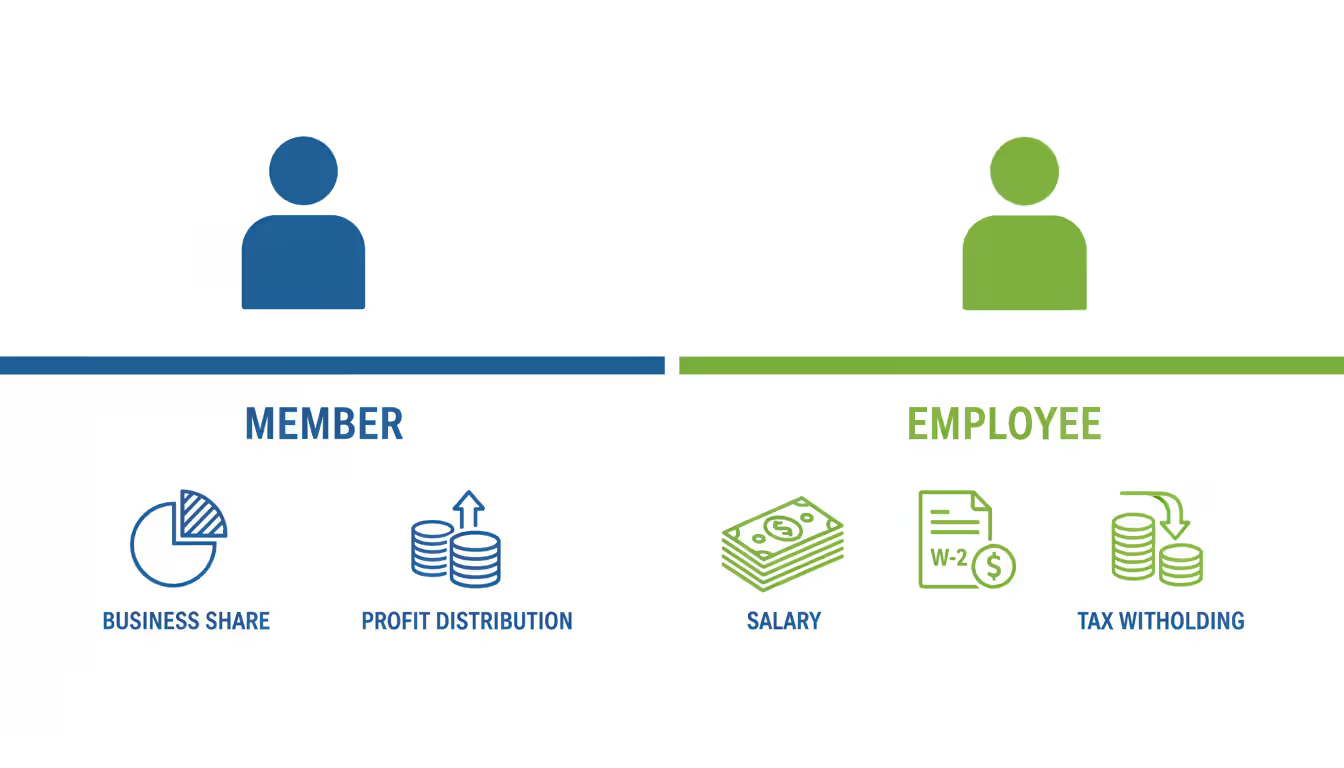
The legal framework separating members from employees rests on ownership and control. Members hold ownership interests in the LLC, share profits according to the operating agreement, and participate in management decisions. Employees work under the direction of the LLC, receive wages for their labor, and have no ownership stake unless separately granted membership units.
Many business owners confuse these roles because LLCs offer flexible management structures. A member might perform daily operational tasks that resemble employee duties, but their legal status stems from their ownership position. This distinction affects tax treatment, benefits eligibility, and liability protection. State LLC statutes uniformly permit hiring employees, though specific registration and reporting requirements vary by jurisdiction.
LLC Members vs Employees: Key Differences
The classification you choose—or the one that applies by default—determines how the IRS and state agencies treat compensation, benefits, and taxes. Members receive distributions based on their ownership percentage or as defined in the operating agreement. These distributions represent profit shares, not wages. Employees earn compensation for services rendered, reported on Form W-2, with taxes withheld from each paycheck.
Author: Samantha Keene;
Source: craftydeb.com
Ownership stake marks the clearest dividing line. Members hold equity and assume the financial risks that come with ownership. Employees have no claim to company assets or future profits beyond their agreed wages. Voting rights follow ownership—members vote on major business decisions while employees have no governance authority unless the operating agreement grants special provisions.
Self-employment tax creates a major financial difference. Members pay self-employment tax on their share of LLC profits, currently 15.3% on net earnings up to the Social Security wage base. Employees split FICA taxes with their employer—7.65% each for Social Security and Medicare. Members receive Schedule K-1 forms showing their profit share; employees receive W-2 forms showing wages and withholdings.
Can LLC Members Also Be Employees?
Multi-member LLCs taxed as partnerships face restrictions. The IRS generally prohibits partners from being employees of their partnership for wage purposes. A member can perform work for the LLC, but their compensation flows through guaranteed payments or profit distributions, not W-2 wages. This rule prevents members from manipulating their tax treatment by switching between employee and owner status.
Single-member LLCs disregarded for tax purposes encounter the same limitation—the sole owner cannot be their own employee. The IRS treats the owner and the business as one entity for employment tax purposes.
The exception: LLCs electing S corporation or C corporation tax treatment. Once you file Form 2553 for S corp status, member-employees who perform substantial services must receive reasonable W-2 wages before taking distributions. This requirement prevents owners from avoiding payroll taxes entirely by taking only distributions. The IRS scrutinizes S corp owner wages and can reclassify distributions as wages if compensation appears unreasonably low for the services provided.
Tax Implications of Each Classification
Members pay quarterly estimated taxes on their profit share, including self-employment tax. They cannot claim unemployment benefits based on their membership status. State unemployment systems exclude owners from coverage because they control their own employment status.
Employees have federal income tax, Social Security, and Medicare withheld from each paycheck. Employers match the Social Security and Medicare contributions, effectively doubling the FICA cost compared to the employee's withholding. Employees gain access to unemployment insurance, workers' compensation coverage, and certain benefit programs that members typically cannot access in their ownership capacity.
Misclassifying a member as an employee to access unemployment benefits or workers' comp invites IRS penalties and state sanctions. Some states permit LLC members to opt into workers' compensation coverage as a business owner, but this differs from employee coverage and requires separate applications.
Single-Member LLCs and Employee Hiring
A single-member LLC can hire employees without adding co-owners. The business structure doesn't require multiple members to become an employer. Once you hire your first employee, you trigger employer status regardless of how many members own the company.
The sole member remains ineligible for employee classification in their own business when the LLC maintains disregarded entity status. You cannot issue yourself a W-2 and withhold payroll taxes as an employee. Your compensation comes through owner's draws, which are not deductible business expenses and don't reduce the LLC's taxable income.
Special considerations arise when your single-member LLC hires family members. Employing your spouse, children, or parents follows the same rules as hiring unrelated workers—you must withhold taxes, pay employer-side FICA, and maintain proper payroll records. The IRS watches family employment arrangements closely for inflated wages or phantom employees. Legitimate work at market-rate pay passes scrutiny; paying your 10-year-old $50,000 annually for filing papers does not.
Employer status activates even if you hire one part-time employee working five hours weekly. The number of hours or wage amount doesn't create a threshold—any employee triggers reporting and tax obligations.
How to Hire Employees Under an LLC
The hiring process involves multiple federal and state agencies, each with specific registration deadlines and ongoing compliance requirements. Missing steps can result in penalties, back taxes, and legal complications that cost far more than proper setup.
Obtaining an EIN and Registering as an Employer
Your LLC needs an Employer Identification Number before hiring anyone. Even if you already have an EIN for banking or tax purposes, verify that the IRS has your entity properly classified. Apply online through the IRS website—the process takes 15 minutes and provides your EIN immediately. Keep the confirmation letter in your permanent records.
Register with your state tax agency as an employer. Most states require registration before your first payroll run. This registration activates your state unemployment insurance account and assigns your tax rate. New employers typically receive a standard new employer rate for the first few years until their experience rating develops based on unemployment claims history.
Contact your state labor department to confirm additional registrations. Some states require new hire reporting systems registration, workplace poster orders, and industry-specific licenses. California, New York, and Massachusetts maintain particularly complex multi-agency registration requirements that can take several weeks to complete.
Setting Up Payroll and Withholding Taxes
Author: Samantha Keene;
Source: craftydeb.com
Choose between manual payroll processing, payroll software, or a payroll service provider. Manual processing saves money initially but increases error risk and consumes significant time. Payroll software automates tax calculations and generates reports but requires you to submit payments and filings. Full-service providers handle everything from calculations through tax deposits and government filings, typically charging $40-$150 monthly plus per-employee fees.
Determine each employee's withholding using Form W-4. The 2026 version uses a five-step process accounting for multiple jobs, dependents, and additional income. Employees can claim exemption from withholding only if they had no tax liability last year and expect none this year—a rare situation for most workers.
Calculate federal income tax withholding using IRS Publication 15-T wage bracket or percentage method. Withhold Social Security tax at 6.2% on wages up to the annual wage base ($168,600 in 2026) and Medicare tax at 1.45% on all wages. Employees earning over $200,000 annually pay an additional 0.9% Medicare tax on earnings above that threshold.
Match the employee's Social Security and Medicare contributions. Your LLC pays 6.2% Social Security and 1.45% Medicare on each employee's wages, making the total FICA cost 15.3% split between employer and employee.
Deposit payroll taxes according to your deposit schedule. New employers typically follow a semi-weekly schedule: deposits due Wednesday for Saturday-Tuesday payrolls, and Friday for Wednesday-Friday payrolls. Monthly depositors, determined by your total tax liability in the lookback period, deposit by the 15th of the following month. Use the Electronic Federal Tax Payment System (EFTPAS)—paper coupons are no longer accepted for most employers.
LLC Payroll Taxes and Employer Requirements
Federal payroll obligations extend beyond FICA withholding. Your LLC pays Federal Unemployment Tax (FUTA) at 6.0% on the first $7,000 of each employee's annual wages. Most employers receive a 5.4% credit for state unemployment taxes paid, reducing the effective FUTA rate to 0.6%. States designated as credit reduction states lose a portion of this credit, increasing your FUTA liability.
State unemployment insurance (SUI) rates vary dramatically by state and industry. New employers might pay anywhere from 1.5% to 6.0% on wage bases ranging from $7,000 to over $50,000 depending on the state. Your rate adjusts annually based on your experience rating—former employees who collect unemployment benefits increase your future rates.
Workers' compensation insurance is mandatory in almost every state once you hire employees. A few states exempt businesses with fewer than three or five employees, but these exemptions are rare. Purchase coverage through a private carrier, state fund, or by self-insuring if you meet your state's financial requirements. Rates depend on your industry classification codes and payroll size. Office workers might cost $0.50 per $100 of payroll while construction workers can exceed $30.00 per $100.
Reporting duties create an ongoing compliance calendar. File Form 941 quarterly to report wages paid and taxes withheld. Submit Form 940 annually for FUTA taxes. Provide W-2 forms to employees by January 31 and file copies with the Social Security Administration. Most states require quarterly wage reports listing each employee's earnings and withheld taxes.
New hire reporting to your state's designated agency must occur within 20 days of hire in most states—some require reporting within seven days. This reporting helps state agencies enforce child support orders and prevent improper unemployment or workers' compensation claims.
Maintain required labor law posters in a location accessible to all employees. Federal posters cover minimum wage, OSHA safety, FMLA rights, and anti-discrimination laws. State posters address state-specific wage laws, workers' comp claims processes, and unemployment insurance. Posters must reflect current law—outdated versions can trigger penalties during inspections.
Table: LLC Employer Requirements Checklist
Requirement
Federal
State
Timeline
EIN registration
IRS (online or Form SS-4)
N/A
Before first payroll
Payroll tax setup
EFTPS enrollment
State tax agency registration
Before first payroll
Unemployment insurance
Form 940 filing (annual)
SUI registration and quarterly reports
Before first payroll; ongoing quarterly
Workers' compensation
N/A
Policy purchase or state fund enrollment
Before first day of work
New hire reporting
N/A
State new hire registry
Within 7-20 days of hire
Labor law posters
DOL, EEOC, OSHA posters
State-specific posters
Before first day of work
Common Mistakes in LLC Employee Classification
Treating members as employees when the LLC maintains partnership tax status creates immediate tax problems. The IRS reclassifies wages as guaranteed payments or distributions, assesses penalties for improper withholding, and may impose accuracy-related penalties on both the business and the individual. This mistake often occurs when owners want to participate in employee benefit plans or access unemployment insurance.
Misclassifying employees as independent contractors represents the most expensive error. The IRS uses common-law rules examining behavioral control, financial control, and relationship type to determine worker status. If your LLC controls when, where, and how someone works, provides tools and training, pays by the hour or week rather than by project, and maintains an ongoing relationship, that worker is likely an employee regardless of what your contract states.
Consequences of misclassification include back taxes for all unpaid FICA, penalties of up to 40% of owed taxes, and potential criminal charges for willful violations. State agencies impose separate penalties for unpaid unemployment insurance and workers' compensation. California's AB5 law and similar statutes in other states have tightened classification standards, making the ABC test (not the IRS common-law test) the determining factor for many purposes.
Paying members guaranteed payments but failing to account for self-employment tax creates another common problem. Guaranteed payments to members for services are subject to self-employment tax, just like profit distributions. Some owners mistakenly believe guaranteed payments escape self-employment tax because they resemble wages, but the tax treatment differs entirely from W-2 compensation.
Failing to verify work authorization through Form I-9 for every employee hired after November 6, 1986, violates federal immigration law. The LLC must examine acceptable documents proving identity and work authorization within three business days of hire and retain the completed I-9 for three years after hire or one year after separation, whichever is later. ICE audits can result in fines of $252 to $2,507 per form violation in 2026.
The biggest mistake I see LLC owners make is assuming flexibility in their operating agreement translates to flexibility in tax classification. The IRS doesn't care what your internal documents say—they apply strict rules to determine whether someone is a member receiving distributions or an employee receiving wages. Getting this wrong from the start often means amending multiple years of tax returns and paying penalties that can exceed the original tax owed
— Jennifer Martinez
FAQ
Does an LLC need employees to operate?
No. An LLC can operate indefinitely with only its members performing all necessary work. Many single-member and small multi-member LLCs never hire employees, relying instead on member labor and independent contractors. Hiring employees is a business decision based on growth needs, not a legal requirement for maintaining LLC status.
Can a single-member LLC hire employees?
Yes. A single-member LLC can hire as many employees as needed. The sole member cannot be an employee of their own disregarded LLC, but hiring others triggers standard employer obligations including payroll taxes, unemployment insurance, and workers' compensation. The business structure doesn't require multiple members to become an employer.
What's the difference between an LLC member and an employee?
Members own equity in the LLC, share profits and losses, participate in management decisions, and pay self-employment tax on their earnings. Employees work for wages, have taxes withheld from paychecks, receive W-2 forms, and have no ownership stake or voting rights. Members cannot typically be employees in partnerships or disregarded entities but can receive W-2 wages in LLCs taxed as corporations.
Do LLC owners pay payroll taxes?
LLC owners taxed as partnerships or sole proprietorships pay self-employment tax (15.3%) on their share of profits, not payroll taxes. They cannot withhold taxes from their own draws. LLC owners who elect S corporation status and perform substantial services must pay themselves reasonable W-2 wages subject to standard payroll tax withholding and employer matching.
Can an LLC owner be on payroll?
Only if the LLC elects corporate tax treatment. S corporations require owner-employees performing substantial services to receive reasonable W-2 wages. C corporations can put owners on payroll as employees. LLCs taxed as partnerships or disregarded entities cannot classify members as employees—their compensation flows through distributions or guaranteed payments subject to self-employment tax.
What taxes does an LLC pay when hiring employees?
The LLC pays employer-side FICA (7.65% of wages), federal unemployment tax (typically 0.6% on the first $7,000 per employee after credits), and state unemployment insurance (rates vary by state and experience rating). The LLC also withholds federal income tax, employee-side FICA, and state income tax from employee paychecks, remitting these amounts to tax agencies on the employee's behalf.
LLCs operate as legitimate employers with the same capacity to hire employees as corporations or partnerships. The key to successful employment relationships lies in understanding the fundamental distinction between ownership and employment, properly classifying workers, and meeting all federal and state obligations from day one.
Whether you run a single-member LLC considering your first hire or a growing multi-member company expanding your team, the employment structure follows clear rules. Members cannot typically be employees unless you elect corporate taxation, employees require proper wage treatment with full payroll tax compliance, and misclassification carries significant financial consequences.
Start the hiring process by obtaining your EIN, registering with state agencies, and establishing compliant payroll systems before your first employee's start date. Budget for the full cost of employment—typically 1.25 to 1.4 times the gross wage when accounting for employer taxes, insurance, and administrative expenses. Consider consulting a CPA or employment attorney when facing complex situations like electing S corporation status, hiring family members, or operating in multiple states.
The flexibility that makes LLCs attractive business structures extends to employment decisions, but that flexibility operates within defined legal boundaries. Respect those boundaries, maintain proper records, and treat employment tax obligations as seriously as your income tax filings. Your LLC's reputation and financial health depend on getting the employment structure right from the beginning.
When you form a corporation or LLC, state law requires you to designate someone to accept legal papers on behalf of your company. That person or entity is your registered agent. Without one, you can't complete your business formation paperwork, and your company risks serious compliance issues down the line
Every US business must submit mandatory statutory filings to government agencies. Understand formation documents, annual reports, tax filings, and employment requirements by entity type—plus common mistakes that trigger penalties and systems to maintain year-round compliance
Every LLC must maintain a registered agent—a designated contact for legal documents and government correspondence. Learn what registered agents do, state-specific requirements, how to appoint or change your agent, and whether to hire a service or act as your own agent
A partnership LLC combines liability protection with partnership flexibility. Learn how multi-member LLCs work, default partnership taxation, operating agreement essentials, formation steps, and when this structure makes sense for your business
The content on this website is provided for general informational and educational purposes only. It is intended to explain concepts related to business and corporate law, contracts, compliance, disputes, M&A, and taxation for companies.
All information on this website, including articles, guides, and examples, is presented for general educational purposes. Legal outcomes may vary depending on jurisdiction, company structure, and individual circumstances.
This website does not provide legal advice, and the information presented should not be used as a substitute for consultation with qualified corporate attorneys or legal professionals.
The website and its authors are not responsible for any errors or omissions, or for any outcomes resulting from decisions made based on the information provided on this website.