Top-down view of a business desk with a laptop showing a world map with location markers, stack of tax documents, coffee cup, and a pen representing international contractor tax compliance
Last quarter, my accountant friend Amy discovered her client owed $47,000 in penalties. The company had hired a Ukrainian developer two years earlier, paid him $180,000 total, and never collected a single tax form.
The business owner thought international payments worked just like cutting checks to US freelancers. By the time the IRS audit letter arrived, the developer had moved to Portugal and stopped responding to emails.
More companies now hire talent across borders than ever before. Your software engineer writes code from Krakow. A graphic designer in Santiago handles your brand refresh. Marketing strategy comes from someone working out of a Manila co-working space.
The tax compliance, though? That's where businesses crash.
You won't use Form 1099-NEC for international workers. Instead, you're navigating W-8 form variants, figuring out withholding requirements that change based on work location, and filing Form 1042-S by specific deadlines. Skip any step and you're looking at penalties equal to 30% of total payments—the IRS will also demand documentation proving compliance for every payment you've made in recent years.
I've watched companies receive assessment notices three years after their last contractor payment. The working relationship ended ages ago, but the tax liability sits squarely on the business owner's desk.
Here's the single factor that determines everything else: where your contractor physically performs the work matters infinitely more than their passport or home address.
When You Need to Withhold Tax from Foreign Contractor Payments
The physical location where someone completes your project—that's what triggers or eliminates your withholding obligation. Their citizenship doesn't matter. Where they call home doesn't matter either.
What matters: where they're sitting when they do the actual work.
Your graphic designer creates brand assets from her home office in Guadalajara? That's foreign-sourced income, so you're sending payment in full. No withholding needed.
Same designer, different scenario: she flies to your Dallas headquarters for an intensive five-day brand workshop. Those five working days create US-sourced income. The default withholding rate? 30% of whatever portion relates to work completed on American soil.
Businesses constantly miscalculate this split. Let's say you pay $10,000 for a project. Your contractor spends one week working from your Chicago office, then completes the remaining three weeks from their apartment in Mumbai. You can't label everything as foreign-sourced just because most work happened overseas. Twenty-five percent occurred in the United States (that's $2,500). Standard tax rules paying foreign workers make you withhold on that US portion.
Tax treaties create exceptions. A consultant based in London might face zero withholding even for US-sourced income if they satisfy specific treaty requirements. But they need proper documentation—you can't just assume treaty benefits apply.
Which income categories require withholding? Personal services like consulting, software development, design work, writing, marketing strategy. Also royalty payments and certain licensing fees, even when the foreign contractor never sets foot in America.
The independent contractor versus employee distinction carries weight. The IRS separates contractors who control their work methods from people functioning like employees regardless of what the contract says. Real contractors set their schedules, work from their own equipment, maintain several clients simultaneously, and decide how to complete tasks. Relationships that look more like employment face different withholding rules no matter what title you use in the agreement.
One complexity trips up experienced finance teams: what actually counts as "performed in the US"? Zoom calls where the contractor joins from abroad? Foreign-sourced. Flying to your office for in-person collaboration sessions? US-sourced. Attending a three-day industry conference in Manhattan? US-sourced, which means you're calculating proportional withholding on the total project fee.
Tax treaties often reduce or completely eliminate withholding tax foreign contractor obligations. The treaty between the US and Canada, the US-UK agreement, and dozens of other bilateral deals provide relief. But—this part matters enormously—the contractor must prove they qualify through correct documentation. No proof means you're withholding 30% regardless of what any treaty says.
Author: Andrew Bellamy;
Source: craftydeb.com
Required Tax Forms for Paying Overseas Freelancers
Documentation isn't some suggestion from an overeager accountant. Missing forms transfer your contractor's tax liability straight to your balance sheet.
W-8BEN and Other W-8 Variants
The W-8 family serves as the international equivalent of Form W-9, except with significantly more complications.
Individual contractors fill out Form W-8BEN—officially called the Certificate of Foreign Status. This document accomplishes three separate things at once: verifies they're not a US person, provides their foreign tax identification number, and claims applicable treaty benefits.
The form stays valid for three years starting from the signature date, expiring on December 31 of that third year. Sign one in May 2025? It becomes invalid December 31, 2028. After that expiration hits, you need a fresh form or you're required to start withholding 30% backup tax from every single payment.
Business entities need Form W-8BEN-E. Paying a Ukrainian LLC or Irish limited company? That's an entity, so they submit the W-8BEN-E variant instead. Same three-year validity period applies.
Form W-8ECI covers unusual circumstances involving foreign persons who operate actual US trade or business operations. Rare for typical contractor arrangements, but if your foreign contractor maintains permanent US business locations, this form enters the picture.
Tax-exempt foreign organizations use Form W-8EXP—foreign governments, international organizations, certain foundations.
Get the appropriate form before you transmit the first payment. Review every single field carefully: full legal name matching their official identification, complete foreign address including country, foreign tax ID number when their country issues them, US taxpayer identification if they happen to have one, treaty claims with the specific article citations from the treaty text, valid signature with a current date.
Keep these documents for at least four years after the final payment. IRS auditors will request them during examinations. Can't produce the forms? You become liable for withholding you never collected, plus penalties and interest.
Author: Andrew Bellamy;
Source: craftydeb.com
Form 1042-S Reporting Requirements
You file Form 1042-S annually whenever you withhold tax from payments to foreign persons—or when you pay US-sourced income even at 0% treaty rates.
The form reports gross payment amounts, tax you withheld, treaty benefits the contractor claimed, and recipient identification details. Think of it as the foreign equivalent of Form 1099, except with a different filing mechanism and deadline.
The deadline is March 15 following the tax year. Every payment made during 2025 gets reported by March 15, 2026. Contractors receive their copies by this same deadline.
You'll also submit Form 1042, which summarizes all your foreign payments and withholding across every contractor. It accompanies the individual 1042-S forms you file.
The mistake I encounter most frequently: businesses correctly determine zero withholding applies, then skip reporting completely. That's wrong. Zero withholding doesn't make the reporting requirement disappear. Pay a Canadian contractor $60,000 for services they completed in Toronto, apply the US-Canada treaty for 0% withholding, and you're still filing Form 1042-S documenting both the payment and your treaty claim.
Miss that March 15 deadline? Penalties start at $310 per form for 2026 filings. File 100 forms late and you're staring at $31,000 in penalties before anyone even examines whether you calculated the underlying tax correctly.
Step-by-Step Process for Paying International Contractors Legally
Here's how I recommend structuring your process for compliance:
Step 1: Confirm this relationship actually qualifies as independent contractor
Employment misclassification creates enormous liability. The IRS applies identical common-law tests to foreign workers—they examine behavioral control, financial control, and relationship type.
Legitimate contractors dictate their own work schedules. They use equipment they own or lease. They maintain multiple clients at the same time. They face genuine business risk beyond just not getting paid.
Your "contractor" works exclusively for your company, follows the schedule you set, uses equipment you provide, and gets treated exactly like staff members? That's an employment relationship, creating employment tax obligations even for workers living abroad.
Step 2: Request the appropriate W-8 variant before the work starts
Individual contractor? Send Form W-8BEN. Entity? Send W-8BEN-E. Get this submitted and reviewed before they deliver the first project milestone.
Check the completed form line by line. Part II (treaty claims section) must be completely filled out if they're claiming reduced withholding rates. Foreign tax ID should appear when their country issues such numbers. Signature and date need to be in ink.
About half the forms I review come back incomplete the first time. Missing signatures void everything. Incomplete treaty sections mean you can't honor whatever rate they claimed. Send incomplete forms back immediately.
Step 3: Document where the services will actually be performed
Entirely outside the US borders? Note this clearly in your contractor documentation file. Any work occurring on US soil? Calculate what percentage of the total project represents US-sourced income.
Mixed arrangements require you to prorate. Example: $15,000 project where the contractor spends 10 days working at your Seattle office and 20 days working from their home in Romania? That's 33% US-sourced, which equals $5,000.
Step 4: Run your withholding calculations
Foreign-sourced income: zero withholding required.
US-sourced income: start with the 30% default statutory rate, then apply treaty reductions if the contractor submitted a properly completed W-8BEN claiming specific benefits.
The US-UK treaty typically allows 0% withholding on independent personal services when the contractor doesn't maintain a fixed base in the US and stays under 183 days in any twelve-month period. The US-India treaty offers similar relief but under different conditions—usually a 90-day presence test plus additional requirements.
Step 5: Execute the actual payment
Choose your payment method (I cover options in detail below). Withhold required amounts before you transmit funds.
Owe $8,000 but must withhold 30%? You send $5,600 to the contractor and deposit $2,400 with the IRS.
Author: Andrew Bellamy;
Source: craftydeb.com
Step 6: Deposit withheld amounts with the IRS
Use the Electronic Federal Tax Payment System (EFTPS) for all tax deposits. Your deposit schedule depends on your total withholding volume—quarterly for smaller amounts, monthly or semi-weekly for larger withholding operations.
Step 7: Organize all your documentation systematically
Keep everything in organized files: W-8 forms, signed contracts, detailed invoices showing work performed, payment confirmations, withholding calculations with your methodology notes, tax deposit receipts, email correspondence about treaty claims.
This complete paper trail proves your compliance when the IRS eventually asks questions. They will ask whenever anything looks remotely unusual.
Step 8: Complete all required year-end reporting
Prepare Form 1042-S for each contractor (when reporting requirements apply) and Form 1042 summarizing all your foreign payments. File electronically through the IRS FIRE system by the March 15 deadline.
Common Compliance Mistakes When Paying Foreign Workers
Even careful businesses fall into these specific traps:
Skipping documentation just because no withholding applies. You still need that W-8BEN proving exactly why you didn't withhold anything. Without the form, the IRS assesses penalties and can force backup withholding on all future payments. No form equals no proof of your decision-making.
Continuing to use expired W-8 forms past their three-year validity. That expiration date isn't optional guidance. An expired form legally equals having no form at all. Set recurring calendar alerts 60 days before expiration to send renewal requests.
Misreading the actual tax treaty provisions. Not every service type qualifies for treaty benefits. Some treaties specifically exclude certain professions from benefits. Others impose physical presence limits that vary by treaty. The US-Germany treaty handles independent personal services completely differently than the US-Canada version handles them. You can't just apply provisions from one country's treaty to a different country's contractor.
Treating all income as foreign-sourced when contractors work partly in the US. Track days your contractor works in each physical location. A contractor who normally lives in Brazil but spends two weeks working at your Miami office can't possibly have 100% foreign-sourced income for that project period. Prorate the income based on actual work location.
Ignoring state-level requirements for foreign contractor compliance. Federal compliance doesn't eliminate your state obligations. California, New York, and several other states impose separate withholding rules and reporting requirements. Some states demand withholding even in situations where federal law doesn't require it.
Applying identical treatment to every foreign payment. Payments to treaty countries need different analysis than non-treaty countries. Services a contractor performs in Canada require completely different evaluation than royalties you pay to a Cayman Islands entity. Each situation demands individual assessment.
Inadequate recordkeeping habits. Maybe you handle 2025 withholding perfectly, but can you actually prove your compliance during a 2028 audit? Organized files showing your complete decision-making process provide your only real defense.
Payment Methods and Platforms for International Contractor Payments
You've handled the tax compliance pieces. Now you actually need to move money across international borders.
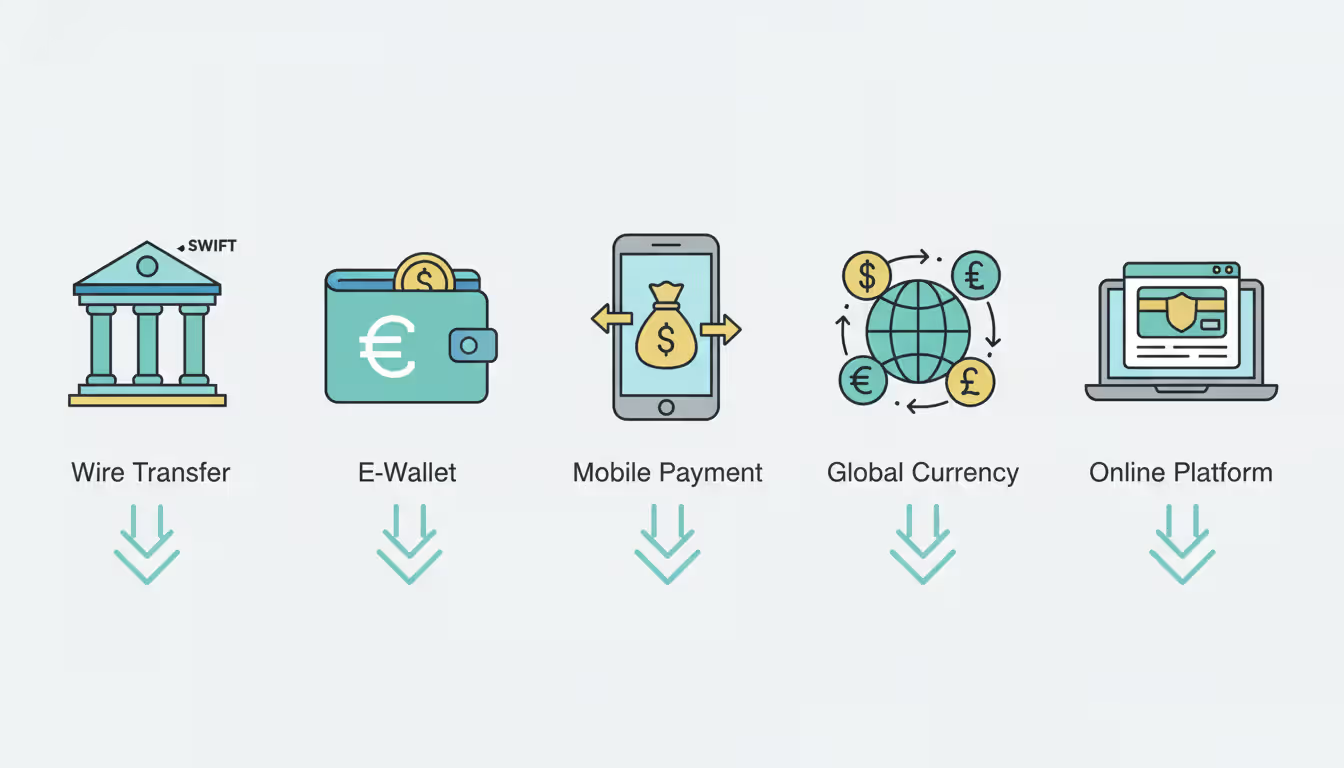
Traditional wire transfers remain the most straightforward method. Your US bank transmits funds directly to your contractor's foreign bank account. Expect to pay $25-50 from your bank, another $10-30 in intermediary bank fees along the transfer route, plus whatever the receiving bank charges. Your contractor might receive $60-90 less than you actually transmitted.
Bank wires typically complete within one to five business days based on which countries are involved and whether the currencies are commonly traded. Wires work for essentially any destination and any payment amount, making them dependable for larger payments despite the fee structure eating into smaller amounts.
PayPal offers immediate speed and familiar convenience, but cross-border fees run 3-5%. Transfers often complete instantly, yet those percentage fees become extremely expensive on larger payment amounts.
Send $5,000 through PayPal? You're paying somewhere between $150-250 in fees. That identical transfer via bank wire might cost you $75 total.
Wise (the company formerly called TransferWise) uses mid-market exchange rates combined with transparent fees that typically run 0.5-2% based on the specific currency corridor. Common currencies like EUR, GBP, or CAD cost less than exotic currencies with thin markets.
The platform handles regular payments under $50,000 efficiently. Currency conversion happens at real exchange rates, and contractors receive local currency within one to three business days depending on the destination country.
Payoneer specializes specifically in cross-border business payment flows. Contractors receive funds in multiple currencies and withdraw to their local banks. Fee structures vary significantly—ACH transfers from your US bank account cost less than funding payments with credit cards.
Specialized contractor management platforms like Deel, Remote, and Papaya Global bundle payment processing together with compliance automation. They collect W-8 forms from contractors, calculate required withholding, generate 1042-S forms automatically, and handle IRS deposits on your behalf. Fees typically run 2-5% of payment amounts or flat monthly rates per contractor.
These platforms justify their cost when you're managing multiple international contractors on a regular ongoing basis. The compliance automation saves substantial time and reduces your error risk significantly. For one or two occasional contractors, the platform fees might exceed the value you receive.
Cryptocurrency payments occasionally get requested by contractors. Tread extremely carefully here—the IRS treats cryptocurrency as property transactions, which adds substantial reporting complexity. You must report the fair market USD value at the moment payment occurs, and withholding rules still apply to that dollar value.
Choose your payment method based on payment frequency, typical amounts, contractor locations, and how much compliance complexity you'll handle yourself versus outsource. A $400 monthly payment to a Philippines-based designer? Wise makes economic sense. A $75,000 quarterly payment to a German consultancy? Traditional wire transfer despite the fees.
Tax Treaty Benefits and How They Affect Withholding
Author: Andrew Bellamy;
Source: craftydeb.com
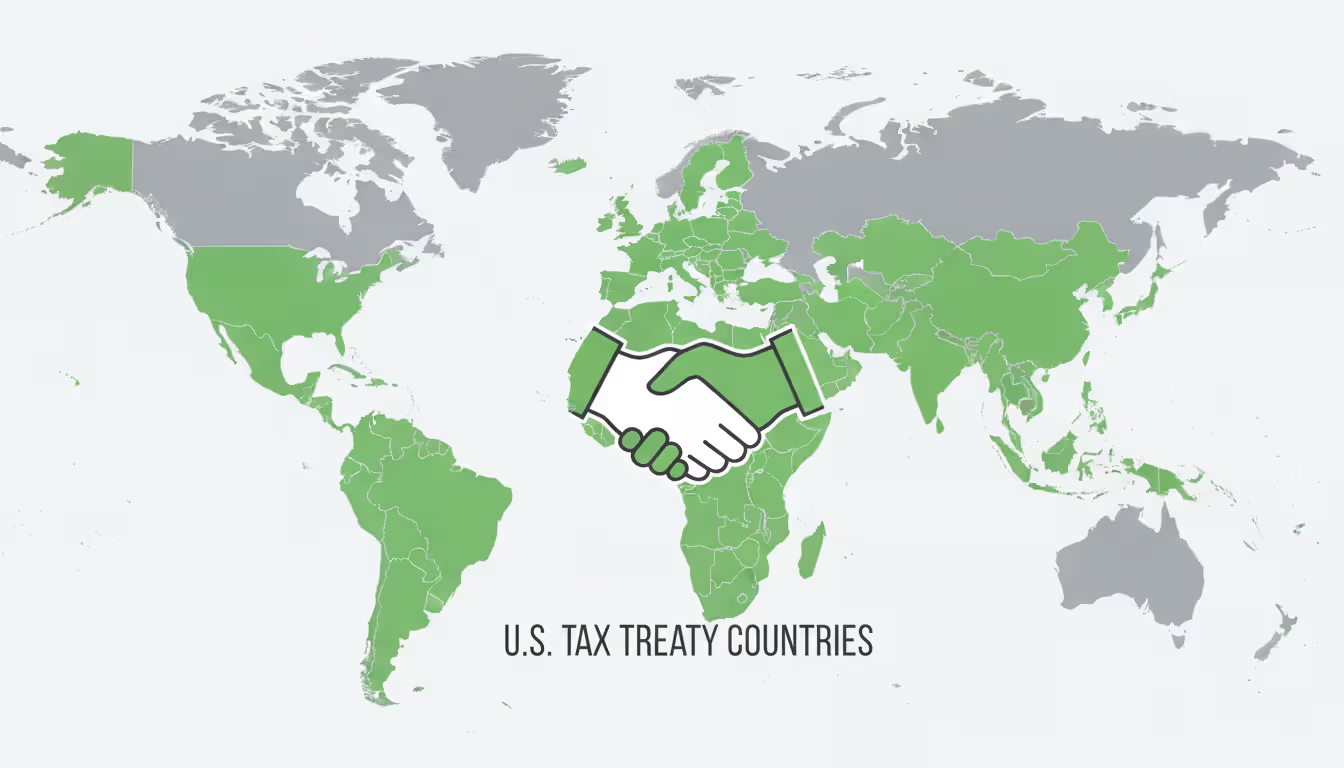
The United States maintains income tax treaties with more than 60 countries. These bilateral agreements prevent double taxation and reduce withholding rates on cross-border payment flows.
Start without any treaty? You're withholding 30% on US-sourced service income by default. Add an applicable treaty? That rate might drop to 15%, 10%, or zero depending on the specific service type and exact treaty language.
Each treaty structures its articles completely differently. Article 7 usually addresses business profits. Article 14 or 15 (this varies by treaty) covers independent or dependent personal services. Article 12 typically handles royalty payments.
Take the US-UK treaty as an example. It generally allows 0% withholding on independent personal services provided the contractor maintains no fixed base of operations in the US. The US-India treaty permits 0% withholding when the contractor stays physically present in the US for under 90 days during any 12-month period and meets several additional conditions.
Contractors claim treaty benefits on Form W-8BEN Part III. They must cite the specific treaty by name, identify the exact article and paragraph number, explain how they personally qualify for benefits, and state their claimed withholding rate clearly.
You're not expected to verify every technical detail, but review claims for obvious problems. Does the cited article actually cover the service type this contractor provides? Do the contractor's personal circumstances match the basic treaty conditions?
Something looks obviously wrong? Like a contractor claiming 0% under an article that clearly requires 15% withholding? Request clarification before you accept the claim.
Limitation on benefits (LOB) provisions appear in most modern treaties, preventing treaty shopping arrangements. Contractors must qualify as genuine residents of the treaty country, not just using it as a pass-through jurisdiction to access treaty benefits.
Saving clauses preserve US rights to tax its own citizens and residents regardless of treaty provisions. Doesn't affect foreign contractors, but matters significantly if you're paying a US citizen who works abroad.
Keep copies of treaty documentation. Save copies of relevant treaty articles alongside each contractor's W-8BEN form. When the IRS questions your withholding rate in an audit, you'll need both the completed form and supporting treaty language showing your calculation.
Treaties change over time through renegotiation and protocol amendments. Stay current on treaties affecting your active contractors, or work with a tax professional who monitors these international tax updates.
Misclassifying foreign contractors or failing to collect proper documentation can result in significant IRS penalties and back-tax liability for US businesses. The key is establishing compliant processes before you make the first payment
— Robert Chen
Frequently Asked Questions About Foreign Contractor Compliance
Do I need an EIN to pay foreign contractors?
Yes, when you're filing Form 1042 and 1042-S with the IRS. Social Security Numbers don't work for these specific forms. Sole proprietors who've always used their SSN for domestic contractor payments must obtain an EIN once they start paying foreign contractors with reporting obligations.
What happens if a foreign contractor refuses to provide a W-8BEN?
You withhold 30% from every single payment—foreign-sourced or US-sourced makes no difference. The IRS assumes worst-case tax scenarios when required documentation is missing. You still report all payments on Form 1042-S. The entire compliance burden shifts directly to you. You can't just pay gross amounts and claim the contractor refused to cooperate with your form requests.
Are there penalties for filing incorrect 1042-S forms?
Absolutely. Late filing carries $310 per form penalties for 2026 filings, capped at $3,783,000 annually for large businesses. Intentional disregard of filing requirements jumps to $630 per form with no maximum cap at all. Incorrect information also triggers penalties when the IRS determines you were negligent in preparing forms. File electronically through the FIRE system to minimize data entry errors.
How do I know if my foreign contractor actually qualifies for treaty benefits?
Pull up the actual tax treaty text between the US and the contractor's country of residence. Read the specific article covering independent personal services or business profits carefully. Verify the contractor meets every single condition listed: residence requirements, absence of a fixed US base, duration limitations, and any additional stipulations the treaty includes. The contractor should explain their qualification clearly in W-8BEN Part III. Uncertain cases? Consult an international tax attorney rather than guessing and hoping the IRS agrees.
Can I use identical processes for paying contractors in all countries?
The basic framework stays consistent: collect appropriate W-8 forms, determine income source based on work location, calculate required withholding, maintain organized records, file annual reports. But withholding rates vary dramatically by country based on whether a treaty exists and its specific provisions. Canadian contractors might qualify for 0% under the US-Canada treaty, while contractors from non-treaty countries face the full 30% withholding. Payment methods also vary in efficiency and cost depending on the destination country and currency. You need country-specific analysis for withholding rates even though the overall compliance process remains largely similar.
What's the difference between a foreign contractor and a foreign employee for tax purposes?
Foreign employees create exponentially more tax complexity. You typically must withhold Social Security and Medicare taxes (FICA) from employee wages—even for foreign employees—unless a totalization agreement specifically covers their country. Federal income tax withholding using Form W-4 may apply depending on circumstances. You'll issue Form W-2 instead of 1042-S at year-end. State unemployment taxes could apply. The employee might need work authorization depending on service performance location. Foreign contractors performing services entirely outside the US bypass most of these requirements completely. This classification distinction carries enormous weight—misclassifying an employee as a contractor creates liability for all taxes you should have withheld over the entire relationship, compounded by penalties and interest.
Managing foreign contractor payments doesn't demand a full accounting department on staff, but it absolutely requires documented systems and consistency in application.
Build yourself a new contractor checklist: collect the appropriate W-8 form, review every field for completeness, verify treaty claims when applicable, determine service performance location, calculate required withholding, document your decisions. Run through this checklist before making the initial payment and you'll sidestep most problems before they develop.
Track W-8 expiration dates systematically using whatever system works for you. A simple spreadsheet noting each contractor's form date and calculated expiration date enables proactive renewal requests months in advance. Losing treaty benefits mid-year because a form quietly expired creates awkward conversations with contractors and potentially requires you to adjust withholding retroactively.
Consider hiring a CPA or tax attorney for your first few foreign contractor relationships. They can audit your entire process, confirm your withholding calculations are correct, and ensure your 1042/1042-S filing is accurate. Once you understand the underlying mechanics, handle routine situations internally and consult professionals only for unusual cases or new treaty countries.
Proper compliance actually pays for itself over time. You avoid penalties completely, maintain smooth relationships with contractors who receive correct payment amounts, and eliminate the risk of IRS problems surfacing years later when documentation has gone missing.
Foreign talent delivers tremendous value to US businesses operating in competitive markets. Understanding IRS rules foreign independent contractors lets you access that global talent pool with complete confidence instead of constant worry about tax compliance.
UCC stands for the Uniform Commercial Code, a comprehensive set of laws governing commercial transactions across the United States. For business owners, attorneys, and anyone involved in buying or selling goods, understanding the UCC is essential to structuring enforceable agreements and avoiding costly disputes
Transactional law encompasses the legal work involved in business deals and commercial arrangements. Unlike litigation attorneys who resolve disputes in court, transactional lawyers structure transactions, draft agreements, and prevent legal problems before they arise
Section 382 limits NOL carryforwards after ownership changes to prevent tax loss trafficking. Learn how ownership tests work, limitation calculations, and compliance requirements for M&A transactions
Personal liability means you can be held financially responsible for business debts and lawsuits using your own assets. Understanding when protection applies, how corporate structures shield personal wealth, and where vulnerabilities exist helps you make informed decisions safeguarding your financial future
The content on this website is provided for general informational and educational purposes only. It is intended to explain concepts related to business and corporate law, contracts, compliance, disputes, M&A, and taxation for companies.
All information on this website, including articles, guides, and examples, is presented for general educational purposes. Legal outcomes may vary depending on jurisdiction, company structure, and individual circumstances.
This website does not provide legal advice, and the information presented should not be used as a substitute for consultation with qualified corporate attorneys or legal professionals.
The website and its authors are not responsible for any errors or omissions, or for any outcomes resulting from decisions made based on the information provided on this website.