Two business professionals sitting on opposite sides of a conference table with a thick legal contract document between them in a modern office setting
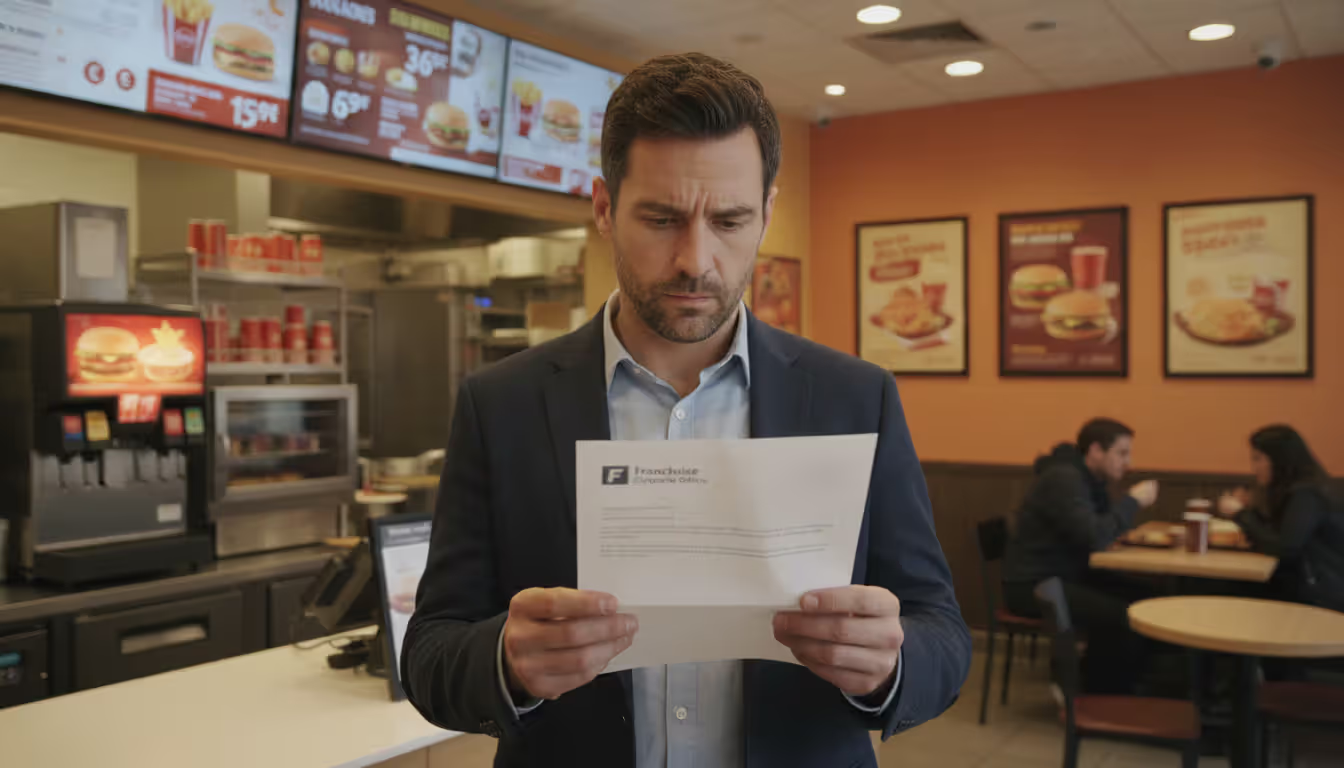
Tensions between franchisors and franchisees don't announce themselves with warning sirens. One day you're celebrating your grand opening, the next you're receiving a certified letter alleging contract violations. Maybe your franchisor just opened a competing location two miles from your "protected" territory. Or perhaps they're claiming you owe back royalties you never agreed to pay.
Here's what catches most franchise owners off guard: your franchise agreement probably decided how you'll resolve these conflicts years before they started. That arbitration clause you skimmed on page 47? It just eliminated your right to a jury trial. The choice-of-law provision selecting your franchisor's home state? You're now fighting under laws you've never heard of.
Understanding your legal options—before you need them—can save your business. Or at minimum, it'll save you from spending $200,000 learning lessons that cost $5,000 if you'd acted sooner.
Common Types of Franchise Disputes
Walk into any franchise attorney's office, and you'll hear the same complaints on repeat.
Money fights dominate the landscape. A franchisee in Phoenix discovers her franchisor has been calculating royalties on gross sales that include sales tax—adding 8.6% to every payment for three years. A franchisor's audit reveals a franchisee who's been excluding catering revenue from royalty calculations, claiming those sales "aren't really restaurant sales." Franchise royalty disputes like these often require forensic accountants who charge $300/hour to reconstruct years of financial records, turning a $15,000 disagreement into a $60,000 investigation before anyone files a single legal document.
Operational violations appear in countless variations. Franchisor attorneys will tell you about franchisees who started buying cheaper ingredients from unauthorized distributors, cut hours to save labor costs, or let health code violations stack up until they damaged the brand. Franchise breach of contract allegations from the franchisee side? Those involve promises that evaporated after the ink dried—the "comprehensive training" that lasted three days instead of three weeks, the territorial protection that the franchisor now claims doesn't apply to online sales, the mandatory system upgrades that cost $80,000 despite the operations manual saying $30,000.
Territory wars have gotten messier in the digital age. Your franchise agreement from 2010 gave you exclusive rights to a five-mile radius. Fast forward to 2024: your franchisor launches delivery partnerships with DoorDash and Uber Eats that blanket your territory with deliveries from locations ten miles away. When you complain, they point to contract language that only restricts "brick-and-mortar locations" in your territory. You're watching your sales drop 22% while paying the same royalties on lower revenu
Author: Olivia Farnsworth;
Source: craftydeb.com
Termination battles destroy businesses overnight. A franchisor sends a 30-day cure notice alleging fifteen separate violations. The franchisee scrambles to fix them—new equipment installed, staff retrained, violations corrected. On day 31, termination papers arrive anyway. Now the franchisee is filing for emergency injunctive relief while watching customers wonder why the doors might close. These franchise termination disputes routinely become the most expensive conflicts because franchisees are literally fighting for their business's survival.
FDD problems surface years later. A franchisee struggling financially starts comparing notes with other operators and realizes the earnings claims in their Franchise Disclosure Document were wildly optimistic—and the franchisor knew it because three locations had already failed before those projections were published. Franchise disclosure violations can trigger rescission rights, but only if the franchisee acts before statutory deadlines expire. Miss that window by a month, and remedies disappear.
Understanding Your Franchise Agreement's Dispute Provisions
Flip to Section 17 of your franchise agreement. That's usually where the dispute resolution language lives, and it matters more than almost anything else in the contract.
Arbitration requirements eliminate courthouse options. Roughly 80% of franchise agreements now mandate binding arbitration through organizations like AAA or JAMS. You'll see language like "any controversy or claim shall be settled by arbitration in accordance with the Commercial Arbitration Rules." That sentence just erased your right to a jury trial. It eliminated class actions. It sent your dispute into a private system where a single arbitrator—not twelve jurors—decides your fate. Some agreements carve out narrow exceptions (you can still seek a court injunction to stop trademark infringement or prevent disclosure of trade secrets), but those exceptions are just that—narrow.
Mediation prerequisites add steps before you can fight. Many contracts require parties to "engage in good faith mediation" for 30 or 60 days before pursuing arbitration or litigation. Skip this step, and the arbitrator might dismiss your case for failing to comply with contractual conditions precedent. Here's the catch: "good faith" is subjective. Show up to mediation and refuse every proposal? That might satisfy the requirement. Send a junior manager with zero settlement authority? You're probably safe. But skip mediation entirely, and you've just given opposing counsel an easy procedural victory.
Author: Olivia Farnsworth;
Source: craftydeb.com
Governing law clauses reshape your legal landscape. That choice-of-law provision selecting Delaware, Minnesota, or Nevada law? It controls which state's contract interpretation rules, statute of limitations periods, and franchise relationship statutes apply to your dispute. California franchisees often find their agreements select another state's law—partially because California's Franchise Relations Act provides powerful franchisee protections that franchisors want to avoid. Courts do limit these clauses when they violate fundamental public policies (you generally can't contract around anti-fraud statutes), but those limitations are narrower than most franchisees hope.
Venue selection forces you to travel. Buried in paragraph 17(c), you'll find language requiring all disputes to be filed "in the federal or state courts of Hennepin County, Minnesota" or wherever the franchisor happens to be headquartered. For a franchisee operating in Florida, this means flying lawyers to Minneapolis for every hearing, paying for hotels during multi-day arbitrations, and conducting depositions two time zones away. The cost and logistical burdens tilt the playing field before substantive issues even surface.
Attorney fee provisions raise the stakes. Some agreements specify that "the prevailing party shall recover reasonable attorney fees and costs." This cuts both ways—win, and the franchisor pays your legal bills; lose, and you're paying both sides. That risk calculus changes settlement dynamics dramatically. A franchisee with a decent but not slam-dunk case might settle for 40 cents on the dollar rather than risk a loss that triggers six-figure fee liability.
Franchise Dispute Resolution Methods Compared
Four roads diverge in franchise conflicts. Each leads somewhere different, costs something different, and takes different amounts of time to travel.
Direct negotiation costs the least but requires cooperation. Before lawyers get involved, before mediators are scheduled, call your franchise business consultant or regional director. Explain the problem. Propose solutions. Document the conversation in a follow-up email. Maybe your royalty dispute stems from a genuine accounting confusion that gets resolved with a spreadsheet and a phone call. Perhaps the territory issue gets solved when the franchisor realizes their delivery expansion accidentally violated contract terms. These informal resolutions happen more than people realize—they just don't generate legal articles because nobody hired lawyers to document them. Budget $2,000-$10,000 for attorney consultation to understand your position before these calls, but if the other side cooperates, you'll avoid the $50,000+ that formal processes require.
Franchise Mediation Process
Think of franchise dispute mediation as hiring a professional translator for a conversation where both sides speak different languages. The mediator doesn't decide anything—they just help you hear what the other side actually means versus what you think they mean.
Day one typically starts around 9 AM with everyone in one conference room. Your side presents opening remarks for 20-30 minutes explaining why you're right and they're wrong. Their side does the same. Then the mediator separates everyone into different rooms—you never see the other side again unless a deal gets reached.
The mediator shuttles between rooms for the next 6-8 hours. They'll tell you things like "your argument about territorial protection is legally strong, but your damages calculation seems inflated" or "the franchisor is confident they'll win on the breach claim, but they're worried about the disclosure violation counterclaim you mentioned." Reality testing happens in private where neither side loses face.
Somewhere around hour five, proposals start flowing. The franchisor offers to waive disputed fees if you agree to certain operational changes. You counter with a reduced payment spread over 18 months plus a territory clarification addendum. By 7 PM, you're either signing a settlement agreement or scheduling another session.
Settlement rates hit 75% when real decision-makers attend and both sides face legitimate litigation costs. Mediation collapses when one party sends representatives without settlement authority or when either side views the process as just a box-checking exercise before "real" arbitration.
Total investment runs $8,000-$20,000 including mediator fees ($4,000-$8,000 per full day split between parties) plus attorney prep time and attendance. That's roughly 10% the cost of taking the same dispute through arbitration.
You file a demand for arbitration with AAA or JAMS, pay filing fees ($3,500-$12,000 depending on claim size), and receive a list of potential arbitrators. Each side strikes unacceptable candidates and ranks acceptable ones. The arbitration organization appoints someone based on these rankings. Good franchise arbitrators have either practiced franchise law for decades or operated franchises themselves—they understand the business dynamics beyond just legal technicalities.
Discovery runs leaner than court litigation. Expect to exchange core documents (franchise agreement, financial records, key correspondence), take 3-7 depositions maximum, and submit written responses to targeted questions. Fishing expeditions don't fly. Ask for five years of irrelevant corporate board minutes, and the arbitrator will deny the request to keep things moving.
Hearings compress weeks of trial testimony into 2-4 days. Evidentiary objections still exist but get resolved quickly—arbitrators often say "I'll hear it and give it the weight it deserves" rather than excluding marginally relevant testimony. You'll present witnesses, cross-examine their witnesses, introduce exhibits, and make closing arguments. Just like trial, except the audience is one arbitrator instead of twelve jurors.
Awards arrive 30-60 days post-hearing. They're typically brief—"Claimant shall recover $127,000 from Respondent"—without detailed explanations. Appeals are nearly impossible. Courts overturn arbitration awards only for fraud, arbitrator corruption, or evident partiality. Disagree with the arbitrator's legal analysis? Too bad. That's the finality you bargained for in paragraph 17(a) of your franchise agreement.
Budget 10-14 months from filing to award if things move efficiently. Factor $60,000-$150,000 in legal fees for straightforward cases, double or triple that for complex multi-issue disputes.
Litigation in Franchise Conflicts
Court litigation becomes your path when franchise legal disputes fall outside arbitration clauses or when agreements lack arbitration provisions entirely.
Filing a complaint triggers months of procedural maneuvering—motions to dismiss, motions to compel arbitration (if the other side claims the dispute belongs there), venue challenges, preliminary injunction requests. Discovery starts with interrogatories, document requests, and deposition notices that can stretch 12-18 months. A franchise royalty dispute might involve subpoenaing five years of POS system data, taking depositions of accounting personnel, retaining forensic accountants to analyze revenue reporting, and fighting over privilege claims on attorney-client communications about the dispute.
Motion practice adds months. Summary judgment motions in franchise cases often involve hundreds of pages of briefs and supporting declarations. Judges take 60-90 days to rule. Denied? You're heading to trial. Granted? The losing side appeals.
Trials in franchise breach cases can last one to three weeks. Juries hear testimony from fact witnesses, expert witnesses (franchise valuation experts, damages economists, industry standard experts), and review hundreds of exhibits. They deliberate for hours or days, then render verdicts that one side immediately vows to appeal.
Appeals add 12-24 months and another $75,000-$150,000 in fees. Appellate courts review legal errors, not factual disputes, so your odds of reversal depend on whether the trial judge made clear legal mistakes.
Total timeline: 30-48 months from complaint to final judgment. Total investment: $150,000-$500,000 in attorney fees and costs for a moderately complex case, potentially exceeding $1 million for multi-party disputes involving multiple locations or complex accounting issues.
The advantage? Full appellate review corrects errors. Public proceedings create transparency. Jury trials sometimes favor sympathetic small business owners against corporate franchisors. Discovery rules allow comprehensive investigation that arbitration limits.
Steps to Take When a Franchise Conflict Arises
Hour one of a franchise dispute shapes month twelve's outcome.
Create written records immediately. Your franchisor sends an email claiming you violated Section 8.3(b) of the operations manual by using unauthorized suppliers. Screenshot that email. Print it. Save it to three locations. Then document your compliance—photograph supplier invoices showing they're authorized distributors, print the operations manual section showing your suppliers meet the specifications, gather emails from six months ago where you notified your franchise consultant about switching suppliers and received approval. The franchisee who documents everything beats the franchisee with perfect legal arguments but zero evidence.
Read your agreement like your business depends on it. Because it does. Find the notice provisions (usually require written notice sent via certified mail to specific addresses), cure periods (typically 10-30 days to remedy alleged violations), and dispute resolution procedures. Your franchisor claims you have 15 days to cure violations? Check the contract—it might actually provide 30 days, and that extra two weeks could save your franchise. Miss contractual deadlines, though, and courts won't save you from your own failure to follow agreed-upon procedures.
Contact the decision-maker, not the messenger. Your franchise business consultant who visits quarterly can't resolve royalty calculation disputes—they lack authority. The regional director might not control territory decisions—that's headquarters' call. Find out who actually decides, and reach that person. If you're a franchisee, request escalation in writing: "I'm requesting this dispute be reviewed by [VP of Franchise Relations] per my escalation rights under Section 15.2." If you're a franchisor, connect the franchisee with the person who can actually authorize the compromise you're considering.
Hire counsel before responding to legal threats. That termination notice demanding you cure fifteen violations in 20 days? The cure letter you draft without legal advice might accidentally admit to violations you didn't commit, waive defenses you didn't know existed, or fail to preserve claims you'll need later. Spend $3,000 on attorney review before sending the response, or spend $50,000 fighting from a weaker position you created with a poorly crafted reply.
Calculate the relationship's future value. Planning to operate this franchise for another decade? Scorched-earth litigation might win but destroy a business relationship you need. Exiting in six months anyway? Your dispute strategy should factor in transition timing. A franchisee who's already planning to sell shouldn't fight the same way as a franchisee who's hoping to renew their agreement in two years.
Author: Olivia Farnsworth;
Source: craftydeb.com
Legal Grounds for Franchise Breach of Contract Claims
Contract law sounds complex until you strip it down to three questions: What did you promise? Did you do it? What happened because you didn't?
Material breach separates serious violations from technical ones. Every franchise agreement gets violated constantly in minor ways—a franchisee opens five minutes late due to staff shortage, a franchisor delivers marketing materials a day after promised. Courts don't care. Material breach requires violations that substantially impair the contract's value. A franchisee who repeatedly fails health inspections, ignores quality standards, and drives away customers commits material breach. A franchisee who submits weekly royalty reports on Tuesday instead of Monday probably doesn't. The line isn't always obvious, which is why these disputes end up in arbitration.
Anticipatory breach lets you act on clear threats. Your franchisor announces at the annual conference that they're eliminating territorial protections across the system in six months. Contract amendment letters arrive. Do you wait until they actually place a competing location in your territory, or can you sue now? Anticipatory breach doctrine says clear, definite repudiation of contractual obligations constitutes immediate breach—you needn't wait for the axe to fall.
Remedies depend on what broke and what you lost. Money damages compensate for financial losses—lost profits, diminished franchise value, costs to find and train replacement franchisees. Specific performance compels contractual performance when damages can't adequately compensate (think territorial protection violations where the harm is unique market positioning, not just calculable dollars). Injunctive relief prevents threatened breaches—stopping a wrongful termination before it destroys the business, preventing territory encroachment before it eliminates the franchisee's customer base. Rescission unwinds the entire franchise agreement in cases of fraudulent inducement or fundamental breach, returning parties to pre-contract positions.
Author: Olivia Farnsworth;
Source: craftydeb.com
Limitation periods create hard deadlines. Contract claims in most states must be filed within 3-6 years of breach (written contracts often get longer periods than oral agreements). Fraud claims frequently have shorter windows—sometimes just 2-3 years—but the clock might not start until discovery of the fraud or when reasonable investigation would have revealed it. Miss the limitation period by one day, and courts dismiss even meritorious claims with perfect evidence. Some franchisees discover FDD misrepresentations years after signing but find their rescission rights expired 18 months post-signing under state franchise law deadlines.
Defenses can flip breach claims entirely. Your franchisor claims you breached by failing to pay royalties for three months. Your defense: they breached first by failing to provide required support services, making it impossible for you to operate profitably enough to pay royalties. Courts recognize impossibility (performance became objectively impossible), impracticability (unforeseen circumstances made performance unreasonably difficult), and prior material breach (the other side's serious violation excused your subsequent non-performance) as defenses. Waiver and estoppel also appear frequently—if your franchisor accepted late payments for five years without objection, they likely waived strict compliance with payment deadlines and can't suddenly enforce them without notice.
Costs and Timeframes for Different Resolution Paths
Money talks. Time screams.
Here's what each resolution method actually costs and how long you'll wait for answers:
Negotiation settlement: Most resolve in 2-8 weeks if both sides want solutions. Attorney consultation fees run $2,500-$12,000 depending on complexity. No filing fees. No neutral fees. Just lawyers advising clients who then talk directly and reach agreement. Best case scenario financially and temporally, but requires both parties acting reasonably and in good faith.
Mediation process: Schedule within 4-8 weeks typically. The mediation itself takes 1-2 full days (sometimes requiring a second session if initial mediation makes progress but doesn't close the deal). Mediator fees range $3,000-$10,000 per day, split between parties. Attorney prep and attendance runs another $5,000-$15,000. Total investment: $8,000-$25,000 per party. Total timeline: 6-12 weeks from decision to mediate through settlement or impasse. Confidential process. Outcomes aren't binding unless you settle. No appeals because there's nothing to appeal—you either agreed or you didn't. Works best for good-faith disputes where both sides see litigation as expensive and risky, or where preserving the business relationship matters.
Arbitration proceedings: File within weeks but expect 10-16 months from filing through final award. Arbitrator selection takes 6-8 weeks. Discovery runs 4-6 months with limited depositions (budget 3-7 depositions at $2,500-$5,000 each including attorney time). Pre-hearing motions and briefing take 2-3 months. The hearing itself lasts 2-4 days. Award issuance takes 30-60 days post-hearing. Arbitrator fees for experienced franchise arbitrators run $6,000-$15,000 total. AAA/JAMS administrative fees range $5,000-$12,000 depending on claim amount. Attorney fees consume $60,000-$175,000 for straightforward cases. Final awards are binding with virtually no appeals. Private process. Confidential outcomes. Mandatory when your contract requires it. Provides finality faster than litigation with less public exposure.
Court litigation: Filing to final judgment spans 24-48 months in most jurisdictions. Discovery alone takes 12-18 months with extensive depositions (expect 15-30 depositions in franchise disputes), massive document production (years of financial records, operations manuals, correspondence), and expert witness involvement ($25,000-$75,000 per expert for reports and testimony). Pre-trial motions add 6-9 months. Trials last 1-3 weeks. Post-trial motions take 2-3 months. Appeals add 12-24 months. Attorney fees start at $125,000 and often exceed $400,000 through trial. Appeal costs another $75,000-$150,000. Expert witnesses, filing fees, deposition costs, and other expenses add $40,000-$100,000. Public proceedings. Full record. Jury trials available. Complete appellate review. Best for complex legal issues requiring precedential decisions, cases needing extensive discovery, or situations where arbitration clauses are unenforceable.
The math is brutal: spend $12,000 on mediation with 75% settlement odds, or spend $150,000 on arbitration with 50/50 win odds? Many franchisees can't afford to vindicate their rights even when they're legally correct. Many franchisors leverage this cost disparity to force disadvantageous settlements.
When to Hire a Franchise Attorney
Some disputes you can handle with a phone call and common sense. Others require legal counsel immediately, before you say or do something that can't be undone.
Termination threats demand immediate response. That certified letter alleging violations and providing 30 days to cure? Day one should involve an attorney reviewing the allegations, your franchise agreement's cure provisions, and available defenses. Maybe the alleged violations didn't actually occur. Perhaps the notice is procedurally defective (sent to the wrong address, missing required specificity, calculated the cure period incorrectly). Possibly the termination is pretextual—they're using minor violations to exit an inconvenient relationship. Attorney consultation fees of $2,500-$5,000 in week one can prevent emergency injunction proceedings costing $25,000-$50,000 in week five after a defective termination attempt.
FDD misrepresentation discoveries trigger time-sensitive rights. You're comparing your FDD's earnings claims with actual results from other franchisees you've befriended. The numbers don't match—not even close. Your FDD projected average gross revenues of $1.2 million, but you're discovering other franchisees averaging $650,000. Worse, you find out three locations closed before your FDD was issued, but the failure rate disclosure says zero closures. Fraud claims and rescission rights under federal and state franchise laws come with strict deadlines. A franchise attorney can evaluate whether actionable misrepresentations occurred, quantify damages, and file claims before statutes of limitations expire—often just 1-3 years from discovery.
Accounting disputes exceeding $50,000 need forensic analysis. Your franchisor's audit claims you underpaid royalties by $120,000 over three years. Their calculation includes revenue streams you believe are excluded under the franchise agreement. You need attorney involvement to engage forensic accountants, review POS system data, analyze the franchise agreement's royalty calculation provisions, and either negotiate a settlement or prepare for arbitration. The attorney's role isn't just legal analysis—it's coordinating expert witnesses and translating complex accounting disputes into contractual interpretation arguments.
Multi-location conflicts compound complexity. You operate five franchise units. The franchisor is terminating two of them while you're disputing royalty calculations across all five. Different franchise agreements (signed in different years with different terms) govern each location. Some disputes belong in arbitration, others might not. You need coordinated strategy across multiple proceedings, potentially involving contribution claims between locations or consolidated arbitration. This isn't DIY territory.
System-wide interpretation battles affect your future. Your franchisor announces a new "technology fee" they claim is authorized under the franchise agreement's Section 6.3 provision allowing "reasonable fees for system improvements." You believe this $800/month charge violates your agreement. Other franchisees are fighting the same battle. Win, and you eliminate an unauthorized fee. Lose, and you're paying $9,600 annually you hadn't budgeted. The stakes justify legal investment beyond this year's fee amount because the interpretation affects your remaining contract term (potentially another 5-10 years) and affects renewal economics.
Franchise agreements get signed during the honeymoon phase when everyone's optimistic. Dispute resolution clauses get read during the divorce when someone's desperate. That's exactly backward. The arbitration requirement buried in Section 17? The venue selection clause sending disputes to the franchisor's home state? Those provisions decide your options more than whether you're 'right' about the underlying dispute. Read them before signing. Negotiate them if possible. Understand them completely—because you can't change them once conflict arises
— Michael H. Seid
Frequently Asked Questions
Can I sue my franchisor if my agreement requires arbitration?
Probably not for contract disputes, but several exceptions exist. Mandatory arbitration clauses generally hold up in court—if you signed an agreement requiring arbitration, you're arbitrating rather than litigating. However, certain claims might escape arbitration provisions. Some state franchise relationship laws create non-arbitrable statutory rights (California's Franchise Relations Act claims sometimes fall here). Injunctive relief requests to prevent trademark misuse or trade secret disclosure often bypass arbitration through specific carve-outs in the arbitration clause itself. Fraud in the inducement of the arbitration provision (as opposed to fraud in the underlying franchise agreement) can invalidate arbitration requirements. Unconscionability arguments occasionally succeed when arbitration provisions are so one-sided they shock the conscience—think provisions requiring franchisees to arbitrate all disputes while preserving franchisors' right to sue in court. An attorney reviewing your specific agreement can identify whether your particular dispute falls within recognized exceptions or whether you're bound to arbitrate.
How long does franchise arbitration typically take?
Budget 12-15 months from filing your demand through receiving the final award, though simple cases sometimes conclude in 8-9 months and complex disputes can stretch to 20 months. Here's how time typically breaks down: arbitrator selection takes 4-8 weeks as parties review candidates and submit rankings. The preliminary conference and scheduling order consume another 3-4 weeks. Discovery runs 4-6 months for document exchange, interrogatory responses, and depositions. Dispositive motion practice (if someone files summary judgment motions) adds 2-3 months. Hearing preparation takes 4-6 weeks. The hearing itself lasts 2-4 days usually. Award drafting and issuance post-hearing takes 30-60 days. Party cooperation dramatically affects these timelines—scheduling conflicts, discovery disputes, and motion practice bloat all add months. Cases involving multiple franchisees, complex accounting issues, or numerous locations extend timelines because more parties means more scheduling complexity and more issues to resolve.
What happens if mediation fails to resolve our dispute?
Nothing changes legally—you're exactly where you started before mediation began. Failed mediation carries no legal consequences. You don't lose anything except the time and mediator fees invested. Everything discussed during mediation remains confidential under mediation privilege rules and can't be used against you in subsequent arbitration or litigation. That settlement offer you made? Can't be introduced as an admission. The weakness your attorney acknowledged? Protected. After unsuccessful mediation, parties return to whatever dispute resolution path their franchise agreement requires—usually either arbitration or litigation. Some agreements require multiple mediation attempts or executive-level participation before proceeding to formal adjudication, so check your contract's mediation provisions. Even failed mediations often narrow issues or clarify positions in ways that make subsequent proceedings more efficient. You might not settle all issues but discover you agree on three of five disputes, focusing later proceedings on the remaining two.
Are franchise dispute resolution outcomes confidential?
Depends entirely on the resolution method. Arbitration proceedings and awards are generally confidential unless parties agree otherwise or applicable law mandates disclosure. AAA and JAMS maintain private processes. Awards typically aren't published. Parties can usually prevent disclosure of arbitration outcomes, though some states require franchisors to disclose adverse arbitration awards in their FDDs. Settlement agreements reached through mediation or negotiation almost always include confidentiality provisions preventing parties from discussing terms—violate those provisions and you'll face breach of contract claims. Court litigation operates oppositely—public by default. Pleadings, motions, discovery documents (absent protective orders), testimony, and judgments become public record accessible through court filing systems. Competitors, journalists, and other franchisees can read everything. Courts sometimes grant protective orders for trade secrets or confidential business information, but general case facts remain public. If confidentiality matters significantly, arbitration or settlement provides better protection than litigation.
Can a franchise agreement be terminated during a dispute?
Sometimes, depending on the termination grounds and your agreement's specific provisions. If the dispute itself involves violations that justify termination (you're not paying royalties, you're violating quality standards, you're misusing trademarks), franchisors can proceed with termination following contractual notice procedures and cure periods. However, some franchise agreements contain status quo provisions preventing termination during pending arbitration except for specified serious violations like criminal activity or imminent brand harm. State franchise relationship laws in states such as California, Washington, Wisconsin, New Jersey, and others impose "good cause" requirements for termination that prevent arbitrary termination during contractual interpretation disputes. If your franchisor claims Section 8.3 authorizes a fee you dispute, they probably can't terminate you for non-payment during good-faith dispute resolution about whether that fee is actually authorized. Franchisees facing termination during disputes should immediately seek temporary restraining orders or preliminary injunctions to preserve business operations while the underlying dispute proceeds through arbitration or litigation. Courts regularly grant such relief when termination appears wrongful and franchisee will suffer irreparable harm.
Who pays for mediation or arbitration costs in franchise disputes?
Your franchise agreement controls cost allocation, and provisions vary significantly. Standard mediation practice splits the mediator's fees equally between parties while each side covers their own attorney fees—so a $6,000 mediator fee becomes $3,000 per party, plus whatever your attorney charges for preparation and attendance. Arbitration cost-splitting varies more. Some agreements require equal sharing of all arbitrator fees and administrative expenses. Others follow American Rule principles where each party pays their own costs including their share of neutral fees. Arbitration organizations have published fee schedules—AAA's commercial rules charge filing fees from $1,600 for small claims up to $12,800 for claims exceeding $10 million, plus arbitrator compensation (experienced arbitrators charge $4,000-$8,000 per day, and complex cases might require 10-15 days of arbitrator time for hearings and award drafting). A minority of franchise agreements include fee-shifting provisions requiring the losing party to reimburse the prevailing party's costs and attorney fees—these dramatically change settlement dynamics because losing means paying both sides' legal bills. Before initiating formal proceedings, review your franchise agreement's cost allocation provisions carefully and budget accordingly. A $75,000 arbitration becomes $150,000 if you lose and your agreement includes fee-shifting.
Most franchise disputes don't start with legal violations—they start with unmet expectations, misunderstood contract terms, or changed circumstances nobody anticipated when the agreement was signed. What transforms everyday business friction into expensive legal conflicts is mishandling those first critical days when problems surface.
Your franchise agreement already decided most of the strategic questions years ago. The arbitration clause, venue selection provision, and governing law designation aren't negotiable now—they're constraints you'll operate within whether you like them or not. Understanding these constraints before conflict escalates lets you choose strategies that work within your actual options rather than ones you wish you had.
Speed matters more than perfection. Document problems immediately, even imperfectly. Consult attorneys early, before you've responded to threatening letters or agreed to things you shouldn't. Attempt good-faith resolution before positions harden and egos take over. These simple steps prevent most disasters.
Resolution method selection depends on your specific situation's realities. Mediation offers cost-effective solutions when preserving the business relationship matters and both sides face meaningful litigation costs. Arbitration provides faster, more private resolution when agreements mandate that path and finality outweighs appeal rights. Litigation makes sense for legally complex questions requiring precedential decisions or when arbitration provisions are unenforceable.
Nobody wins franchise disputes—one side just loses less than the other. The franchisor who "wins" termination pays $150,000 in legal fees and faces bad publicity from a sympathetic franchisee. The franchisee who "wins" a wrongful termination claim collects damages but probably can't operate the franchise relationship anymore. Smart resolution minimizes losses rather than maximizing victories.
Your franchise represents significant investment—possibly your life savings, certainly years of your working life. Protecting that investment through informed, strategic dispute resolution isn't just good legal practice. It's basic business sense.
Trade libel protects businesses when false statements harm their products or services. Unlike personal defamation, commercial disparagement requires proving specific economic losses. Understand the legal elements, filing process, and protection strategies for your business.
Securities fraud undermines capital markets through deceptive practices in securities transactions. This guide explains legal elements, common fraud types including insider trading and Ponzi schemes, SEC enforcement mechanisms, civil and criminal penalties, and how investors can file claims
Securities class actions allow investors to collectively sue companies for securities fraud. Learn how these lawsuits work, who qualifies, legal requirements under Rule 10b-5, the settlement process, and common mistakes investors make when participating in shareholder class actions
A derivative action allows shareholders to sue on behalf of a corporation when directors or officers harm the company but refuse to take action. This guide explains standing requirements, demand rules, the litigation process, and how derivative suits differ from direct shareholder claims
The content on this website is provided for general informational and educational purposes only. It is intended to explain concepts related to business and corporate law, contracts, compliance, disputes, M&A, and taxation for companies.
All information on this website, including articles, guides, and examples, is presented for general educational purposes. Legal outcomes may vary depending on jurisdiction, company structure, and individual circumstances.
This website does not provide legal advice, and the information presented should not be used as a substitute for consultation with qualified corporate attorneys or legal professionals.
The website and its authors are not responsible for any errors or omissions, or for any outcomes resulting from decisions made based on the information provided on this website.