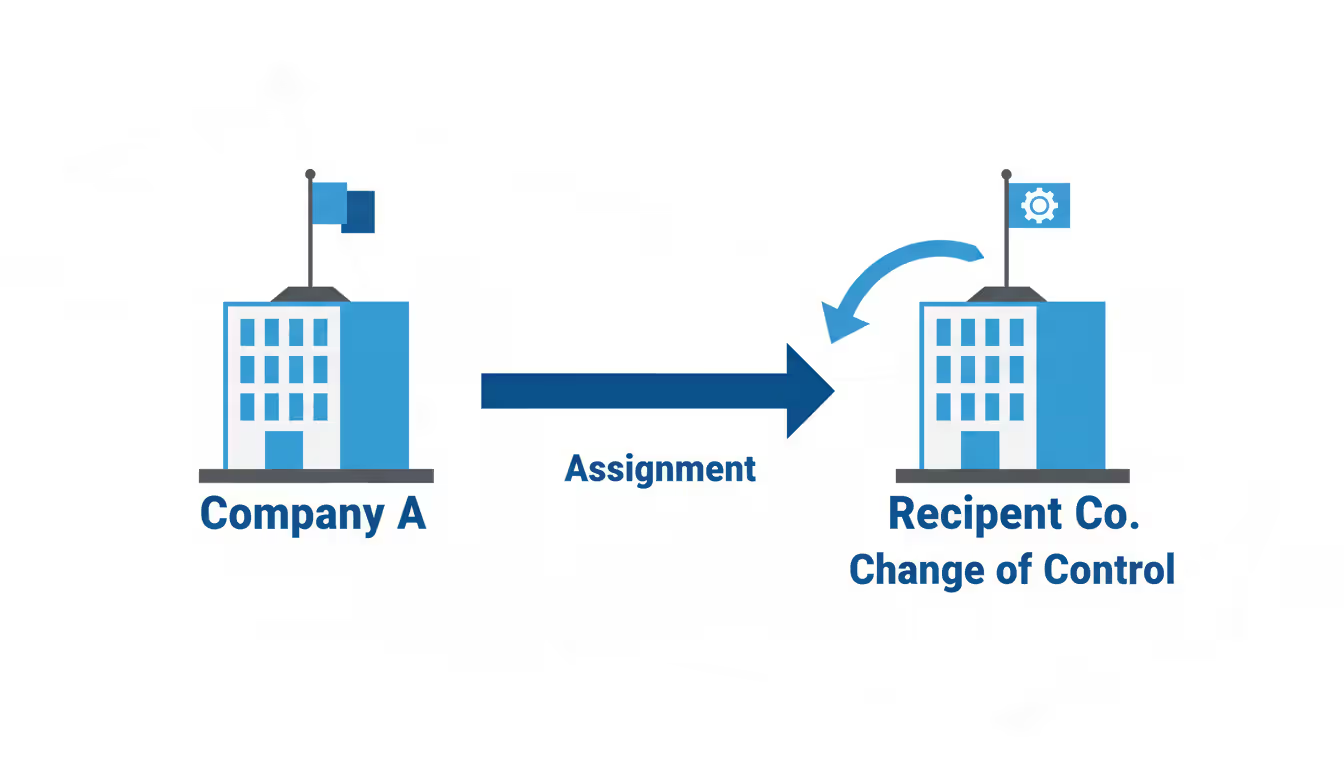
A change of control provision is a contractual clause that grants specific rights or triggers particular obligations when ownership, management, or voting power of one party to a contract shifts significantly. These provisions appear in employment agreements, commercial contracts, loan documents, and vendor relationships to protect parties from unexpected changes in the entity they originally agreed to do business with.
The fundamental purpose is risk management. When you sign a contract with a company, you're betting on that company's stability, reputation, financial strength, and management philosophy. A change of control provision acknowledges that a different owner might operate differently—perhaps more aggressively, less ethically, or with conflicting business priorities. The clause gives the non-changing party options: renegotiate terms, terminate the relationship, or demand compensation.
Under the change of control definition in law, these clauses are generally enforceable provided they meet basic contract formation requirements and don't violate public policy. Courts across most U.S. jurisdictions recognize them as legitimate tools for managing counterparty risk, though specific enforceability standards vary by state and contract type.
Key Elements of Change of Control Clauses
Most change of control clauses in contracts contain four core components:
Definition of triggering events. The clause specifies what constitutes a "change of control"—typically a percentage threshold of stock ownership transfer, merger or consolidation, sale of substantially all assets, or change in board composition. Precision matters here. A vague definition invites disputes.
Notice requirements. The party experiencing the change usually must notify counterparties within a specified timeframe, often 30 to 60 days before or after the triggering event. Failure to provide timely notice can itself constitute a breach.
Rights and remedies. The clause outlines what the non-changing party can do: consent to continue the relationship, renegotiate pricing or terms, terminate without penalty, or receive accelerated payments. In executive employment contracts, these often include severance packages or equity vesting acceleration.
Carve-outs and exceptions. Well-drafted provisions exclude certain transactions from triggering the clause—internal reorganizations, transfers to affiliates, estate planning transfers, or public offerings. Without these, routine corporate housekeeping could inadvertently trigger the provision.
How Change of Control Differs from Anti-Assignment Clauses
Change of control provisions and anti-assignment clauses both address counterparty substitution, but they operate differently. An anti-assignment clause prevents one party from transferring its contractual rights and obligations to a third party without consent. If Company A has a supply agreement with Company B, an anti-assignment clause stops Company A from handing that contract to Company C.
A change of control provision, however, doesn't prevent assignment—it addresses what happens when the contracting party itself fundamentally changes through ownership transfer. Company A remains the named party to the contract, but new owners now control it. Anti-assignment change of control strategies sometimes combine both protections, particularly in sensitive commercial relationships where both the identity of the contracting party and the identity of its owners matter.
Author: Marcus Ellwood;
Source: craftydeb.com
The practical difference: anti-assignment clauses are easier to circumvent through corporate restructuring. If Company A merges into a new entity or transfers all its assets to a subsidiary, the original contract might technically remain with Company A even though economic reality has shifted. Change of control provisions catch these maneuvers.
Common Triggers in Change of Control Agreements
Understanding what activates a change of control provision prevents surprises during corporate transactions. Different triggers serve different protective purposes.
Stock or equity ownership transfers represent the most common trigger. A typical threshold is 50% of voting securities changing hands, though some agreements use lower thresholds (30% or 35%) to capture situations where a large minority stake effectively controls the company. Private equity acquisitions almost always hit these triggers.
Mergers and consolidationstrigger most change of control clauses regardless of ownership percentages. When Company A merges with Company B to form Company C, the original contracting entity has legally ceased to exist—even if shareholders receive equivalent value in the new entity.
Asset sales can trigger provisions when "substantially all" assets transfer to another party. The definition of "substantially all" varies, but courts generally interpret it as enough assets that the selling company cannot continue its primary business operations. A threshold of 70-80% of total assets is common in commercial practice.
Board composition changes serve as triggers in some agreements, particularly those where management expertise matters. A provision might activate if more than half the board seats turn over within a 12-month period, even without ownership changes. This catches situations where activist investors replace management.
Voting control shifts can occur without ownership transfers through voting agreements, proxies, or dual-class share structures. Some sophisticated provisions define change of control as any transaction that gives a person or group the power to elect a majority of directors or direct management decisions.
Trigger Type
Typical Threshold
Common in Which Contracts
Ease of Avoidance
Stock/Equity Sale
50% of voting securities
Employment, vendor, financing
Difficult; requires complex structures
Merger/Consolidation
Any merger where original entity doesn't survive
All contract types
Very difficult; fundamental transaction
Asset Sale
70-80% of total assets
Commercial agreements, leases
Moderate; can structure as multiple smaller sales
Board Changes
Majority turnover in 12 months
Executive employment, key vendor contracts
Easy; gradual replacement over longer periods
Voting Control Shift
Ability to elect majority of directors
Financing, strategic partnerships
Moderate; depends on clause sophistication
Change of Control Provisions in Mergers and Acquisitions
Change of control in mergers creates tension between buyers seeking clean acquisitions and sellers wanting maximum value. These provisions can derail deals, reduce purchase prices, or require extensive pre-closing consent processes.
From a buyer's perspective, change of control clauses in the target company's contracts represent contingent liabilities. If key vendor contracts, customer agreements, or facility leases contain termination rights triggered by the acquisition, the buyer might lose critical relationships. Sophisticated buyers conduct thorough due diligence to identify all change of control provisions and quantify the risk of counterparties exercising their rights.
Sellers face different challenges. If too many contracts contain change of control provisions requiring third-party consent, the deal might become impractical. Imagine a software company where 40% of customer contracts allow termination upon change of control. Buyers will either demand price reductions to account for potential customer losses or walk away entirely.
Deal structures often attempt to minimize change of control triggers. Asset purchases (where the buyer purchases specific assets rather than stock) sometimes avoid triggering provisions that focus on equity ownership changes, though many modern clauses have closed this loophole. Mergers structured as reverse triangular mergers can sometimes preserve the target entity's legal identity, potentially avoiding some triggers.
Pre-closing consent solicitation has become standard practice. Sellers contact counterparties with change of control rights months before closing, seeking advance waivers or consents. This process reveals which relationships might not survive the transaction and allows time to negotiate alternative arrangements.
Change of control provisions are the hidden icebergs in M&A transactions. You might have a perfect strategic fit and agreed-upon valuation, but if the target has change of control clauses in 30% of its revenue contracts and customers start exercising termination rights, your acquisition thesis falls apart. Smart buyers map every single one of these provisions during due diligence and build consent strategies before signing the purchase agreement
— Rachel Thornton
Legal Rights and Obligations Under Change of Control Clauses
Change of control rights and obligations vary significantly based on contract type and negotiating leverage, but certain patterns emerge across industries.
Notification requirements typically obligate the party experiencing the change to provide written notice within 15 to 60 days. Some provisions require notice before the change closes, allowing counterparties to object or renegotiate. Others require notice after closing but within a short window. The change of control notification must usually include details about the acquiring party, transaction structure, and expected closing date.
Failure to provide required notice constitutes a material breach in most jurisdictions, giving the non-notified party grounds to terminate or seek damages. However, courts sometimes excuse late notice if the non-changing party suffered no actual prejudice—for example, if they learned about the transaction through public filings and had ample time to exercise their rights.
Consent rights give counterparties veto power over the transaction's effect on the contract. The changing party must obtain written consent before the change of control closes, or the counterparty can terminate the agreement. Consent rights create significant leverage. A vendor with a consent right can demand better pricing, extended terms, or other concessions in exchange for approval.
Most jurisdictions impose an implied duty of good faith on consent rights. A party cannot withhold consent arbitrarily or for reasons unrelated to the contract's subject matter. If a landlord refuses consent to a tenant's change of control solely to extract higher rent unrelated to the new owner's creditworthiness, courts might find bad faith.
Termination options allow counterparties to exit the relationship without penalty following a change of control. This protects parties who would not have contracted with the new owner. In employment contexts, executives often negotiate "golden parachute" provisions allowing them to resign for "good reason" following a change of control and receive substantial severance.
Payment acceleration provisions require immediate payment of amounts that would otherwise be paid over time. Loan agreements commonly include change of control provisions that accelerate the entire debt balance, allowing lenders to exit relationships with new owners they consider higher risk. Earnout provisions in acquisition agreements might accelerate, paying sellers immediately rather than over the agreed performance period.
The change of control legal implications extend beyond contract law. Securities regulations require public companies to disclose change of control agreements in proxy statements and SEC filings. Tax considerations affect executive compensation arrangements, with IRS Section 280G potentially imposing excise taxes on excessive golden parachute payments. Antitrust laws might require pre-merger notification for transactions that trigger numerous change of control provisions across an industry.
Author: Marcus Ellwood;
Source: craftydeb.com
Industry-Specific Applications and Variations
Change of control provisions adapt to different industries' unique risks and relationship dynamics.
Employment contracts, particularly for executives, commonly include "double-trigger" change of control provisions. The executive receives severance or equity acceleration only if two events occur: a change of control and a subsequent qualifying termination (firing without cause or resignation for good reason). This prevents windfalls when executives remain employed post-acquisition but protects them if the new owner eliminates their role.
Single-trigger provisions, which pay out solely upon change of control regardless of continued employment, have fallen out of favor. They create perverse incentives for executives to seek acquisitions even when not in shareholder interests and generate tax penalties under Section 280G.
Typical executive severance multiples range from 1x to 3x annual compensation (salary plus target bonus). C-suite executives often negotiate 2-3x multiples, while vice presidents might receive 1-1.5x. Equity vesting acceleration varies—some agreements vest 100% of unvested equity, others vest a pro-rata portion, and some require the acquirer to assume equity grants without acceleration.
Commercial vendor agreements use change of control provisions to manage supply chain risk. A manufacturer relying on a single-source supplier for critical components wants assurance that a new owner won't disrupt supply, raise prices arbitrarily, or become a competitor. These provisions typically grant termination rights or renegotiation options rather than payment acceleration.
Financing documents almost universally include change of control provisions favorable to lenders. Credit agreements typically define change of control as an event of default, allowing lenders to accelerate the loan and demand immediate repayment. This protects lenders from lending to Company A but effectively having exposure to Company B, which might have different risk characteristics.
Bond indentures often include "change of control put" provisions requiring the issuer to repurchase bonds at 101% of par value following a change of control that results in a ratings downgrade. This protects bondholders from leveraged buyouts that increase debt levels and impair credit quality.
Real estate leases increasingly contain change of control provisions, particularly for tenants in retail, restaurant, and specialized industrial spaces. Landlords want to ensure that a creditworthy national tenant doesn't transfer the lease to a weaker operator. These provisions typically require landlord consent (not to be unreasonably withheld) when a tenant undergoes a change of control.
Technology licensing agreements often include change of control provisions addressing competitive concerns. If Company A licenses valuable IP to Company B, and Company B is then acquired by Company A's primary competitor, Company A wants termination rights. These provisions must be carefully drafted to survive antitrust scrutiny.
Negotiating and Drafting Effective Change of Control Terms
Effective change of control provisions balance protection against flexibility. Overly restrictive clauses make companies difficult to sell; overly permissive clauses provide inadequate protection.
Define triggers precisely. Vague language like "change in ownership" invites disputes. Specify exact percentages, measurement methods (voting securities, equity interests, beneficial ownership), and time periods. Address indirect control through parent companies or affiliates.
A common mistake: defining the trigger as transfer of "50% or more of stock" without specifying whether that means a single transaction or cumulative transfers over time. If the original owner sells 30% to one buyer and 25% to another in separate transactions, has the provision triggered? Clear drafting eliminates ambiguity.
Author: Marcus Ellwood;
Source: craftydeb.com
Include appropriate carve-outs. Standard exceptions include:
Transfers to affiliates or subsidiaries under common control
Estate planning transfers to family members or trusts
Public offerings and secondary market trading
Internal reorganizations that don't change ultimate beneficial ownership
Transfers required by law or court order
Without these carve-outs, routine corporate actions trigger provisions unnecessarily.
Calibrate thresholds to actual risk. A 50% threshold makes sense for most commercial contracts—ownership below 50% rarely constitutes practical control. Lower thresholds (30-35%) might be appropriate when dealing with companies that have dispersed ownership where a large minority stake effectively controls operations.
Higher thresholds (66% or 75%) appear in contracts where the non-changing party has limited leverage or where the changing party needs flexibility for estate planning or bringing in minority investors.
Address timing and notice mechanics. Specify whether notice is required before closing (allowing the counterparty to prevent the transaction's effect on the contract) or after closing (simply informing them of a completed change). Pre-closing notice gives counterparties more leverage but can complicate transactions. Post-closing notice is more seller-friendly but provides less protection.
Include cure periods. If the changing party fails to provide timely notice, allow 10-15 days to cure before the counterparty can terminate.
Consider mutual provisions. In contracts between companies of similar size and bargaining power, mutual change of control provisions (applying to both parties) demonstrate fairness and increase enforceability. One-sided provisions can sometimes be challenged as unconscionable, particularly in adhesion contracts.
Link remedies to actual harm. A vendor whose customer undergoes a change of control faces uncertainty but not necessarily damage. A termination right might be appropriate; automatic price increases might not be. Remedies should address the specific risks the provision aims to mitigate.
Plan for partial changes. What happens if 40% of ownership changes in Year 1 and another 15% in Year 2? Some provisions include "creeping change of control" language that aggregates transfers over a specified period (typically 12-24 months) to prevent circumvention through staged transactions.
Review state law variations. While change of control provisions are generally enforceable across U.S. jurisdictions, some states impose specific requirements. California, for example, scrutinizes non-compete provisions in employment agreements more strictly than other states, which can affect change of control severance agreements that include non-compete obligations.
Frequently Asked Questions About Change of Control Provisions
What percentage of ownership change typically triggers a change of control provision?
The most common threshold is 50% of voting securities or equity interests changing hands in a single transaction or series of related transactions. However, thresholds vary based on contract type and negotiating leverage. Executive employment agreements sometimes use 30-35% thresholds to capture situations where a large minority stake provides effective control. Financing documents occasionally use even lower thresholds (25%) because lenders are particularly risk-averse about ownership changes. The appropriate threshold depends on the ownership structure—widely held public companies might justify lower thresholds since 30% ownership could represent practical control, while closely held companies typically use 50% or higher.
Can a change of control provision be waived?
Yes, change of control provisions can be waived by the party entitled to exercise rights under the clause. Waivers should be in writing and signed by an authorized representative to ensure enforceability. In M&A transactions, buyers routinely request that sellers obtain written waivers from counterparties with change of control rights before closing. Some contracts specify that waivers must be explicit and cannot be implied from conduct or course of dealing. Parties sometimes negotiate conditional waivers—agreeing not to exercise change of control rights provided certain conditions are met (maintaining service levels, honoring existing pricing, retaining key personnel). A waiver of one change of control event doesn't necessarily waive future events unless the language clearly indicates that intent.
What happens if a party violates a change of control clause?
Violating a change of control provision—typically by failing to provide required notice or completing a transaction without obtaining required consent—constitutes a material breach of contract. The non-breaching party can pursue several remedies: terminating the contract without penalty, seeking damages for losses caused by the breach, or obtaining specific performance requiring the breaching party to cure the violation. Damages might include costs of finding replacement vendors, lost profits, or transition expenses. In some cases, courts have unwound transactions or imposed injunctions preventing the changing party from enforcing contract terms against the counterparty. The severity of consequences depends on whether the violation was intentional, whether the non-breaching party suffered actual harm, and the specific remedies outlined in the contract.
Are change of control provisions enforceable in all states?
Change of control provisions are generally enforceable across all U.S. states provided they meet basic contract formation requirements: mutual assent, consideration, lawful purpose, and capacity. However, enforceability nuances vary by jurisdiction and contract type. Most states enforce these provisions in commercial contracts with minimal scrutiny. Employment-related change of control provisions face more variable treatment, particularly regarding non-compete obligations, equity forfeiture, and excessive severance payments. Some states limit enforceability of provisions that excessively restrict employee mobility or impose penalties unrelated to legitimate business interests. Courts in Delaware, New York, and California—major commercial jurisdictions—have extensive case law supporting change of control provisions when reasonably drafted. Parties should ensure their contracts include choice-of-law provisions selecting favorable jurisdictions and consult local counsel when enforceability concerns arise.
How do change of control provisions affect employee contracts?
In employee contracts, change of control provisions typically protect executives and key employees from job loss or diminished roles following an acquisition. Common protections include severance payments (often 1-3x annual compensation), accelerated equity vesting, continuation of benefits, and outplacement services. Most modern executive agreements use "double-trigger" structures requiring both a change of control and a qualifying termination (firing without cause or resignation for good reason within 12-24 months post-change). This prevents executives from receiving windfalls while remaining employed but protects them if the new owner eliminates their position or materially reduces responsibilities. Some agreements include "golden parachute" provisions providing enhanced benefits, though IRC Section 280G imposes excise taxes on payments exceeding 3x the executive's average annual compensation. For rank-and-file employees, change of control provisions are less common, though some companies provide retention bonuses to prevent departures during acquisition uncertainty.
What is the difference between single-trigger and double-trigger change of control?
Single-trigger change of control provisions activate based solely on the change of control event itself. When the triggering transaction closes, the employee immediately receives severance, equity vests, or other benefits regardless of whether employment continues. Single-trigger provisions have become disfavored because they create perverse incentives (executives might seek acquisitions to trigger payments even when not in shareholder interests) and impose unnecessary costs on acquirers. Double-trigger provisions require two events: a change of control and a subsequent qualifying termination within a specified period (typically 12-24 months). Qualifying terminations usually include termination without cause by the employer or resignation for "good reason" by the employee (material reduction in responsibilities, compensation cuts, relocation requirements). Double-trigger structures better align executive and shareholder interests—executives don't benefit from acquisitions unless they actually lose their jobs—and reduce acquisition costs, making companies more attractive targets. Most public companies have shifted to double-trigger provisions for new executive agreements, though some legacy single-trigger arrangements remain.
Change of control provisions serve as essential risk management tools in modern commercial relationships, protecting parties from fundamental shifts in the entities they contract with. Whether you're an executive negotiating employment terms, a vendor entering a supply agreement, or a lender extending credit, understanding how these clauses work—their triggers, rights, obligations, and strategic implications—prevents surprises and preserves optionality during corporate transitions.
The key to effective change of control provisions lies in precise drafting that balances legitimate protective interests against practical business flexibility. Overly broad provisions make companies difficult to sell and impose unnecessary transaction costs; overly narrow provisions fail to protect against the risks they're designed to address. Successful negotiation requires understanding industry norms, accurately assessing counterparty risk, and crafting triggers and remedies proportionate to actual potential harm.
As M&A activity continues at elevated levels and corporate ownership structures grow increasingly complex, change of control provisions will remain critical contractual components. Parties entering significant commercial relationships should carefully consider whether these protections are appropriate, draft them with precision when included, and maintain awareness of all existing change of control obligations when planning corporate transactions.
An LLC operating agreement is a legally binding document that outlines ownership structure, management procedures, and operational rules. While only some states require it, this internal document strengthens liability protection, prevents disputes, and satisfies banks and investors
Master Service Agreements establish reusable legal frameworks for ongoing vendor relationships. Discover how MSAs work, essential clauses, negotiation strategies, and when to use master agreements versus individual contracts for your business needs
A transition services agreement (TSA) is a contract where the seller provides operational services to the buyer post-closing. This guide covers TSA fundamentals, contract terms, duration, negotiation strategies, and post-merger management for successful M&A transitions
A side letter is a separate agreement that modifies or supplements a main contract, commonly used in private equity and investment funds. This guide explains side letter provisions, enforceability, negotiation tactics, and how they differ from primary agreements
The content on this website is provided for general informational and educational purposes only. It is intended to explain concepts related to business and corporate law, contracts, compliance, disputes, M&A, and taxation for companies.
All information on this website, including articles, guides, and examples, is presented for general educational purposes. Legal outcomes may vary depending on jurisdiction, company structure, and individual circumstances.
This website does not provide legal advice, and the information presented should not be used as a substitute for consultation with qualified corporate attorneys or legal professionals.
The website and its authors are not responsible for any errors or omissions, or for any outcomes resulting from decisions made based on the information provided on this website.