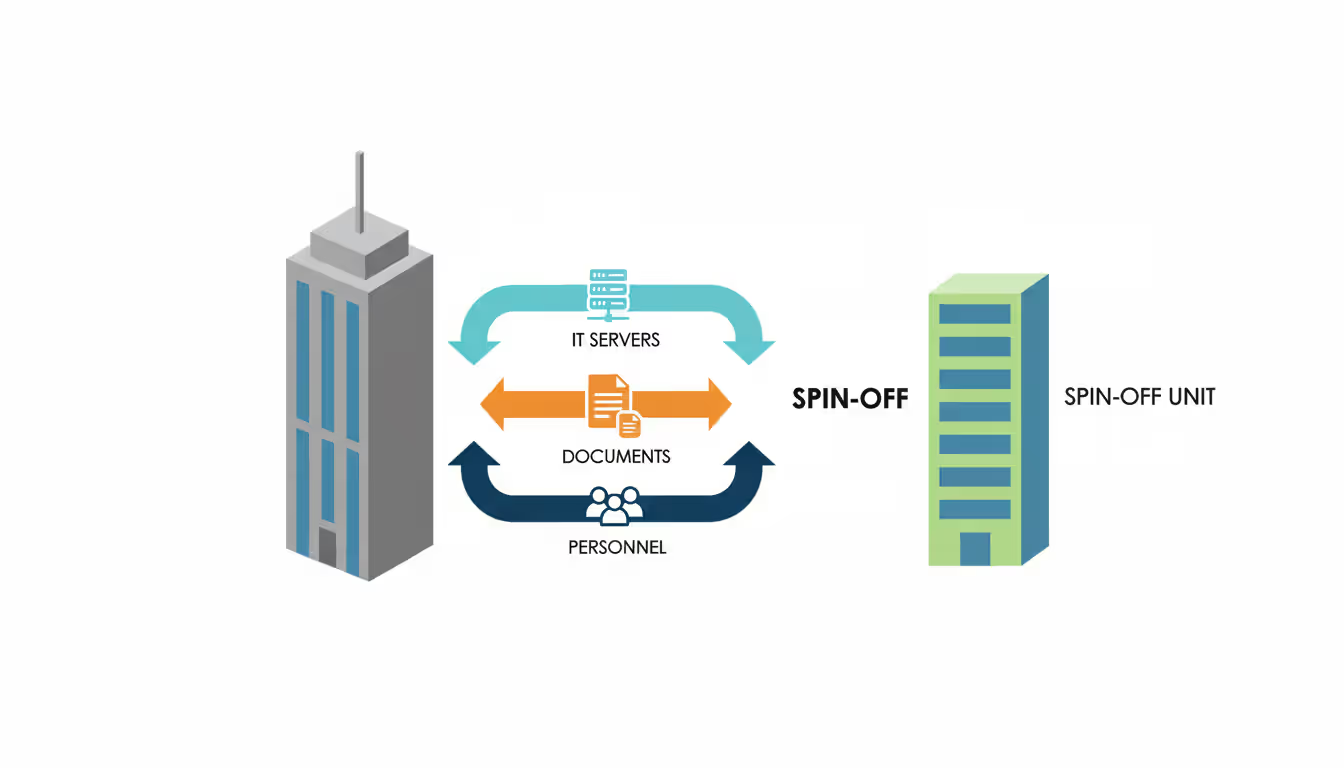
A transition services agreement (TSA) is a contract in which the seller of a business agrees to provide specific operational services to the buyer for a defined period following the closing of a transaction. These agreements bridge the gap between ownership transfer and the buyer's ability to operate the acquired business independently.
The fundamental purpose of a transition services agreement is straightforward: when a company acquires another business or specific assets, the acquired entity often relies on the seller's infrastructure, systems, and personnel to function. The buyer cannot immediately replicate payroll systems, IT infrastructure, facilities management, or supply chain operations overnight. The TSA ensures the acquired business continues operating smoothly while the buyer builds or integrates these capabilities.
Parties to a TSA include the seller (service provider) and the buyer (service recipient). In complex transactions involving carved-out divisions or subsidiaries, multiple entities may participate. The seller typically provides services from its existing operations, while the buyer pays for these services at agreed-upon rates.
Companies use transition services agreements most frequently in mergers and acquisitions, particularly when acquiring a division that shares resources with the seller's remaining operations. A software division being sold might depend on the parent company's data centers, HR systems, and accounting functions. Without a TSA, the division would lose access to these critical services the moment the transaction closes, creating immediate operational chaos.
The transition service agreement explained simply: it's a temporary safety net that keeps the lights on while the buyer establishes independence. Duration typically ranges from six months to two years, though specific services may terminate earlier or later based on complexity and migration timelines.
Why Companies Use TSAs in Mergers and Acquisitions
Business continuity drives TSA adoption in mergers and acquisitions. Buyers cannot afford service interruptions that disrupt customer relationships, revenue streams, or regulatory compliance. A manufacturing business acquired mid-quarter still needs to process payroll, maintain quality certifications, and fulfill customer orders without missing a beat.
Operational handover challenges vary by industry and transaction structure. Carve-out transactions present the most complex scenarios because the seller must separate intertwined operations while maintaining service delivery. A consumer products division might share enterprise resource planning (ERP) systems, distribution networks, and corporate support functions with ten other divisions. Untangling these dependencies takes months of planning and execution.
Author: Marcus Ellwood;
Source: craftydeb.com
Temporary support through a TSA agreement post-merger serves multiple strategic purposes. Buyers gain time to assess acquired operations firsthand before committing to permanent infrastructure investments. A private equity firm acquiring a regional bank might discover opportunities to outsource certain functions rather than building internal capabilities, but this assessment requires operating the business first.
Risk mitigation represents another critical rationale. Attempting to migrate all services simultaneously on closing day multiplies the chances of catastrophic failure. TSAs allow phased transitions where IT systems migrate first, followed by finance functions, then HR and facilities. This sequencing reduces risk and allows the buyer to learn from early migrations before tackling more complex services.
Sellers benefit from TSAs too, though their motivations differ. Service fees provide revenue that offsets stranded costs—the overhead that remains after selling a division. A corporate headquarters that supported five divisions but sold two still maintains much of its infrastructure and headcount. TSA payments help cover these costs during the adjustment period.
Key Components of TSA Contract Terms
Scope of Services Covered
Service scope definitions make or break TSA effectiveness. Vague descriptions like "IT support" or "accounting services" create disputes and performance gaps. Effective TSAs specify exactly which services transfer, often through detailed schedules or exhibits.
IT services might include network access, email hosting, application support for specific software packages, help desk tickets, and cybersecurity monitoring. Each service requires definition: response times, availability windows, user counts, and included versus excluded activities.
HR and payroll services typically cover benefits administration, payroll processing, recruitment support, and employee relations. The TSA should specify whether the seller handles only transaction processing or also provides strategic guidance, policy interpretation, and compliance monitoring.
Finance and accounting services range from accounts payable and receivable processing to financial reporting, tax compliance, and treasury functions. Buyers must clarify whether they receive only transaction processing or also month-end close support, audit coordination, and management reporting.
Duration and Termination Provisions
TSA agreement duration varies significantly by service category and transaction complexity. Standard terms run twelve months, but this represents an average across all services rather than a universal timeframe.
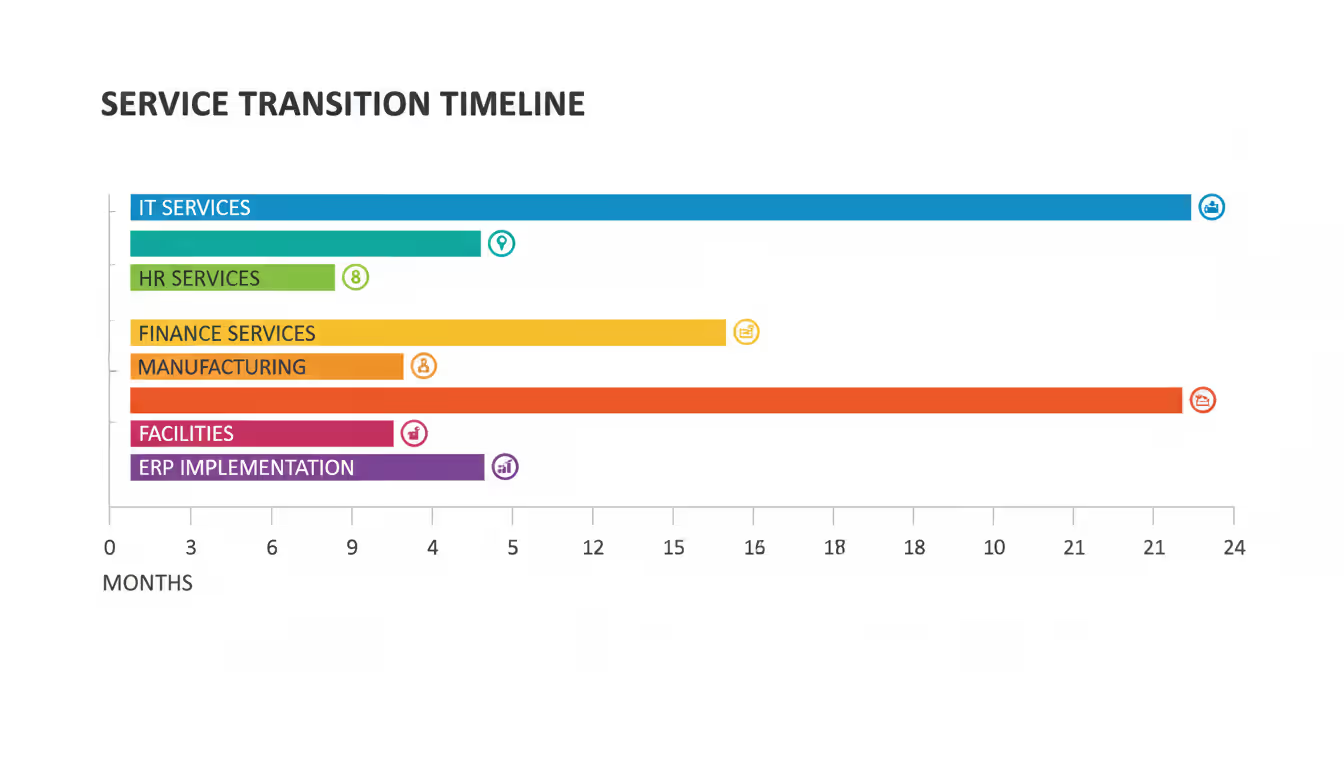
Simple services like facilities management or basic IT infrastructure support might terminate after six months. Complex services such as ERP system access or specialized manufacturing support can extend eighteen to twenty-four months. Buyers negotiate different termination dates for different service categories, creating a phased exit strategy.
Author: Marcus Ellwood;
Source: craftydeb.com
Early termination provisions give buyers flexibility to exit services once they achieve independence. A buyer that migrates payroll processing in month four shouldn't pay for unused services through month twelve. Well-drafted TSAs allow termination of individual services with thirty to ninety days' notice, though sellers often require minimum service periods to justify setup costs.
Extension provisions prove equally important. Despite best intentions, migrations frequently take longer than planned. TSAs should specify extension terms, including pricing (often at a premium to encourage timely exit), notice requirements, and maximum extension periods. Some agreements cap extensions at six months; others allow indefinite extensions at escalating rates.
Pricing and Payment Structure
TSA pricing models range from cost-based to market-based approaches, each with distinct trade-offs. Cost-plus pricing charges the buyer for the seller's actual costs plus a markup (typically 5-15%). This approach ensures the seller recovers expenses and earns a modest profit without gouging the buyer.
Fixed-fee pricing establishes set monthly charges regardless of actual usage or costs. This model provides budget certainty for buyers but creates risk for sellers if actual costs exceed projections. Fixed fees work best for stable, predictable services like facilities access or standard application hosting.
Hybrid models combine elements of both approaches. Base fees cover fixed costs and expected service levels, while variable charges apply to usage above defined thresholds. A TSA might include a fixed monthly fee for up to 500 help desk tickets, with per-ticket charges for additional volume.
Payment terms typically follow monthly invoicing cycles with 30-day payment windows. Buyers should negotiate detailed invoicing requirements that break down charges by service category, allowing verification against service level agreements and usage metrics.
Performance Standards and SLAs
Service level agreements (SLAs) within TSAs define expected performance and consequences for failures. Unlike commercial service agreements where providers compete for business, TSA providers are sole-source suppliers with limited accountability incentives. Strong SLAs protect buyer interests.
Availability metrics specify uptime requirements for IT systems, application access, and infrastructure services. A 99.5% availability standard allows roughly 3.5 hours of downtime monthly, while 99.9% permits only 45 minutes. These distinctions matter for business-critical systems.
Response time commitments govern how quickly the seller addresses service requests or incidents. Priority levels typically range from critical (15-minute response) to low priority (next business day). The TSA should define priority criteria to prevent disputes.
Performance reporting requirements obligate the seller to provide regular metrics demonstrating SLA compliance. Monthly reports should detail availability, response times, ticket volumes, and any SLA breaches. Without reporting obligations, buyers lack visibility into service quality.
Remedies for SLA failures range from service credits (fee reductions) to termination rights for persistent breaches. Service credits of 5-10% for monthly SLA failures provide modest accountability, though they rarely compensate for actual business disruption. Termination rights after repeated failures give buyers ultimate recourse.
Common Transition Services Agreement Clauses
Beyond service-specific terms, several standard clauses appear in most transition services agreement contracts, each addressing distinct legal and operational concerns.
Liability limitations cap the seller's financial exposure for service failures, data breaches, or other TSA-related issues. Sellers typically negotiate liability caps equal to 6-12 months of TSA fees, arguing they provide services at cost without profit margins to absorb significant claims. Buyers should carve out exceptions for gross negligence, willful misconduct, and breaches of confidentiality obligations.
Confidentiality provisions protect sensitive information exchanged during service delivery. Sellers access buyer business plans, customer data, and strategic initiatives while providing services. Confidentiality terms should survive TSA termination, typically for 3-5 years, and specify permitted uses of confidential information.
Dispute resolution mechanisms establish processes for addressing disagreements about service quality, pricing, or contract interpretation. Escalation procedures typically start with operational managers, progress to senior executives, and ultimately reach mediation or arbitration. Litigation should be a last resort given the ongoing service relationship.
Governance structures define decision-making processes and communication protocols. Monthly steering committee meetings with representatives from both parties review performance metrics, address issues, and coordinate migration planning. Clear governance prevents small problems from escalating.
Exit provisions detail the seller's obligations as services terminate. Data migration requirements ensure the buyer receives all business records, system data, and documentation in usable formats. Knowledge transfer obligations might require the seller to train buyer personnel or document processes before service termination.
TSA Clause Category
Primary Purpose
Typical Buyer Priority
Typical Seller Priority
Liability Caps
Limit financial exposure
Higher caps with carve-outs
Lower caps, few exceptions
Confidentiality
Protect sensitive data
Broad scope, long duration
Narrow scope, reasonable term
Dispute Resolution
Address disagreements
Quick resolution, operational focus
Formal processes, legal protection
Governance
Manage ongoing relationship
Transparency, responsiveness
Efficiency, limited burden
Exit Provisions
Ensure clean separation
Comprehensive data/knowledge transfer
Defined scope, limited duration
How Long Does a TSA Agreement Last?
TSA agreement duration depends on service complexity, buyer capabilities, and transaction structure. Generalizations prove dangerous, but patterns emerge across industries and service categories.
IT infrastructure services typically run 12-18 months. Migrating email systems, network access, and application hosting requires planning, testing, and phased cutover. Buyers must procure hardware, license software, configure systems, migrate data, and train users. Compressed timelines increase failure risk.
Finance and accounting functions often transition within 6-12 months. Once the buyer implements its own ERP system or engages a third-party provider, transaction processing can migrate relatively quickly. However, tax compliance services sometimes extend longer to ensure the seller completes tax returns for periods when it owned the business.
Author: Marcus Ellwood;
Source: craftydeb.com
HR and payroll services show wide variation. Basic payroll processing might transition in 3-6 months, especially if the buyer uses a standard payroll provider. Benefits administration takes longer due to plan year timing, carrier transitions, and employee communication requirements. Expect 9-15 months for comprehensive HR services.
Manufacturing and supply chain support can extend 18-24 months or longer. Specialized production processes, quality certifications, supplier relationships, and regulatory approvals create dependencies that cannot be rushed. A pharmaceutical manufacturing division might need two years to achieve regulatory approval for transferred processes.
Facilities services usually represent shorter commitments, often 6-12 months. Real estate leases, utilities, security, and maintenance transition once the buyer secures its own facilities or negotiates direct service contracts.
Several factors influence actual duration beyond service complexity. Buyer readiness matters enormously—a buyer with established infrastructure can migrate faster than one building capabilities from scratch. Regulatory requirements in industries like healthcare, financial services, and manufacturing impose minimum timelines for approvals and certifications.
Extension provisions come into play frequently. Despite detailed planning, migrations encounter unexpected obstacles: vendor delays, integration challenges, resource constraints, or business disruptions. Well-structured TSAs allow extensions for individual services rather than requiring all-or-nothing decisions.
Phased termination provisions let buyers exit services as they achieve independence rather than waiting for a single termination date. A buyer might exit payroll services in month six, email hosting in month nine, and ERP access in month fifteen. This approach reduces costs and allows the seller to wind down its support infrastructure gradually.
Negotiating a Transition Services Agreement
Negotiating transition services agreements requires balancing competing pressures: buyers want comprehensive services at low cost with flexibility to exit; sellers want limited obligations at compensatory pricing with predictable commitments.
Timing considerations significantly impact negotiation dynamics. TSAs negotiated before definitive purchase agreements face less time pressure but more uncertainty about actual service needs. Post-signing negotiations benefit from detailed due diligence insights but face compressed timelines before closing.
Most sophisticated buyers negotiate TSA frameworks during purchase agreement discussions, establishing pricing methodologies, duration ranges, and key terms. Detailed service schedules follow during the pre-closing period once integration teams complete operational assessments.
Common negotiation points include service scope boundaries, performance standards, pricing models, duration and extension terms, liability limitations, and exit requirements. Buyers push for detailed service descriptions with robust SLAs; sellers prefer general descriptions with limited accountability.
Seller priorities center on cost recovery, limited liability, and finite commitments. Sellers want to exit the TSA relationship as quickly as the buyer, viewing ongoing service obligations as distractions from their core business. They negotiate caps on liability, exclusions for consequential damages, and termination rights if the buyer fails to pay or interferes with service delivery.
Buyer priorities emphasize service quality, operational continuity, and transition flexibility. Buyers need assurance that critical services will continue without disruption while they build independence. They negotiate strong SLAs, termination rights for seller performance failures, and flexible extension options.
Common pitfalls damage both parties. Inadequate service descriptions create disputes and performance gaps. A buyer expecting "full IT support" discovers the seller interprets this as basic infrastructure access without application support or help desk services. Detailed schedules listing specific services, systems, and support levels prevent these misunderstandings.
Unrealistic timelines set both parties up for failure. Buyers underestimate migration complexity; sellers overestimate buyer capabilities. Conservative duration estimates with extension provisions provide a safer approach than aggressive timelines requiring perfect execution.
Insufficient attention to exit planning creates crises as TSA termination approaches. Agreements should require joint transition planning, regular migration status reviews, and formal readiness assessments before service termination. A buyer that discovers critical data migration issues two weeks before TSA expiration faces expensive emergency extensions or service disruptions.
The biggest TSA mistakes happen when parties treat it as a standard commercial contract rather than a unique interdependency that requires ongoing collaboration. You're asking the seller to continue supporting a business they no longer own while the buyer transforms operations. Without strong governance, clear communication, and realistic expectations, TSAs become sources of conflict rather than bridges to independence
— Jennifer Morrison
Managing TSA Obligations Post-Merger
Signing the TSA represents the beginning, not the end, of transition service management. Effective execution requires dedicated governance, proactive monitoring, and disciplined migration management.
Governance best practices start with clear organizational accountability. Buyers should designate a TSA program manager responsible for coordinating across all service categories, managing seller relationships, and driving migration execution. This role requires authority to make decisions, access to senior leadership, and sufficient resources to address issues.
Steering committee structures bring together senior representatives from both parties monthly or quarterly to review performance, address escalated issues, and coordinate strategic decisions. These meetings supplement operational working groups that manage day-to-day service delivery for specific categories.
Monitoring performance requires systematic tracking of SLA compliance, service quality metrics, and migration progress. Buyers should implement dashboards that consolidate performance data across all TSA services, highlighting trends and exceptions requiring attention.
Regular service reviews with the seller for each major service category allow detailed discussion of performance issues, upcoming changes, and improvement opportunities. These sessions build working relationships and surface problems before they escalate.
Managing the exit represents the ultimate TSA objective. Successful exits require detailed migration planning that begins during TSA negotiation, not months later. Integration teams should develop service-specific migration plans identifying tasks, dependencies, resources, timelines, and success criteria.
Phased migration approaches reduce risk by tackling simpler services first, learning from experience, and building confidence before addressing complex services. A buyer might migrate facilities services in quarter one, payroll in quarter two, email systems in quarter three, and ERP access in quarter four.
Readiness assessments before service termination verify the buyer can operate independently. These assessments should include technical validation (systems work correctly), operational validation (processes function smoothly), and user validation (employees can perform their jobs). Discovering gaps during readiness assessments is far better than learning about them after service termination.
Communication protocols keep stakeholders informed throughout the TSA lifecycle. Regular updates to business unit leaders, affected employees, and executive sponsors prevent surprises and maintain confidence. Communication should address migration status, upcoming changes, and actions required from stakeholders.
Risk management processes identify potential TSA-related risks and implement mitigation strategies. Common risks include seller performance failures, migration delays, resource constraints, and unexpected dependencies. Contingency plans for high-impact risks might include alternative service providers, extended TSA terms, or temporary workarounds.
Frequently Asked Questions About Transition Services Agreements
What happens if TSA services aren't delivered on time?
Service level agreements within the TSA should specify remedies for performance failures, typically including service credits (fee reductions) for SLA breaches and termination rights for persistent failures. Minor delays might trigger 5-10% monthly fee reductions, while critical failures affecting business operations could justify immediate termination of specific services. Buyers should document all service failures and invoke contractual remedies promptly rather than allowing issues to accumulate. For significant disruptions, buyers may also have claims for consequential damages if not waived in the agreement, though sellers typically negotiate liability caps and exclusions that limit exposure.
Can a TSA be extended beyond the original term?
Most TSAs include extension provisions allowing the buyer to continue services beyond the initial term, typically with 60-90 days' advance notice. Extension pricing often increases 10-25% above base rates to encourage timely migration and compensate the seller for extended obligations. Agreements may cap total duration (e.g., initial 12 months plus maximum 6-month extension) or allow indefinite extensions at escalating prices. Buyers should negotiate extension rights during initial TSA negotiations rather than attempting to add them later when leverage has shifted. Sellers sometimes refuse extensions if they've committed resources elsewhere or shut down supporting infrastructure.
Who typically pays for transition services?
Buyers pay for TSA services, though pricing models vary. Cost-plus arrangements charge actual seller costs plus a markup (usually 5-15%), ensuring the seller recovers expenses and earns modest profit. Fixed-fee models establish set monthly charges regardless of actual costs, providing budget certainty. In some transactions, sellers provide limited services at no charge as a closing concession, though this approach often leads to disputes about service quality and scope. Purchase price negotiations may adjust for expected TSA costs, with buyers paying lower purchase prices when assuming expensive transition service obligations. The key principle: TSA costs should reflect actual service delivery expenses without allowing either party to profit significantly from the arrangement.
What's the difference between a TSA and a long-term services agreement?
TSAs are temporary arrangements (typically 6-24 months) intended to bridge the gap until the buyer achieves operational independence, while long-term service agreements establish ongoing relationships extending years. TSAs typically charge cost-plus pricing with limited service development, while long-term agreements use market-based pricing with service improvements and technology investments. Sellers provide TSA services from existing infrastructure without customization; long-term service providers tailor offerings to client needs. Governance also differs—TSAs focus on transition management and exit planning, while long-term agreements emphasize service optimization and relationship development. Some transactions include both: a TSA for immediate post-closing needs and a long-term agreement for specific functions the buyer chooses to outsource permanently.
How detailed should service descriptions be in a TSA?
Service descriptions should be detailed enough that operational teams can deliver services without constant clarification but not so prescriptive that they prevent reasonable operational flexibility. Effective descriptions specify which systems, applications, processes, and support activities are included, expected service levels, hours of availability, and user populations. For IT services, list specific applications, infrastructure components, and support tiers. For finance services, identify which legal entities, accounts, and processes are covered. Include schedules or exhibits with technical details rather than embedding everything in contract text. The test: could a third party reading the service description understand what the seller must deliver? If descriptions require extensive interpretation or leave significant ambiguity, disputes will follow.
What are the tax implications of TSA arrangements?
TSA service fees are generally taxable income to the seller and deductible expenses to the buyer, but specific treatment depends on service types and jurisdictions. Sales and use taxes may apply to certain services depending on state rules—IT services face sales tax in some states but not others. Transfer pricing rules govern TSA pricing when parties are in different countries, requiring arm's-length pricing documentation. Sellers must consider whether TSA activities create ongoing nexus in jurisdictions where the sold business operates, potentially extending tax filing obligations. Value-added tax (VAT) treatment varies by country for cross-border TSAs. Both parties should involve tax advisors during TSA structuring to optimize tax treatment and ensure compliance, particularly for international transactions or complex service arrangements.
Transition services agreements serve as essential tools in mergers and acquisitions, providing the operational continuity that allows acquired businesses to function while buyers establish independence. Success requires moving beyond viewing TSAs as standard commercial contracts and recognizing them as complex interdependencies requiring careful structuring, realistic planning, and disciplined execution.
The most effective TSAs balance comprehensive service coverage with clear boundaries, establish fair pricing that compensates sellers without burdening buyers, and create governance structures that foster collaboration rather than conflict. Detailed service descriptions, robust performance standards, and realistic duration estimates prevent the disputes that plague poorly drafted agreements.
Buyers should begin TSA planning during due diligence, not after signing purchase agreements. Early assessment of service dependencies, migration complexity, and resource requirements enables realistic timeline and budget development. Sellers benefit from thoughtful TSA structuring too—clear service boundaries, appropriate pricing, and defined exit paths reduce the burden of supporting businesses they no longer own.
The ultimate measure of TSA success is not whether services continue without disruption, though that matters enormously, but whether the buyer achieves true operational independence on schedule and within budget. This outcome requires treating TSA management as a strategic program deserving dedicated resources, executive attention, and ongoing investment throughout the transition period.
An LLC operating agreement is a legally binding document that outlines ownership structure, management procedures, and operational rules. While only some states require it, this internal document strengthens liability protection, prevents disputes, and satisfies banks and investors
Master Service Agreements establish reusable legal frameworks for ongoing vendor relationships. Discover how MSAs work, essential clauses, negotiation strategies, and when to use master agreements versus individual contracts for your business needs
A side letter is a separate agreement that modifies or supplements a main contract, commonly used in private equity and investment funds. This guide explains side letter provisions, enforceability, negotiation tactics, and how they differ from primary agreements
A PSA agreement is a legally binding contract between buyer and seller outlining terms for transferring property or assets. This comprehensive guide explains how purchase and sale agreements work, essential clauses, negotiation strategies, and the differences between PSAs and asset purchase agreements
The content on this website is provided for general informational and educational purposes only. It is intended to explain concepts related to business and corporate law, contracts, compliance, disputes, M&A, and taxation for companies.
All information on this website, including articles, guides, and examples, is presented for general educational purposes. Legal outcomes may vary depending on jurisdiction, company structure, and individual circumstances.
This website does not provide legal advice, and the information presented should not be used as a substitute for consultation with qualified corporate attorneys or legal professionals.
The website and its authors are not responsible for any errors or omissions, or for any outcomes resulting from decisions made based on the information provided on this website.