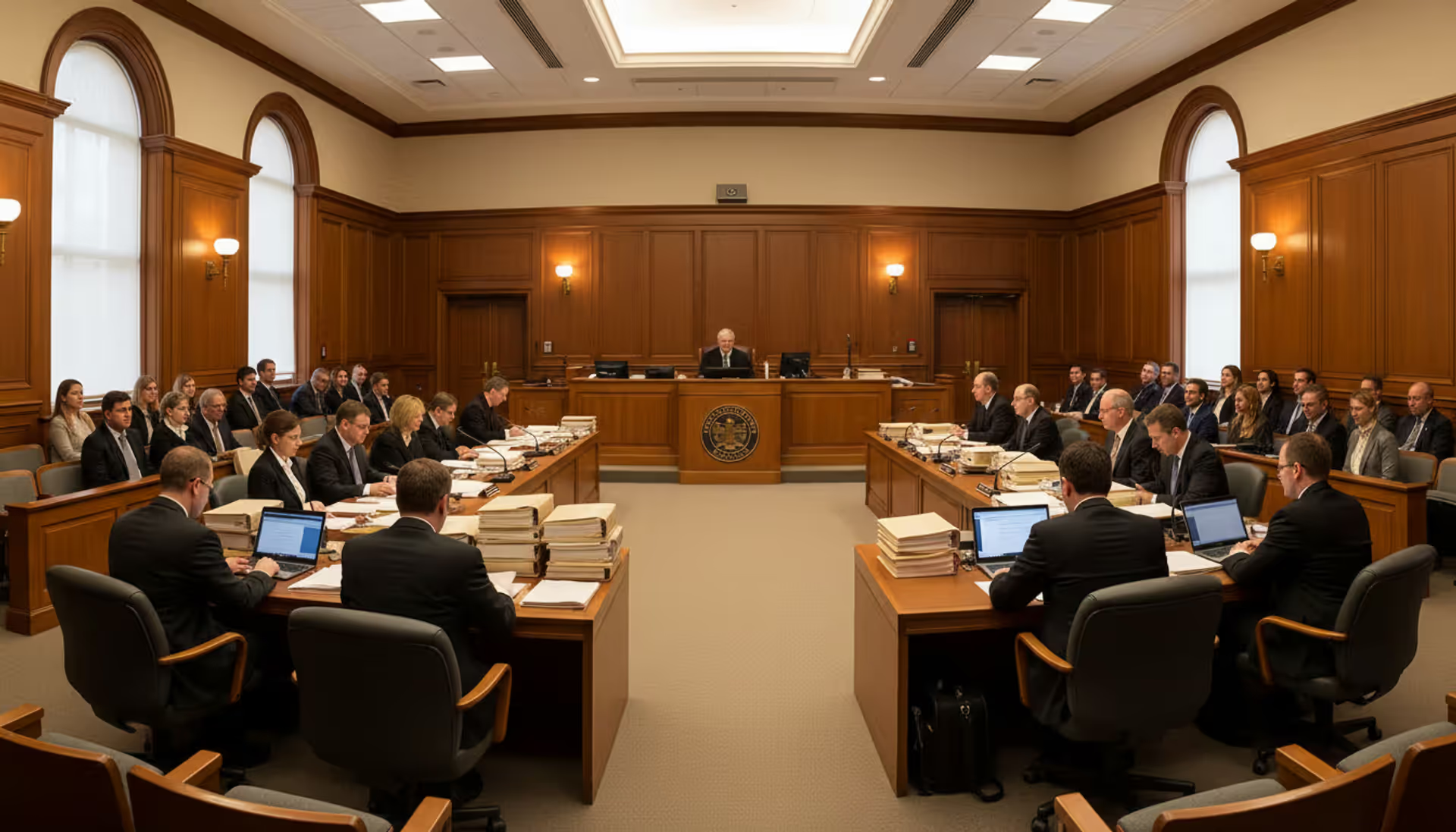
Modern conference room with three business professionals at a dark wood table during an arbitration hearing, folders and laptops on the table, city skyline visible through panoramic windows
Picture this: Your company just discovered a vendor violated your software licensing agreement. You're looking at potential losses exceeding $800,000. Now you've got two roads ahead—haul them into court for what could become a three-year public spectacle, or activate that arbitration clause buried in Section 12 of your contract. That choice? It'll reshape everything from your legal budget to whether your proprietary code gets discussed in open court filings.
What Is Commercial Arbitration?
Think of commercial arbitration as hiring a private judge. You and the other party pick one or more neutral experts—arbitrators—who'll listen to your evidence, examine your arguments, then hand down a decision you're both stuck with.
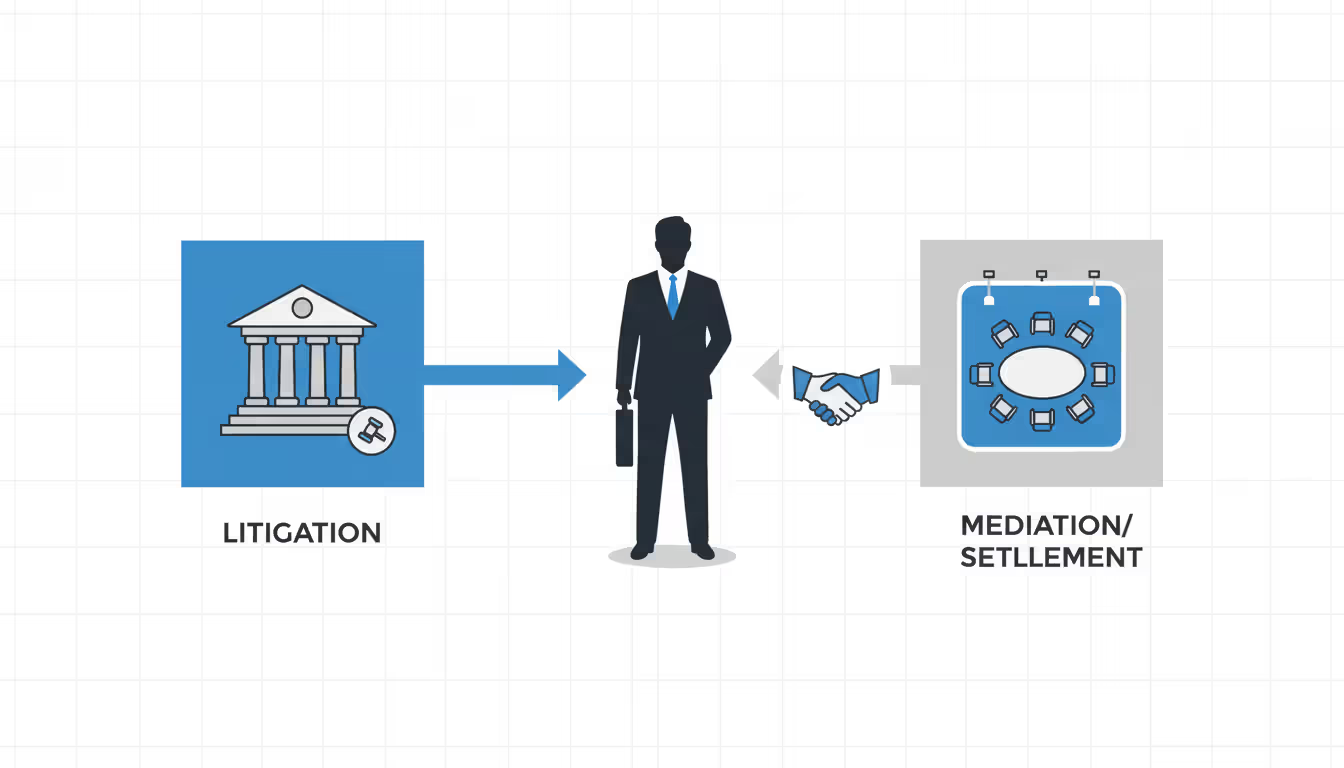
Here's where it differs from mediation: mediators help you negotiate. They suggest, they facilitate, but they don't impose. An arbitrator? They decide. You present your case, they rule, and that's typically the end of it.
This whole process kicks off from an agreement. Maybe you wrote an arbitration clause into your original contract back when everyone was friendly. Or perhaps you're agreeing to it now, mid-dispute, because neither side wants the courthouse drama. Either way, you're choosing a different path than traditional litigation.
Most business arbitration is binding. That ruling carries the same punch as a court judgment—you can enforce it, collect on it, and the losing party can't just walk away. Non-binding arbitration exists (where either side could theoretically ignore the result), but that's about as common in commercial disputes as a handshake deal for a $5 million transaction. Companies pursue arbitration precisely because they want closure, not another round of fighting.
Author: Andrew Bellamy;
Source: craftydeb.com
The disputes that land in arbitration run the gamut. Breach of contract cases. Partnership blowups where former friends are now adversaries. IP conflicts over who owns what technology. Cross-border trade disagreements. According to AAA data, their 2025 commercial caseload included claims as modest as $8,000 and as massive as $127 million. That range tells you something—arbitration scales.
What makes arbitration different from other dispute resolution options? It's adjudicative. Mediation needs both parties to agree on the outcome. Direct negotiation requires you to convince the other side. Arbitration works like court—someone with authority makes the call. The critical distinction is you're not bound by courtroom procedures, your dispute stays private, and you actually choose who decides your case.
How the Commercial Arbitration Process Works
Everything starts when someone files a demand for arbitration. If you're using AAA or another administrator, you submit it to them along with your filing fee. Independent arbitration (less common) means you send it straight to the other party. This demand spells out what happened, what you want, and why the arbitration clause applies.
Next comes arbitrator selection, and this matters more than most parties realize. Single-arbitrator setups work fine for straightforward disputes under half a million dollars. Three arbitrators make sense when you're dealing with complex issues or serious money. Here's what's brilliant about this: you get actual input. AAA sends you a list of potential arbitrators with their backgrounds. Maybe your construction defect case could go to someone who spent twenty years as a structural engineer before getting their law degree. Your SaaS contract dispute? Pick an arbitrator who understands technology licensing inside out.
Discovery looks nothing like litigation's document tsunami. Instead of spending six months deposing everyone remotely connected to the case and requesting every email since 2019, you're typically exchanging core documents and witness lists within a few weeks. Some arbitration agreements eliminate depositions entirely—just document production. This compression saves enormous time and money, but it requires laser focus on what evidence actually matters.
The hearing feels like a streamlined trial. Opening statements happen. Witnesses testify. You submit documents. Closing arguments wrap it up. But formal evidence rules? Mostly out the window. Arbitrators generally accept whatever's relevant and decide themselves what weight to give it. A simple contract dispute might wrap in a day. A multi-million-dollar claim involving dueling engineering experts could stretch across several weeks.
Author: Andrew Bellamy;
Source: craftydeb.com
After the hearing, arbitrators deliberate and draft their award. Unlike judges who write lengthy opinions explaining their reasoning, arbitrators often deliver just the bottom line—who won, how much they owe. Some agreements require "reasoned awards" with full explanations, but expect higher costs and longer wait times for those.
Timeline and Duration of Commercial Arbitration
You're typically looking at 6-12 months from filing to final award. Compare that to litigation's 2-4 year slog to trial. Smaller claims using AAA's Expedited Procedures often finish in 3-6 months. Complex multi-party disputes might stretch to 18 months, but that still beats courthouse timelines.
What affects speed? Arbitrator availability tops the list—experienced neutrals often book months ahead. Discovery scope matters (limited exchange moves faster than extensive requests). Hearing length makes a difference (one day versus multiple sessions spread across weeks). Geographic dispersion used to slow things down significantly, but virtual hearings have become standard since 2020. No more coordinating everyone's travel to Chicago for depositions.
AAA's Fast Track procedures apply to claims under $75,000 and mandate completion within six months of appointing the arbitrator. One arbitrator handles it. Discovery's minimal. The hearing can't exceed one day. For routine contract disputes where speed trumps exhaustive fact-finding, this structure delivers.
Understanding the Arbitration Award and Enforcement
The arbitration award is your final answer—a written document stating who won and what they're getting. Could be money damages. Could be specific performance. Could be a declaration of rights. Whatever it is, it's enforceable.
Here's how enforcement works: the winning party files the award with a court and requests confirmation. The court issues a judgment that can be executed like any other—bank levies, asset seizure, the whole collection toolkit. The Federal Arbitration Act sets up this framework and tells courts to treat arbitration awards with serious deference.
Author: Andrew Bellamy;
Source: craftydeb.com
Courts will overturn an award only in narrow circumstances. We're talking arbitrator corruption or fraud. Arbitrators exceeding their authority and ruling on something outside the arbitration agreement's scope. Denial of a fundamentally fair hearing. Notice what's missing? "The arbitrator got the law wrong" isn't grounds for vacatur. Neither is "the arbitrator misunderstood the facts." Courts won't second-guess the merits.
For international deals, the New York Convention (ratified by over 170 countries) requires member nations to recognize and enforce foreign arbitration awards. This makes arbitration invaluable for cross-border transactions. Try enforcing a Texas court judgment in Shanghai—good luck. An arbitration award? The Convention's got your back.
Common mistake: parties assume they can appeal like a court decision. Unless your arbitration agreement specifically creates an appellate arbitration process (a second panel reviews the first award), what you get is final. Some industries use appellate arbitration, but it's uncommon and adds both time and expense.
Commercial Arbitration vs Litigation
Choosing between arbitration and court involves real trade-offs that shift depending on your specific situation.
Factor
Arbitration
Litigation
Cost
Usually lower—compressed discovery and faster timelines cut attorney fees, though arbitrator fees add expense not present in court
Higher—extensive discovery battles, motion practice, and drawn-out proceedings pile up legal bills
Duration
6-12 months on average
2-4 years to reach trial
Privacy
Confidential—hearings and awards stay private unless you agree otherwise
Public record—court filings, hearings, and decisions accessible to anyone
Formality
Flexible procedures, relaxed evidence rules, streamlined process
Rigid procedural requirements, formal evidence standards, extensive motion practice
Appeal Rights
Minimal—awards rarely overturned except for fraud or arbitrator misconduct
Full appellate review—decisions can be appealed on legal and factual grounds
Enforceability
Smooth enforcement domestically and internationally under FAA and New York Convention
Domestic enforcement straightforward, international enforcement complex and uncertain
Let's get specific about costs. For a $200,000 contract dispute, arbitration might run $40,000-$70,000 total in legal fees plus arbitrator costs versus $100,000-$150,000 to litigate through trial. But here's the catch—complex cases needing extensive expert testimony and multiple hearing days can generate $50,000-$100,000 in arbitrator fees alone, narrowing that cost advantage considerably.
Privacy drives plenty of businesses toward arbitration. Trade secrets stay secret. Proprietary manufacturing processes don't appear in public filings. Sensitive financial information remains confidential. Companies worried about reputation damage or competitors learning their business strategies value this protection enormously.
The flip side? Limited appeal rights cut both ways. You get finality—no years of appellate litigation. But you also accept that an arbitrator's mistake, even an obvious misreading of contract language, will almost certainly stand. For disputes involving unsettled legal questions where you'd benefit from appellate court clarification, litigation might serve you better.
Arbitration works best for contract disputes between sophisticated parties, matters needing industry expertise, international transactions, and situations where privacy matters most. Litigation suits cases requiring extensive third-party discovery, disputes needing immediate injunctive relief, matters involving novel legal questions, and situations where appeal rights add value.
Author: Andrew Bellamy;
Source: craftydeb.com
AAA Commercial Arbitration Rules and Procedures
The American Arbitration Association handles thousands of commercial disputes annually using its Commercial Arbitration Rules (most recently updated in 2023). These rules provide comprehensive structure covering arbitrator selection through award issuance.
AAA acts as neutral administrator. They maintain arbitrator rosters, provide case management support, and ensure procedural compliance. You can specify AAA administration in your arbitration clause upfront or agree to it after a dispute emerges. They offer both in-person and virtual case management, with most hearings now conducted via secure video platforms.
Key AAA rule provisions worth knowing:
Arbitrator selection: You receive a list of potential arbitrators with detailed biographies showing their background and experience. Each side strikes unacceptable candidates and ranks their preferences. AAA appoints based on mutual rankings or, when no agreement emerges, makes the selection themselves.
Preliminary hearing: A case management conference establishes the hearing schedule, discovery parameters, and procedural ground rules early. This upfront structure prevents later disputes about process.
Discovery: The rules permit document exchange and depositions but give arbitrators discretion to limit scope. Many arbitrators restrict discovery to core documents and maybe one or two key depositions unless complexity demands more.
Expedited procedures: Automatically apply to claims under $75,000 unless parties opt out. You get one arbitrator, minimal discovery, a single hearing day, and a six-month completion deadline.
AAA fee structures vary by claim amount. Administrative fees start at $1,050 for claims under $10,000 and climb to $12,800 for claims exceeding $10 million, plus additional case service fees. Arbitrator compensation typically runs $3,000-$6,000 per hearing day and $300-$600 hourly for case review and award preparation. Three-arbitrator panels triple these costs.
AAA's International Centre for Dispute Resolution (ICDR) handles cross-border commercial disputes under specialized rules addressing multi-jurisdictional challenges, currency issues, and international enforcement complexities.
Alternative administering organizations include JAMS (Judicial Arbitration and Mediation Services), which emphasizes retired judges as arbitrators, and industry-specific bodies like FINRA for securities disputes. Each offers distinct advantages—JAMS arbitrators bring courtroom experience, while industry-specific panels provide deep sector knowledge.
Arbitration Clauses in Business Contracts
A well-drafted arbitration clause determines whether your process runs smoothly or devolves into preliminary litigation over whether arbitration even applies.
Essential elements you need:
Scope definition: Specify which disputes fall under arbitration. Broad language like "any dispute arising out of or relating to this agreement" captures most conflicts. Narrow language might exclude specific issues like intellectual property or injunctive relief. Choose strategically.
Administering organization: Name AAA, JAMS, or another administrator, or specify independent arbitration. Institutional administration provides structure and arbitrator selection support. Independent arbitration offers flexibility but requires parties to agree on procedures while they're fighting.
Number of arbitrators: One arbitrator cuts costs and speeds scheduling. Three arbitrators provide more deliberative review and suit high-stakes matters where you want multiple perspectives.
Arbitrator qualifications: Require specific expertise. "An arbitrator with at least ten years' experience in construction law" or "an arbitrator who is a licensed professional engineer." This ensures your decision-maker actually understands industry context.
Location: Specify the arbitration seat (legal jurisdiction governing the process) and hearing location. These can differ—the seat might be New York for its favorable legal framework while hearings occur in Chicago for convenience.
Procedural rules: Adopt AAA Commercial Rules, JAMS Comprehensive Rules, or create custom procedures. Custom rules allow tailoring to specific needs but risk ambiguity and enforcement issues.
Discovery limitations: Spell out whether depositions are permitted, document production scope, and interrogatory limits. Clear parameters prevent fights about discovery extent.
Confidentiality: Explicitly require confidentiality of proceedings, documents, and awards. Some jurisdictions imply it; others require express agreement.
Common drafting mistakes that'll cause headaches:
Inconsistent dispute resolution clauses: A contract requiring both arbitration and litigation creates ambiguity courts must untangle. Pick one.
Unenforceable arbitrator selection methods: Requiring parties to agree on an arbitrator without a fallback mechanism can deadlock if they cannot reach consensus (and they probably can't—they're in a dispute).
Unclear scope: Vague language about which disputes are arbitrable invites preliminary litigation over arbitrability itself, exactly what you're trying to avoid.
Inadequate cost allocation: Failing to specify who pays arbitrator and administrative fees creates disputes, particularly when one party significantly outweighs the other financially.
Sample clause that actually works: "Any dispute arising out of or relating to this Agreement shall be resolved by binding arbitration administered by the American Arbitration Association under its Commercial Arbitration Rules. The arbitration shall be conducted by one arbitrator selected in accordance with AAA procedures, shall take place in Dallas, Texas, and shall be governed by the Federal Arbitration Act. The arbitrator's award shall be final and binding, and judgment may be entered in any court of competent jurisdiction."
The greatest value of arbitration isn't just avoiding court—it's the ability to select a decision-maker who actually understands your industry and can cut through legal complexity to reach a commercially sensible result
— Thomas Stipanowich
Benefits and Drawbacks of Choosing Commercial Arbitration
Speed: Arbitration typically cuts resolution time in half compared to litigation. Compressed discovery and flexible scheduling allow faster progression from filing to award. For businesses needing quick resolution to salvage relationships or move forward with operations, this advantage matters significantly.
Cost savings: Reduced attorney time from shorter timelines and limited discovery generally outweighs arbitrator fees, particularly for mid-sized disputes. A $500,000 claim might cost $75,000 to arbitrate versus $150,000 to litigate, even accounting for arbitrator fees.
Expertise: Selecting an arbitrator with specific industry knowledge ensures your decision-maker understands technical context without needing extensive expert testimony. A pharmaceutical licensing dispute benefits enormously from an arbitrator familiar with FDA regulations and biotech business models rather than a generalist judge.
Confidentiality: Private proceedings protect trade secrets, business strategies, and reputational concerns. You avoid creating public records that competitors, media, or future litigation opponents could access.
Flexibility: You control procedural details—hearing schedules, discovery scope, evidence presentation format—allowing customization to your dispute's specific needs rather than one-size-fits-all court procedures.
International enforceability: The New York Convention makes arbitration awards far easier to enforce across borders than court judgments, critical for global commercial relationships.
But arbitration carries real disadvantages:
Limited discovery: Narrow discovery prevents full fact development, potentially disadvantaging parties who need extensive document review or multiple depositions to prove their case. Fraud claims often require broad discovery that arbitration severely limits.
Minimal appeal options: Arbitrator errors—even significant misapplications of controlling law—rarely justify vacating an award. You're accepting that a demonstrably wrong decision will likely stand because appeal rights barely exist.
Potential cost in complex cases: Multi-week hearings with three-arbitrator panels generate substantial fees. A $10 million dispute requiring 15 hearing days might incur $200,000 in arbitrator fees alone before you factor in administrative costs and attorney fees.
Limited injunctive relief: Arbitrators can issue preliminary relief, but enforcement requires court involvement anyway. Parties needing immediate injunctions often fare better heading straight to court.
Arbitrator bias concerns: Repeat players (parties who arbitrate frequently) may benefit from relationships with arbitrators who depend on appointments for income. Research on this "repeat player effect" shows mixed results, but the concern persists.
No precedent: Arbitration awards create no binding precedent, so you can't rely on consistent interpretation of similar contract language across cases. Every dispute starts fresh.
The choice depends on your specific circumstances. Companies valuing speed, privacy, and expertise over appeal rights and extensive discovery typically prefer arbitration. Those prioritizing thorough fact development, precedent-setting decisions, or preserving appeal options lean toward litigation.
Frequently Asked Questions About Commercial Arbitration
Can arbitration decisions be appealed?
Arbitration awards can be challenged in court only on very narrow grounds: arbitrator corruption or fraud, arbitrators exceeding their authority beyond the arbitration agreement's scope, denial of a fundamentally fair hearing, or arbitrator refusal to hear material evidence. Courts won't overturn awards just because the arbitrator misinterpreted contract language or reached what you believe is a factually incorrect conclusion. Some arbitration agreements include appellate arbitration provisions allowing a second panel to review the initial award, but this remains uncommon and adds considerable time and expense.
Is commercial arbitration legally binding?
Yes—when parties agree to binding arbitration (the standard form in commercial contexts), the arbitrator's award carries the same legal force as a court judgment. The winning party files the award with a court to obtain a judgment, which can then be enforced through standard collection mechanisms like bank levies, asset seizure, or wage garnishment. The Federal Arbitration Act requires courts to enforce arbitration awards with minimal review, giving them strong legal effect that's difficult to challenge.
How much does commercial arbitration cost?
Total costs vary dramatically based on claim size, complexity, and whether you've got one or three arbitrators. A straightforward $100,000 contract dispute with one arbitrator might cost $30,000-$50,000 combining legal fees, arbitrator compensation, and administrative charges. A complex $5 million case with three arbitrators and multiple hearing days could reach $200,000-$400,000. AAA administrative fees range from roughly $1,000 to $13,000 depending on claim amount. Arbitrators typically charge $3,000-$6,000 per hearing day and $300-$600 hourly for case review and award drafting. Attorney fees follow similar hourly rates as litigation but accumulate over a compressed timeframe.
How long does the commercial arbitration process take?
Most commercial arbitrations conclude within 6-12 months from filing to final award. Simple cases under expedited procedures may finish in 3-6 months. Complex multi-party disputes can extend to 18 months. Timeline depends heavily on arbitrator availability (busy neutrals book months ahead), discovery scope, and hearing length. Virtual hearings have dramatically reduced scheduling delays since parties no longer coordinate travel logistics. Compare this to litigation's typical 2-4 year journey to trial.
What's the difference between AAA and other arbitration providers?
The American Arbitration Association is the largest commercial arbitration administrator in the United States, offering comprehensive rules, extensive arbitrator rosters, and established procedures refined over decades. JAMS emphasizes retired judges as arbitrators, providing parties with decision-makers who have courtroom experience and judicial temperament. Industry-specific organizations like FINRA handle specialized disputes (securities in FINRA's case) with arbitrators possessing deep sector knowledge. The choice depends on your preferences for arbitrator background, procedural rules, and administrative support level. AAA suits general commercial disputes. JAMS appeals to parties wanting judicial experience. Industry bodies fit specialized conflicts where sector expertise matters most.
What should every arbitration clause include?
At minimum, specify: (1) scope of disputes subject to arbitration (broad or narrow), (2) number of arbitrators (one or three), (3) administering organization or independent arbitration, (4) arbitration location and seat, (5) governing procedural rules, and (6) confirmation that the award is binding and enforceable in court. Consider adding: arbitrator qualification requirements (industry experience, technical background), discovery limitations (document-only or depositions permitted), confidentiality requirements (explicit protection), cost allocation (who pays what), and timeline expectations (completion deadlines). Clear drafting prevents disputes about the arbitration process itself and ensures courts will enforce your clause.
Commercial arbitration gives businesses a practical alternative to traditional litigation—trading courtroom formality and appeal rights for speed, privacy, and expert decision-making. The process delivers best results when parties understand its mechanics, draft clear arbitration clauses, and align their dispute resolution choice with their specific business priorities.
Success starts long before any dispute emerges. Thoughtful contract drafting that specifies arbitrator qualifications, procedural parameters, and scope of arbitrable disputes prevents preliminary battles over process. Evaluate whether you value quick, confidential resolution over extensive discovery and appeal rights, then structure your arbitration agreements to match those priorities.
When disputes do arise, strategic choices about arbitrator selection, discovery scope, and evidence presentation significantly impact outcomes. Unlike litigation's rigid procedures, arbitration's flexibility allows you to tailor the process to your dispute's unique characteristics—but only if you actively exercise that control rather than accepting default approaches.
The enforcement advantages of arbitration awards, particularly in international contexts, make this mechanism especially valuable for companies engaged in cross-border commerce. The New York Convention's broad reach ensures that an arbitration award issued in Texas can be enforced in Tokyo or London far more easily than a court judgment could be.
As business relationships grow more complex and global, commercial arbitration's role in dispute resolution continues expanding. Companies that master its strategic use—knowing when to include arbitration clauses, how to draft them effectively, and how to navigate the process efficiently—gain significant advantages in managing commercial conflicts while preserving business relationships and protecting confidential information
Trade libel protects businesses when false statements harm their products or services. Unlike personal defamation, commercial disparagement requires proving specific economic losses. Understand the legal elements, filing process, and protection strategies for your business.
Securities fraud undermines capital markets through deceptive practices in securities transactions. This guide explains legal elements, common fraud types including insider trading and Ponzi schemes, SEC enforcement mechanisms, civil and criminal penalties, and how investors can file claims
Securities class actions allow investors to collectively sue companies for securities fraud. Learn how these lawsuits work, who qualifies, legal requirements under Rule 10b-5, the settlement process, and common mistakes investors make when participating in shareholder class actions
Franchise relationships can become strained when expectations diverge or contractual obligations go unmet. Understanding the legal mechanisms available for resolving conflicts—from mediation to arbitration to litigation—is essential before tensions escalate into costly legal battles
The content on this website is provided for general informational and educational purposes only. It is intended to explain concepts related to business and corporate law, contracts, compliance, disputes, M&A, and taxation for companies.
All information on this website, including articles, guides, and examples, is presented for general educational purposes. Legal outcomes may vary depending on jurisdiction, company structure, and individual circumstances.
This website does not provide legal advice, and the information presented should not be used as a substitute for consultation with qualified corporate attorneys or legal professionals.
The website and its authors are not responsible for any errors or omissions, or for any outcomes resulting from decisions made based on the information provided on this website.