Last month, a contractor I know lost $45,000 because he signed what looked like a simple property purchase contract without reading page 23. Buried in there? A clause that let the seller keep his entire deposit if financing fell through—even though he'd explicitly been promised the opposite during negotiations.
Most six-figure transactions in the U.S.—that warehouse in the industrial park, the dry cleaning business on Main Street, the dental practice someone spent twenty years building—all change hands through purchase and sale agreements. Some people call them PSAs. Others just say "the contract." Either way, this single document controls everything about your deal.
The part nobody mentions until it's too late? Your email threads and verbal promises mean absolutely nothing once you sign. Courts don't care what the seller told you over coffee.
What Is a PSA Agreement?
A PSA—short for Purchase and Sale Agreement—spells out the exact terms of transferring ownership from one party to another. You're stating the purchase price. You're setting the closing date. You're documenting who handles what if problems surface before money changes hands.
Here's what makes these contracts different from casual promises: they create obligations that judges will enforce. When a buyer tried backing out of a $1.2 million equipment purchase in Delaware last year, citing "changed circumstances," the court forced him to complete the transaction anyway. His signed PSA left no wiggle room.
The psa contract meaning comes down to this—it's your legally binding roadmap from initial agreement through final ownership transfer.
These agreements pop up everywhere:
Real estate deals: Commercial properties almost never change hands without detailed PSAs addressing environmental assessments, existing tenant leases, property tax prorations, and about fifteen other items that can derail a closing. Residential transactions use them too, though they're usually simpler.
Business purchases: When Maria bought that pet grooming franchise in Austin, her purchase and sale agreement covered the grooming tables and dryers (obviously), but also the customer database, social media accounts, supplier relationships, and the seller's promise not to open a competing business within ten miles for three years.
Intellectual property transfers: A software developer selling a mobile app needs a PSA explaining whether they're transferring the source code, who handles ongoing bug fixes, what happens to revenue from existing users, and whether the original developer can build similar apps later.
Who actually signs? The buyer and seller, naturally. But expect other parties at closing. Your lender needs signatures to release loan funds. The escrow company holding your earnest money deposit wants authorization to disburse it. If you're buying a business that leases its location, the landlord often must approve the lease transfer. Guarantors who promise to cover the buyer's obligations if they default also sign their lives away.
A verbal contract isn't worth the paper it's written on
— Samuel Goldwyn
Key Components of a Purchase and Sale Agreement
Certain elements show up in essentially every PSA worth the paper it's printed on.
Purchase price looks simple—$875,000, done—until you examine how that money actually moves. One buyer structures it as $200,000 down, $100,000 from an SBA loan, $500,000 in seller financing at 6.5% interest over seven years, plus $75,000 held in escrow for eighteen months to cover potential indemnification claims. Another wires the full amount at closing. Completely different risk profiles.
Closing dates create deadlines that drive the entire transaction timeline. "On or before August 15, 2024" gives you a target. Smart PSAs include extension language—maybe two automatic 15-day extensions if you're waiting on municipal permits or lender approvals. Miss your outside deadline without an approved extension? The seller can terminate and pocket your deposit.
Contingencies function as your safety net. They're specific conditions that must be satisfied before you're obligated to close. A buyer might include:
Obtaining a loan commitment for at least 75% of the purchase price at interest rates below 8.5% by June 1
Environmental Phase I report showing no recognized environmental conditions requiring remediation exceeding $25,000
Inspection revealing no deferred maintenance or required repairs costing more than $15,000
Current business revenue verified at no less than 90% of seller's represented figures
Fail to satisfy a contingency? You terminate the agreement and get your deposit back.
Representations and warranties are promises about current facts. The seller swears "the roof was replaced in 2021 and has no known leaks" or "the business owns all equipment free and clear of liens." Buyers make representations too—usually about having sufficient funds and legal authority to complete the purchase. Break a representation? You've committed breach of contract, opening yourself to lawsuits.
Indemnification provisions establish who compensates whom when specific problems arise. Imagine buying a business, then discovering six months later that the previous owner failed to pay $80,000 in payroll taxes. If the seller indemnified you against pre-closing tax liabilities, you can demand they pay that $80,000 bill plus any penalties and your attorney fees fighting the IRS.
Author: Andrew Bellamy;
Source: craftydeb.com
Essential Purchase and Sale Agreement Clauses
The difference between a bulletproof PSA and one full of holes often comes down to these provisions.
Due diligence windows: You need time to investigate what you're actually buying. Commercial real estate typically allows 45-90 days. Business acquisitions might give you 60-120 days to review tax returns, interview employees, verify revenue claims, and assess equipment condition. Negotiate for a "free look" period early on—maybe the first 30 days—where you can terminate for any reason or no reason at all.
Title and survey specifications: Real estate PSAs demand ALTA surveys meeting 2021 standards and title insurance policies with only approved exceptions. Your title commitment might reveal that an adjacent property owner claims a prescriptive easement across your parking lot. That's grounds to demand the seller fix it or reduce the price.
Risk of loss allocation: A fire destroys half the building three weeks before closing. Who pays for repairs—you or the seller? Most purchase and sale agreement clauses keep this risk with the seller until the deed transfers, though some shift it to buyers once they waive their inspection contingency.
Dispute resolution procedures: Litigation can cost $200,000+ before you even get to trial. Many PSAs require mediation first, then binding arbitration if mediation fails. These clauses also specify governing law—New York law treats certain contract provisions differently than California law does.
Assignment restrictions: Can you sign a PSA, then flip your contract rights to another buyer before closing and pocket a quick $50,000? Not unless the agreement explicitly permits assignment. Most sellers prohibit this or require written consent for any assignment.
Standard PSA Contract Terms and Conditions
Attorneys call this "boilerplate," but these provisions carry serious weight.
Merger clauses state that your written PSA represents the complete agreement between parties. That seller's verbal assurance about including the riding lawnmower? Doesn't count unless it's written in the contract. Courts consistently enforce merger clauses, refusing to consider outside promises or prior draft versions.
Severability provisions ensure that if a judge strikes down one clause as unenforceable—maybe an overly broad non-compete restricting the seller from working anywhere in the entire state for ten years—the rest of your agreement survives.
Notice requirements dictate exactly how you communicate important messages. Your PSA might require all notices via email to specific addresses with receipt confirmation, or certified mail return receipt requested. Send your financing contingency termination notice by text message instead? The seller might successfully argue they never received proper notice, trapping you in the deal.
"Time is of the essence" language removes flexibility on deadlines. Without this phrase, courts might excuse a two-day delay as immaterial. Include it, and missing a deadline by even six hours can constitute breach—potentially costing you your entire deposit.
How PSA Agreements Work in Different Transactions
Every deal follows a similar pattern, though timelines compress or expand based on complexity.
Initial negotiation and LOI stage: Most substantial deals start with a letter of intent before anyone drafts the full PSA. This 2-4 page document outlines basics—$1.8 million purchase price, buyer's $90,000 earnest money deposit, 75-day due diligence period, seller financing for $400,000. The LOI typically makes only exclusivity (seller won't negotiate with other buyers for 60 days) and confidentiality binding. The actual purchase remains non-binding until you sign the definitive PSA.
Drafting and legal review: Usually the seller's attorney produces the first PSA draft. Expect it to favor the seller—limited warranties, tight contingency deadlines, caps on indemnification. The buyer's lawyer marks it up with revisions, broadening protections and extending timeframes. After four to six rounds of back-and-forth over two to eight weeks, you reach an agreed version.
Execution and earnest money: Once all parties sign, the buyer wires earnest money to escrow—typically 3-5% of the purchase price for commercial property, sometimes 10% for business acquisitions. This money sits in a trust account proving you're serious while earning interest (usually credited to you at closing).
Due diligence phase: Now you're really digging. Hire inspectors to examine the property. Review ten years of financial statements. Interview key employees and major customers. Run environmental assessments. For a business purchase, you might discover the seller inflated EBITDA by counting personal expenses as one-time adjustments. For real estate, you might find the "fully occupied" building actually has two tenants on month-to-month leases planning to vacate.
Contingency decisions: As deadlines approach, you're making firm choices. Waive your financing contingency even though your lender hasn't issued a final commitment? Risky—if financing falls through later, you'll lose your deposit. Waive inspection despite finding $12,000 in necessary repairs? You're accepting that cost as yours to bear.
Closing preparation: The final 30 days feel chaotic. Attorneys are drafting bills of sale, deeds, assignment agreements, promissory notes, and security documents. Title companies are resolving minor exceptions. You're coordinating fund transfers with your bank. The seller is gathering door codes, security system passwords, vendor contracts, and equipment manuals.
Closing day and beyond: At a typical commercial closing, you'll sign 20-30 documents, wire anywhere from $300,000 to millions, and receive keys plus access to what you just bought. But your PSA obligations continue. Indemnification provisions typically survive 18-36 months post-closing. Earn-out payments might extend three to five years. Non-compete restrictions could run two to five years.
Actual timelines vary wildly. A straightforward office condo purchase might close in 35 days. A multi-tenant retail property could take 150 days. Buying a regulated business requiring state licensing approval—like a pharmacy or cannabis dispensary—might stretch nine months.
PSA vs Asset Purchase Agreement: Understanding the Differences
Terminology matters more than most people realize, especially when buying businesses.
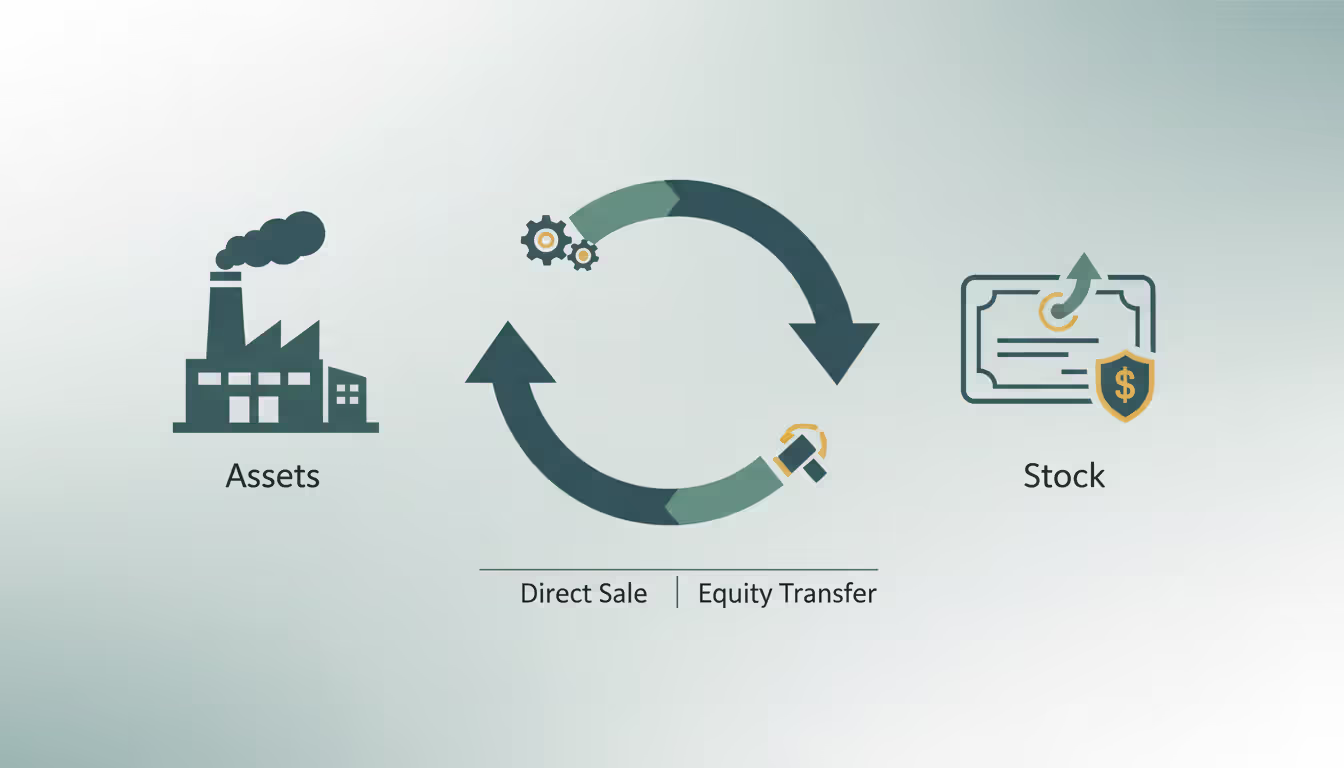
Sometimes people use "PSA" and "asset purchase agreement" interchangeably. They're related but not identical. A generic PSA can cover any asset transfer—a house, a boat, mining equipment. An asset purchase agreement specifically refers to cherry-picking selected parts of a business without buying the legal entity itself.
This distinction creates massive practical differences compared to stock purchase agreements.
Transaction Type
What's Transferred
Liability Treatment
Common Use Cases
Tax Implications
General PSA
Specific assets like real property, vehicles, equipment, or single-item purchases
Buyer assumes only liabilities explicitly listed in the contract; everything else stays with seller
Real estate closings, equipment sales, vehicle transfers, single-asset deals
Varies by asset type; investment real estate may qualify for Section 1031 tax-deferred exchanges; equipment generates depreciation deductions
Asset Purchase Agreement
Selected business components: machinery, inventory, intellectual property, customer lists, goodwill, specific contracts
Buyer chooses which liabilities to assume (typically only clearly specified ones like assumed leases); seller keeps everything else including unknown claims, old lawsuits, pension obligations, environmental cleanup responsibilities
Buying part of a business, acquiring distressed companies while avoiding legacy problems, situations where undisclosed liabilities create major concerns
Buyer receives stepped-up tax basis in acquired assets enabling larger future depreciation; seller often faces double taxation—corporate tax on asset sale plus shareholder tax on distributions
Stock Purchase Agreement
Ownership shares in the business entity itself, which continues unchanged
Buyer inherits everything the company owns and owes—all disclosed and undisclosed liabilities transfer automatically
Acquiring entire operating companies, preserving contracts that don't transfer easily, maintaining licenses tied to the entity, avoiding customer confusion
Seller receives favorable long-term capital gains treatment (potentially 15-20% federal rates); buyer gets no basis step-up and inherits the company's existing tax basis in assets
The psa vs asset purchase decision can swing deal value by $100,000+ on a $1 million transaction.
Consider buying a small manufacturing business. Structure it as an asset purchase, and you acquire the CNC machines, customer contracts, and proprietary processes while explicitly refusing to assume the environmental liability from 1990s chemical spills. The seller keeps that $400,000 cleanup obligation.
Try achieving the same liability protection through a stock purchase? Impossible. Buy the shares, and every liability transfers automatically—even ones you don't know about.
Liability considerations often drive deal structure more than price. A buyer interested in an automotive repair business discovered during due diligence that a former employee filed a wrongful termination lawsuit seeking $1.5 million. Asset purchase structure meant the buyer acquired the equipment and hired the employees through a new company, leaving the lawsuit as the seller's problem. Stock purchase would have transferred the lawsuit along with everything else.
Tax treatment creates another fork in the road with real financial impact. Asset purchases let buyers step up their tax basis in acquired assets to fair market value. You're buying $600,000 in machinery the seller fully depreciated over fifteen years? Your basis becomes $600,000, creating substantial future depreciation deductions worth potentially $150,000+ in tax savings over five to seven years. Sellers pay for this buyer benefit through less favorable tax treatment—corporate-level tax on asset gains plus individual capital gains tax on distributions.
Stock sales flip this entirely. Sellers enjoy clean capital gains treatment at favorable rates. Buyers receive no basis adjustment and inherit the seller's lower depreciated basis, generating smaller future tax deductions.
Author: Andrew Bellamy;
Source: craftydeb.com
Definitive Purchase Agreement Structure and Negotiation
You'll hear "definitive purchase agreement" frequently in deal discussions. It distinguishes the final binding contract from preliminary negotiations.
Your LOI probably states "this letter of intent is non-binding except for Sections 4 (Exclusivity) and 6 (Confidentiality)." That's because it's not yet the definitive agreement—just a framework. The comprehensive PSA that follows creates full binding obligations.
Purchase agreement structure in definitive PSAs follows predictable organization:
Recitals section: Those "WHEREAS" clauses at the beginning provide context. "WHEREAS, Seller operates a commercial printing business at 2240 Commerce Street generating approximately $2.4 million in annual revenue..." Courts sometimes reference recitals when contract language elsewhere seems ambiguous.
Definitions article: This section often runs 8-12 pages, precisely defining every capitalized term. "Material Adverse Effect," "Working Capital Target," "Permitted Encumbrances," "Knowledge of Seller"—exact definitions prevent fights later. When your contract says "Working Capital shall not fall below the Target," you need to know whether that's $180,000 or $420,000.
Purchase and sale mechanics: The core deal terms—purchase price of $2.7 million, earnest money of $135,000 due within two business days of execution, closing scheduled for October 30, 2024, with two automatic 15-day extensions if lender approval is pending.
Representations and warranties: Often the longest section in business acquisition PSAs—sometimes 20-30 pages for complex deals. Sellers represent everything from "the financial statements present fairly the business's financial condition in accordance with GAAP" to "no employee earns more than $100,000 annually" to "all equipment is in good working order."
Covenants and conduct provisions: Promises about future behavior between signing and closing. Sellers typically covenant to operate the business normally—no selling major assets, firing key employees, or changing vendor terms. Buyers might covenant to maintain confidentiality about sensitive information and use reasonable efforts to obtain financing.
Closing conditions: A checklist that must be satisfied before closing occurs. "No material adverse change affecting the business," "Seller obtains landlord consent to lease assignment," "All seller representations remain accurate," "Buyer receives required licenses."
Indemnification mechanics: Who compensates whom for what losses, subject to what limitations? These provisions address baskets (claims under $20,000 don't count toward the threshold), deductibles (buyer absorbs the first $20,000 of total losses), caps (seller's maximum exposure limited to $400,000), and survival periods (indemnification rights expire 24 months after closing for general reps, 48 months for tax matters).
Termination provisions: Circumstances allowing either party to walk away. Buyers can terminate if contingencies aren't satisfied. Either party can terminate if closing doesn't happen by the outside date. Sellers might terminate if buyers fail to deposit earnest money or breach material covenants.
Miscellaneous provisions: The standard clauses that matter more than their placement suggests—governing law (Delaware versus New York creates real differences), amendment procedures (must be written and signed), waiver provisions (waiving one breach doesn't waive future breaches), counterpart signatures (electronic signatures binding).
Negotiation strategies depend heavily on who has leverage.
In competitive bidding scenarios, sellers control the process. They might demand 10% earnest money instead of 3%, 30-day contingency periods instead of 60 days, and limited representations with broad knowledge qualifiers. Buyers lacking competition can push for comprehensive reps, extended due diligence windows, and favorable indemnification.
Common negotiation battlegrounds include:
Earnest money deposits: Sellers want larger deposits—more compensation if buyers breach after contingencies expire. Buyers resist, preferring to keep funds liquid and reduce at-risk capital.
Contingency breadth: Buyers want subjective financing contingencies ("buyer must obtain financing on terms satisfactory to buyer"). Sellers demand objective standards ("buyer must obtain at least $1.4 million at interest rates not exceeding 8.75% with standard commercial terms").
Rep and warranty scope: Sellers try limiting reps to critical items and qualifying everything with knowledge ("to Seller's actual knowledge without investigation, no environmental violations exist"). Buyers want absolute unqualified representations covering every business aspect.
Indemnification structure: Sellers negotiate caps limiting total exposure to 30-40% of purchase price and $40,000 baskets before any claims get paid. Buyers push for dollar-one coverage on certain reps (taxes, environmental) and caps at 100% of purchase price.
Non-compete terms: Buyers purchasing businesses want sellers barred from competing for four to five years within a broad geographic area. Sellers negotiate narrow restrictions—perhaps a 15-mile radius or only the specific product line being sold, not related businesses.
Author: Andrew Bellamy;
Source: craftydeb.com
Attorney involvement isn't optional unless you enjoy expensive mistakes. Your neighbor who does estate planning can't competently review a $3 million business acquisition PSA. You need transactional lawyers who've closed fifty similar deals and know where problems hide.
Legal fees sting—$6,000 to $12,000 for simpler commercial real estate, $20,000 to $80,000+ for business acquisitions, occasionally $150,000+ for complex deals. But weigh that against the alternative. One missed indemnification provision could expose you to $300,000 in undisclosed liabilities. One vague contingency might trap you in a terrible deal with no exit and a forfeited $100,000 deposit.
Common Mistakes and How to Avoid Them
Even sophisticated buyers and sellers make PSA mistakes that create six-figure problems.
Vague descriptions of included assets: "All restaurant equipment" sounds comprehensive until the seller removes the $15,000 commercial ice maker, claiming it was actually leased equipment. Fix this by attaching detailed schedules listing every included item—Hobart commercial dishwasher model XYZ, serial number 12345, plus photographs if possible. Or explicitly list exclusions if that's shorter.
Inadequate contingency protection: A buyer waived all contingencies to win a bidding war, then discovered during final walk-through that the HVAC system was completely non-functional. No contingency meant no exit without forfeiting the $65,000 deposit. Better approach: negotiate longer contingency periods rather than eliminating them, or at minimum retain a final inspection contingency even after waiving financing and other conditions.
Rushed due diligence: Thirty days isn't enough to properly investigate a business with 25 employees, three locations, complex inventory management, and multiple supplier contracts. Yet buyers agree to compressed timeframes under seller pressure, then miss critical problems like a major customer planning to leave. Request 75-90 days for complex transactions. Start investigations the day you sign rather than waiting three weeks.
Ambiguous closing conditions: "Property must be delivered in clean condition" triggered a nasty closing-day fight about whether the seller needed to shampoo carpets and wash windows or simply remove trash and the old furniture. Replace subjective standards with measurable ones: "Seller must remove all personal property, debris, and trash; professionally clean all floors, carpets, and windows; and leave all systems in working order as verified by buyer's inspector."
Title problems discovered late: Finding a $120,000 federal tax lien on the property four days before closing creates chaos and potential deal failure. Require preliminary title commitments within seven to ten days of execution. Build specific provisions addressing which exceptions you'll accept (standard utility easements, recorded CC&Rs) versus which require cure (all mortgages, judgment liens, mechanics liens, tax liens).
Ignoring tax structure: A buyer structured a $1.6 million business purchase as a stock deal without consulting a CPA first. Later realized they overpaid by approximately $120,000 in deal value compared to an asset structure that would have generated tax savings offsetting a slightly higher purchase price. Engage tax advisors before finalizing deal structure—before you sign the LOI, ideally.
Missing third-party consent requirements: A buyer signed a PSA to purchase a franchised hotel, only learning later that the franchisor's consent process required 120 days, a $45,000 transfer fee, and facility upgrades costing $200,000. The PSA's 75-day closing deadline made compliance impossible. Review all contracts, licenses, leases, and permits during initial diligence to identify required consents, then make closing expressly conditional on obtaining them.
Author: Andrew Bellamy;
Source: craftydeb.com
Frequently Asked Questions About PSA Agreements
How long does a PSA agreement remain valid?
Most PSAs include an outside closing deadline—commonly 90 to 120 days from signing. If closing hasn't occurred by that date, either party can typically terminate without penalty. Some agreements stay in effect indefinitely until closing happens, but that creates unnecessary risk and uncertainty. During the agreement's active period before closing, all provisions remain fully enforceable. After closing occurs, most executory obligations end, but certain commitments continue: indemnification rights commonly survive 18-36 months post-closing, non-compete covenants might run three to five years, and earn-out payment obligations could extend three to five years based on future business performance.
Can you cancel a purchase and sale agreement?
Your ability to cancel depends entirely on whether you have contractual grounds. During contingency periods, buyers can walk away by properly exercising contingency rights—"I'm terminating pursuant to Section 4.2 because my lender denied financing" or "I'm terminating under the inspection contingency because structural issues exceed the $20,000 threshold." You'll recover your earnest money. After contingencies expire, canceling without seller consent typically constitutes material breach. You'll forfeit your deposit and potentially face additional liability if seller's damages exceed the deposit amount. Sellers have narrower cancellation rights—usually only when buyers breach obligations or fail to perform required acts. Mutual agreement allows cancellation anytime both parties consent, though getting the other side's agreement when you want out usually requires financial concessions.
What happens if contingencies aren't met in a PSA?
You've got three options. First, terminate the agreement under the contingency and recover your deposit—that's your clean exit. Second, waive the unsatisfied contingency and proceed anyway, accepting whatever risk or issue the contingency was meant to protect against. Third, propose renegotiation. Maybe your inspection revealed $40,000 in needed roof repairs. You might propose reducing the purchase price by $40,000, having the seller complete repairs before closing, or creating an escrow holdback to cover the work post-closing. The PSA typically requires written notice about unsatisfied contingencies within specific timeframes—often three to five business days before the contingency deadline expires. Miss that notification deadline? Many PSAs treat silence as automatic waiver, meaning you've lost your right to invoke that contingency as an exit mechanism.
Do I need an attorney to review a PSA agreement?
Legally required? No—in most states you can sign any contract you want without legal counsel. Practically advisable? Absolutely yes for anything beyond the simplest transactions. PSAs create six or seven-figure financial obligations with complex legal implications that non-lawyers routinely misunderstand. Attorneys spot unfavorable provisions you'd never notice, negotiate protective terms, ensure the written agreement matches your actual business understanding, and draft additional documents needed at closing. For residential real estate, expect $1,200-$2,500 in legal fees. Commercial property transactions run $4,000-$15,000. Business acquisitions justify $12,000-$100,000+ depending on complexity and deal size. Think of it as insurance—you're paying thousands to avoid potentially hundreds of thousands in losses from poorly structured agreements or missed red flags.
What's the difference between a PSA and a letter of intent?
An LOI is preliminary negotiations documented in writing; the PSA is your binding commitment. Letters of intent typically run two to four pages covering high-level business terms—$1.5 million purchase price, $75,000 earnest money, 60-day due diligence period, seller financing for $300,000 at 7% interest. Critically, most LOIs explicitly state the transaction itself remains non-binding. Only specific provisions create binding obligations—usually exclusivity (seller can't shop the deal for 45-60 days), confidentiality, and expense allocation. The PSA is the comprehensive, fully binding contract—often 30-80 pages with detailed provisions, lengthy schedules, and multiple exhibits. Once you sign a PSA, you're legally committed subject only to the specific contingencies and termination rights spelled out in that contract. Courts will enforce PSAs but generally refuse to enforce LOI provisions about the transaction itself.
Are earnest money deposits required in all PSA agreements?
Required by law? No statute mandates earnest money. Expected by sellers in practice? Almost always, with some exceptions. Residential real estate PSAs typically demand 1-3% deposits. Commercial property deals expect 3-5%, sometimes 10% for highly competitive properties. Business acquisition PSAs commonly require 5-10% earnest deposits. The earnest money serves two functions: demonstrating serious buyer intent (sellers view no-deposit offers as less credible) and providing sellers partial compensation if buyers breach after contingencies expire. Some situations proceed without deposits—sales between related parties, certain equipment purchases, or transactions where desperate sellers lack negotiating leverage to demand them. But proposals without earnest money usually receive less favorable treatment during negotiations. Sellers question whether you're actually committed and often demand other concessions—shorter contingency periods, limited representations, or higher purchase prices—to compensate for the missing deposit security.
Purchase and sale agreements determine whether your transaction closes smoothly or explodes into expensive litigation costing more than the deal itself.
Strong agreements share common characteristics. They define terms precisely. They address foreseeable problems explicitly rather than hoping issues won't arise. They balance risk fairly while providing clear remedies when someone breaches.
Get the fundamentals right—purchase price mechanics, contingency structures, representation scope, indemnification frameworks. Understand how these elements interact throughout the deal lifecycle from signing through post-closing obligations.
Recognize when you need a general PSA versus an asset purchase agreement versus a stock purchase structure. Each creates different tax consequences and liability exposure potentially swinging net deal value by 15-25%.
Avoid the traps that sink deals. Build adequate due diligence time into your schedule. Define objective, measurable closing conditions instead of vague standards. Order title commitments early. Consult tax advisors before finalizing structure. Identify required third-party consents upfront.
Most important: engage experienced transactional counsel before signing anything. The $8,000 you spend on proper attorney review prevents the $250,000 loss from poorly drafted indemnification provisions, missed environmental liabilities, or ambiguous terms that blow up at closing.
Your PSA isn't just paperwork—it's your protection when things go wrong. Treat it that way, and you'll close more deals successfully while avoiding the disputes that plague transactions built on inadequate agreements.
An LLC operating agreement is a legally binding document that outlines ownership structure, management procedures, and operational rules. While only some states require it, this internal document strengthens liability protection, prevents disputes, and satisfies banks and investors
Master Service Agreements establish reusable legal frameworks for ongoing vendor relationships. Discover how MSAs work, essential clauses, negotiation strategies, and when to use master agreements versus individual contracts for your business needs
A transition services agreement (TSA) is a contract where the seller provides operational services to the buyer post-closing. This guide covers TSA fundamentals, contract terms, duration, negotiation strategies, and post-merger management for successful M&A transitions
A side letter is a separate agreement that modifies or supplements a main contract, commonly used in private equity and investment funds. This guide explains side letter provisions, enforceability, negotiation tactics, and how they differ from primary agreements
The content on this website is provided for general informational and educational purposes only. It is intended to explain concepts related to business and corporate law, contracts, compliance, disputes, M&A, and taxation for companies.
All information on this website, including articles, guides, and examples, is presented for general educational purposes. Legal outcomes may vary depending on jurisdiction, company structure, and individual circumstances.
This website does not provide legal advice, and the information presented should not be used as a substitute for consultation with qualified corporate attorneys or legal professionals.
The website and its authors are not responsible for any errors or omissions, or for any outcomes resulting from decisions made based on the information provided on this website.