Modern office team of professionals standing before a large transparent digital screen displaying abstract neural network patterns and a glowing shield symbol representing AI regulation and compliance
Artificial intelligence has moved from experimental technology to core business infrastructure. Companies now deploy AI systems for hiring decisions, credit approvals, medical diagnoses, and customer service—applications that directly affect people's lives and livelihoods. This shift has triggered a regulatory response worldwide, creating a complex compliance landscape that businesses must navigate carefully.
The stakes are high. Companies face potential penalties ranging from millions in fines to operational restrictions in key markets. More importantly, non-compliant AI systems can cause real harm: discriminatory hiring algorithms, biased lending decisions, or unsafe automated systems that put customers at risk.
What Is AI Regulatory Compliance
AI regulatory compliance refers to the set of legal obligations, industry standards, and ethical guidelines that govern how organizations develop, deploy, and monitor artificial intelligence systems. Unlike traditional software compliance, AI presents unique challenges that stem from its probabilistic nature, opacity, and capacity to make autonomous decisions.
Traditional compliance frameworks assume deterministic systems—software that produces the same output given the same input. AI systems, particularly those using machine learning, behave differently. They learn from data, adapt over time, and can produce unexpected results that even their developers struggle to explain. This creates accountability gaps that regulators are racing to close.
The distinction between regulated and unregulated AI applications depends primarily on risk. A chatbot that answers basic customer questions faces minimal oversight. An AI system that determines insurance premiums, evaluates loan applications, or screens job candidates triggers multiple regulatory requirements across consumer protection, anti-discrimination, and sector-specific laws.
Regulatory compliance and machine learning intersect most critically around data governance, model transparency, and outcome monitoring. Companies must demonstrate not just that their AI works, but that it works fairly, safely, and within legal boundaries—often requiring documentation that many organizations don't maintain.
Current AI Compliance Requirements in the United States
The United States lacks comprehensive federal AI legislation as of 2026, creating a fragmented regulatory environment where businesses must navigate sector-specific rules, agency guidance, and state laws simultaneously.
At the federal level, existing laws apply to AI systems even without explicit mention. The Equal Employment Opportunity Commission enforces Title VII against discriminatory AI hiring tools. The Federal Trade Commission uses Section 5 authority to pursue unfair and deceptive practices involving AI, having brought enforcement actions against companies making unsubstantiated algorithmic claims or deploying biased systems. The Consumer Financial Protection Bureau scrutinizes AI in lending under fair lending laws.
Author: Andrew Bellamy;
Source: craftydeb.com
Healthcare AI faces particularly stringent oversight. The FDA regulates AI-enabled medical devices through a risk-based framework, requiring premarket approval for high-risk applications. HIPAA governs patient data used to train or operate healthcare AI systems, with violations carrying penalties up to $1.5 million annually per violation category.
Financial services AI must comply with model risk management guidance from banking regulators, fair lending requirements, and consumer protection rules. Banks using AI for credit decisions must provide adverse action notices explaining denials—a requirement that conflicts with the opaque nature of some AI models.
State-level artificial intelligence compliance requirements have proliferated. California's automated decision-making law requires businesses to provide meaningful information about algorithmic decisions affecting consumers. Colorado mandates impact assessments for high-risk AI systems and gives consumers rights to opt out of certain automated decisions. New York City requires bias audits for automated employment decision tools, with annual civil penalties reaching $500 per violation.
The patchwork creates real compliance headaches. A national employer using AI recruiting tools must conduct bias audits in New York City, maintain different documentation for California applicants, and potentially face different standards in Colorado—all while ensuring federal anti-discrimination compliance.
How the EU AI Act Affects US Companies
The EU AI Act, which entered into force in stages starting in 2024 and reached full application in 2026, represents the world's first comprehensive AI regulation. US companies cannot ignore it—the law applies extraterritorially to organizations placing AI systems on the EU market or whose systems affect people in the EU.
Risk Classification System Explained
The Act categorizes AI systems into four risk levels, each triggering different obligations:
Unacceptable risk systems are banned outright. This includes social scoring by governments, real-time biometric identification in public spaces (with narrow exceptions), and AI that exploits vulnerable groups. No compliance pathway exists—these applications simply cannot operate in the EU.
High-risk AI systems face the strictest requirements. This category includes AI used in critical infrastructure, education, employment, essential services, law enforcement, migration management, and justice administration. High-risk systems must undergo conformity assessments, maintain technical documentation, implement human oversight, and meet accuracy and cybersecurity requirements before deployment.
Limited risk systems trigger transparency obligations. AI chatbots must disclose they're not human. Deepfakes require labeling. Emotion recognition systems need user notification. The requirements are lighter but still mandatory.
Minimal risk systems—the majority of AI applications like spam filters or inventory management—face no specific obligations under the Act.
Compliance Obligations for US Businesses Operating in Europe
US companies with EU operations or customers face substantial compliance burdens for high-risk AI. Required actions include:
Establishing a quality management system documenting the AI's entire lifecycle from design through deployment. This isn't a one-time exercise but an ongoing process requiring regular updates.
Conducting conformity assessments before market placement, often involving third-party auditors for certain high-risk categories. The assessment must verify that the system meets all technical requirements.
Maintaining detailed technical documentation including training data characteristics, model architecture, testing results, and human oversight measures. Regulators can demand this documentation during investigations.
Implementing post-market monitoring to track AI performance and identify emerging risks. When systems underperform or cause harm, companies must report serious incidents to authorities.
Appointing an authorized representative in the EU if the US company lacks an EU establishment. This representative acts as the compliance contact point for authorities.
Non-compliance carries penalties up to €35 million or 7% of global annual revenue for the most serious violations—making the EU AI Act explained essential reading for any US business with European exposure.
Building an AI Governance Framework
Effective AI governance frameworks provide the organizational structure, policies, and processes to ensure AI systems align with legal requirements, ethical principles, and business objectives. Without governance, compliance becomes reactive firefighting rather than proactive risk management.
Core components start with clear policies defining acceptable AI use cases, prohibited applications, and approval requirements for new AI deployments. These policies should address data quality standards, fairness requirements, transparency expectations, and security controls. A policy that simply states "we will use AI responsibly" provides no actionable guidance—effective policies specify who can approve AI projects, what testing is required, and when human oversight is mandatory.
Author: Andrew Bellamy;
Source: craftydeb.com
Oversight committees bring cross-functional expertise to AI governance. The most effective structures include representatives from legal, compliance, IT, business units, and ethics or diversity teams. This committee reviews proposed AI systems, assesses risks, approves deployments, and monitors ongoing performance. One common mistake: making the committee purely technical. Legal and business perspectives are equally critical.
Documentation requirements form the backbone of ai accountability in corporations. Organizations should maintain records of AI system purposes, data sources, training methodologies, validation testing, bias assessments, and deployment decisions. When regulators investigate or litigation arises, this documentation becomes essential evidence of good-faith compliance efforts.
Third-party vendor management deserves particular attention. Many companies purchase AI tools rather than building them internally, but outsourcing doesn't outsource liability. Vendor contracts should require compliance warranties, audit rights, incident notification, and indemnification. Due diligence should verify that vendors maintain adequate documentation, conduct bias testing, and can explain how their systems work.
Internal audit processes provide independent verification that governance actually functions. Audits should test whether policies are followed, documentation is maintained, required assessments occur, and monitoring systems operate effectively. Annual audits work for low-risk AI; high-risk systems may require quarterly reviews.
AI Risk Management and Accountability Strategies
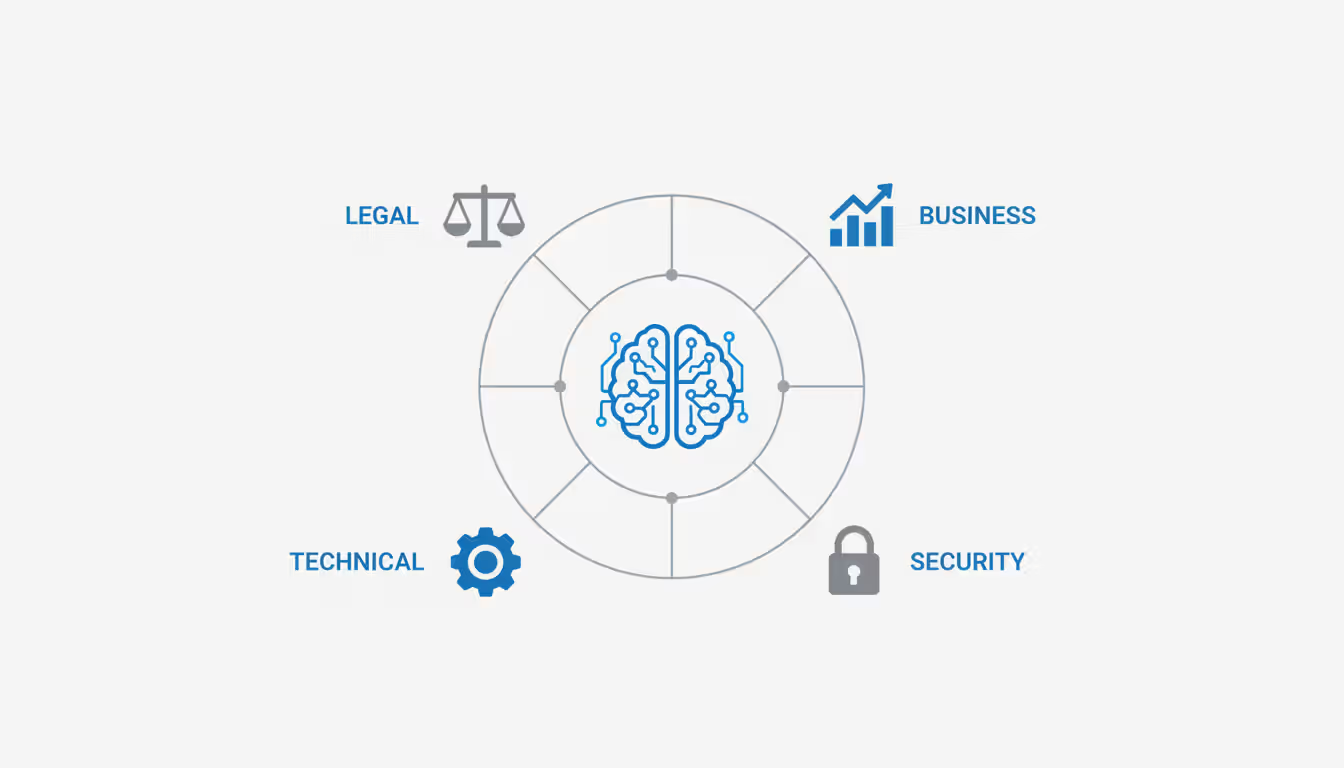
AI risk management begins with systematic identification of potential harms. Technical risks include model errors, data quality issues, adversarial attacks, and system failures. Legal risks span discrimination, privacy violations, consumer protection breaches, and sector-specific regulatory violations. Reputational risks arise when AI systems behave in ways that damage public trust, even if technically legal.
Bias testing should occur throughout the AI lifecycle, not just at deployment. Pre-deployment testing examines whether the system produces disparate outcomes across protected groups. Post-deployment monitoring tracks whether bias emerges over time as models retrain on new data or as user populations shift. Effective testing requires disaggregated data—you can't identify gender bias if you don't track outcomes by gender.
Author: Andrew Bellamy;
Source: craftydeb.com
Explainability requirements vary by use case and jurisdiction. Some laws mandate that individuals receive meaningful information about automated decisions. This doesn't always require full technical transparency—often a clear explanation of factors considered and their relative importance suffices. The challenge: many advanced AI models function as black boxes even to their developers.
AI liability in business remains an evolving area. When an AI system causes harm, who bears responsibility? The developer who created the algorithm? The company that deployed it? The executive who approved its use? Current law generally holds the deploying organization liable, applying traditional product liability, negligence, and statutory violation theories. Some jurisdictions are developing strict liability frameworks for high-risk AI, eliminating the need to prove fault.
Automated decision making law increasingly requires human oversight for consequential decisions. This doesn't mean humans must make every decision, but meaningful human review should occur for high-stakes outcomes. A loan officer who rubber-stamps AI denials without review provides no real oversight. Effective human oversight requires training people to question AI recommendations, providing them access to explanatory information, and creating incentives to override the system when appropriate.
Incident response planning prepares organizations for AI failures. Plans should define what constitutes an AI incident (accuracy drops, bias detection, security breaches, regulatory inquiries), establish notification protocols, assign response roles, and outline remediation steps. After an incident, root cause analysis should identify whether the problem stemmed from design flaws, data issues, inadequate testing, or deployment failures.
The development of full artificial intelligence could spell the end of the human race. It would take off on its own, and re-design itself at an ever increasing rate
— Stephen Hawking
Common AI Compliance Mistakes Businesses Make
Lack of documentation tops the list. Companies deploy AI systems without maintaining records of training data, model validation, bias testing, or approval decisions. When regulators investigate or litigation arises, the absence of documentation suggests negligence even if the system performed appropriately.
Ignoring algorithmic bias remains surprisingly common. Organizations test whether their AI achieves business objectives—does it predict customer churn accurately?—without examining whether it produces disparate outcomes across demographic groups. A hiring algorithm might effectively identify productive employees while systematically disadvantaging women or minorities, creating legal liability.
Inadequate human oversight occurs when companies treat AI recommendations as automatic decisions. A health insurance company that automatically denies claims flagged by AI, without meaningful human review, bears full responsibility for wrongful denials. Human oversight requires genuine authority to override the system, adequate information to exercise judgment, and sufficient time to review decisions carefully.
Failing to assess third-party AI tools creates hidden compliance risks. A company that purchases a vendor's AI recruiting platform may assume the vendor handles compliance, but legal liability typically remains with the employer. Due diligence should verify that vendors conduct bias testing, maintain documentation, and can explain their systems' operation.
Author: Andrew Bellamy;
Source: craftydeb.com
Not updating policies as AI evolves leaves organizations operating under outdated governance frameworks. An AI policy written in 2023 likely doesn't address generative AI risks, multimodal models, or recent regulatory developments. Annual policy reviews should assess whether governance keeps pace with technology and legal changes.
Treating AI compliance as purely a legal or IT issue, rather than a cross-functional business challenge, results in disconnected efforts. Legal teams create policies that IT teams can't implement. Business units deploy AI without informing compliance. Effective AI governance requires coordination across all functions.
FAQ: AI and Regulatory Compliance
Do US companies need to comply with the EU AI Act?
Yes, if they place AI systems on the EU market, have EU establishments, or deploy AI that affects people located in the EU. The Act applies extraterritorially similar to GDPR. A US company selling AI-powered software to EU customers must comply. A US employer using AI to screen EU-based job applicants must comply. Geography of the company's headquarters doesn't determine obligations—the location of AI system use and impact does.
What are the penalties for AI compliance violations?
Penalties vary by jurisdiction and violation severity. The EU AI Act imposes fines up to €35 million or 7% of global annual revenue for prohibited AI systems, and up to €15 million or 3% of revenue for other violations. US penalties depend on the violated law—FTC enforcement can result in millions in civil penalties, injunctive relief, and monitoring requirements. State laws impose per-violation fines that accumulate rapidly. Beyond financial penalties, companies may face operational restrictions, reputational damage, and private litigation.
How do I know if my AI system requires regulatory approval?
This depends on your jurisdiction and the AI application. In the EU, high-risk AI systems require conformity assessments before deployment. In the US, no general AI approval process exists, but sector-specific rules apply—FDA approval for medical AI devices, banking regulator oversight for financial AI models. The key question: does your AI make decisions affecting people in regulated domains like employment, credit, healthcare, or housing? If so, assume regulatory requirements apply and consult legal counsel for specific guidance.
What is the difference between AI governance and AI compliance?
AI governance is the broader organizational framework—policies, processes, oversight structures, and accountability mechanisms that guide responsible AI development and use. AI compliance is the subset of governance focused on meeting legal obligations. You can have governance without compliance (ethical AI principles that exceed legal requirements) and compliance without governance (checking regulatory boxes without systematic oversight). Effective organizations integrate both: governance frameworks that embed compliance requirements while pursuing broader ethical objectives.
Who is liable when an AI system causes harm?
Liability typically falls on the organization that deployed the AI system, not the technology itself. Under current US law, companies face liability through multiple theories: product liability if the AI is defective, negligence if deployment was unreasonable, and statutory violations of anti-discrimination or consumer protection laws. Developers and vendors may share liability depending on contracts and circumstances. Some jurisdictions are moving toward strict liability for high-risk AI, eliminating the need to prove negligence. The key principle: using AI doesn't shield companies from responsibility for harmful outcomes.
What documentation should we maintain for AI compliance?
Comprehensive AI documentation should cover the system's purpose and intended use, data sources and characteristics, model development methodology, validation and testing results including bias assessments, human oversight procedures, deployment decisions and approvals, performance monitoring, and incident reports. For high-risk systems, maintain technical specifications, risk assessments, user instructions, and conformity assessment records. Documentation should be sufficient to demonstrate to regulators that you exercised reasonable care in developing, testing, and deploying the AI system. Retention periods vary by jurisdiction but plan for at least seven years for high-risk applications.
The regulatory landscape for artificial intelligence will continue evolving as governments respond to emerging risks and technologies. Companies that treat compliance as an afterthought—deploying AI first and addressing legal requirements only when problems arise—face mounting risks of enforcement actions, litigation, and reputational damage.
Proactive AI governance provides competitive advantages beyond risk mitigation. Organizations with robust compliance frameworks can move faster when deploying new AI systems because approval processes are clear and documentation practices are established. They build customer trust by demonstrating responsible AI use. They attract talent who want to work for ethical organizations.The path forward requires investment in people, processes, and technology. Hire or train compliance professionals who understand both AI technology and regulatory requirements. Implement governance processes that embed compliance into AI development rather than treating it as a final checkpoint. Deploy monitoring tools that track AI performance and detect emerging risks.
Start by inventorying existing AI systems across your organization—many companies don't know all the places they use AI. Assess each system's risk level based on its purpose and potential impact. Prioritize compliance efforts on high-risk applications while establishing baseline governance for all AI use.
Engage with regulators proactively. Many agencies offer guidance, informal feedback, and sandbox programs for testing novel AI applications. Companies that wait for enforcement actions miss opportunities to shape their compliance approach collaboratively.
The question facing businesses isn't whether to comply with AI regulations—that's mandatory. The strategic question is whether to pursue minimum compliance or build governance frameworks that position the organization as a leader in responsible AI. Companies that choose the latter approach will find themselves better prepared for regulatory evolution, customer expectations, and the ethical challenges that AI inevitably presents.
Commercial use refers to employing copyrighted material for business purposes or financial gain. Understanding these boundaries prevents costly legal disputes and ensures compliance with licensing requirements for images, software, and creative content
The Sarbanes-Oxley Act transformed corporate accountability by making executives personally responsible for financial reporting accuracy. This comprehensive guide explains who must comply, key requirements under Sections 302 and 404, internal control frameworks, audit standards, penalties for violations, and practical implementation steps
Financial institutions rely on sanctions and PEP screening to prevent money laundering and meet AML compliance obligations. This guide explains how sanctions list screening and politically exposed person checks work, regulatory requirements, implementation challenges, and best practices for building effective programs
Safe harbor codes provide legal protection when businesses meet specific compliance requirements. This comprehensive guide explains how these provisions work across tax law, employment regulations, copyright, and data privacy—plus common mistakes that can eliminate your protection
The content on this website is provided for general informational and educational purposes only. It is intended to explain concepts related to business and corporate law, contracts, compliance, disputes, M&A, and taxation for companies.
All information on this website, including articles, guides, and examples, is presented for general educational purposes. Legal outcomes may vary depending on jurisdiction, company structure, and individual circumstances.
This website does not provide legal advice, and the information presented should not be used as a substitute for consultation with qualified corporate attorneys or legal professionals.
The website and its authors are not responsible for any errors or omissions, or for any outcomes resulting from decisions made based on the information provided on this website.