Federal and state regulations trip up businesses daily. You follow what seems like the rules, then face penalties anyway because some interpretation differed from yours. Safe harbor codes eliminate this guessing game—they're the government saying “do exactly this, and we guarantee you're protected.”
You'll find these provisions in tax codes, employment law, copyright statutes, data privacy regulations, and corporate governance rules. They work differently depending on context, but they all share one characteristic: precision matters more than good intentions.
What Is a Safe Harbor Provision?
Here's how safe harbors work: lawmakers write regulations with general standards that require judgment calls. Businesses hate judgment calls because they create audit risk. So regulators often add safe harbor provisions—specific formulas or procedures that automatically satisfy the broader requirement.
The safe harbor definition in legal terms boils down to this: meet condition A, B, and C exactly, and you're protected from consequence X. No analysis of your intentions. No weighing of factors. Just a checklist.
The safe harbor rule meaning shifts across different laws, but the core concept stays constant. Regulators know certain requirements discourage beneficial activities because compliance costs outweigh the benefits when outcomes remain uncertain. Creating a protected zone—a safe harbor—encourages participation.
Take 401(k) plans. The general rule says retirement plans can't discriminate in favor of highly paid employees. Sounds simple, but testing for discrimination involves complex calculations that many plans fail. A safe harbor 401(k) lets you skip testing entirely. You make either a 3% contribution to everyone or match deferrals in a specific pattern, contributions vest immediately, and you're done. No testing required.
The trade-off? Higher employer costs and zero flexibility on vesting schedules. But you've eliminated the risk that your plan fails testing and forces you to refund contributions to executives—a compliance disaster.
Safe harbor provisions aren't immunity from everything. DMCA safe harbor protects YouTube from copyright claims about user videos, but it doesn't shield them from privacy lawsuits, defamation claims, or trademark disputes. The protection addresses one specific legal exposure.
Author: Olivia Farnsworth;
Source: craftydeb.com
How Safe Harbor Codes Work in Different Legal Contexts
Safe harbor codes adapt to whatever domain they're protecting. Tax safe harbors look nothing like copyright safe harbors because the underlying problems differ completely.
Safe Harbor in Tax Law
Tax law builds safe harbors around areas where correct answers are genuinely unclear or require extensive documentation.
The home office deduction used to invite audits. Calculate square footage, allocate utilities, track mortgage interest—the complexity discouraged legitimate claims. In 2013, the IRS introduced a simplified method: $5 per square foot, maximum 300 square feet. You give up precision and potentially money, but you gain certainty and save record-keeping time.
Estimated taxes create a different problem. Businesses with unpredictable income can't accurately forecast their current-year tax liability. Pay too little, and you face underpayment penalties. The safe harbor solves this: pay either 90% of what you'll owe this year or match last year's liability (110% if your adjusted gross income exceeded $150,000). Hit either target, and penalties disappear even if you underpaid.
Depreciation rules illustrate how safe harbors reduce disputes. The IRS publishes recovery periods for every asset class imaginable. Follow their schedule, and they won't challenge your depreciation. Want to argue your delivery trucks actually wear out faster than the IRS table suggests? You can, but now you're defending your position with evidence instead of following a pre-approved path.
Rental property owners hit safe harbor questions when determining whether their activity qualifies as a business for tax deductions. Material participation has traditionally required facts-and-circumstances analysis—auditor catnip. The IRS created a bright-line test: 250 hours of documented participation plus maintaining contemporaneous records. Meet that threshold, and your rental qualifies without subjective debate.
The hardest thing in the world to understand is the income tax
— Albert Einstein
Safe Harbor in Business and Corporate Law
Corporate governance relies heavily on safe harbors, particularly regarding director liability.
Delaware's business judgment rule protects directors who make informed decisions in good faith, believing they're acting in the corporation's interest. This safe harbor allows boards to take calculated risks without personal liability when ventures fail. Directors who followed proper procedures—reviewed materials, asked questions, deliberated—can approve acquisitions that later tank without facing shareholder lawsuits claiming they should have known better.
The Private Securities Litigation Reform Act created safe harbor for forward-looking statements in 1995. Companies discussing future plans or projections include cautionary language identifying risks, and that protects them from securities fraud claims if forecasts don't pan out. Without this safe harbor, public companies might avoid discussing strategy entirely rather than risk litigation over predictions that prove inaccurate.
Delaware law establishes percentage thresholds for transactions requiring shareholder votes. Stay below these specific numbers and meet other criteria, and boards can approve deals without holding shareholder meetings. This accelerates strategic transactions while preserving voting rights for major decisions that cross the thresholds.
Author: Olivia Farnsworth;
Source: craftydeb.com
Safe Harbor in Data Privacy and Technology
Technology platforms depend on safe harbors more than almost any other industry.
The Digital Millennium Copyright Act's Section 512 protects internet service providers from copyright infringement liability for user-posted content. YouTube hosts millions of videos daily—impossible to pre-screen for copyright issues. The DMCA safe harbor says platforms aren't liable if they implement notice-and-takedown systems, register designated agents with the Copyright Office, respond promptly to valid complaints, and don't profit directly from known infringement.
Miss any requirement—say you fail to terminate repeat infringers—and you lose protection for all past infringement, not just future violations.
Data privacy safe harbors have experienced dramatic shifts. The EU-US Privacy Shield allowed American companies to transfer European personal data to US servers by self-certifying compliance with privacy principles. That framework collapsed in July 2020 when Europe's highest court invalidated it in the Schrems II decision. Companies scrambling to find alternative legal mechanisms for data transfers discovered how quickly safe harbors can disappear.
The Trans-Atlantic Data Privacy Framework replaced Privacy Shield in 2023, but companies now approach it more cautiously given the predecessor's fate.
COPPA—the Children's Online Privacy Protection Act—includes a less-common safe harbor type: industry self-regulation. Trade associations can develop privacy programs, submit them to the FTC for approval, and member companies following those programs gain protection from certain enforcement actions.
Author: Olivia Farnsworth;
Source: craftydeb.com
Common Types of Safe Harbor Exemptions and Rules
Different legal domains have developed distinct safe harbor frameworks tailored to their specific challenges.
Legal Area
Safe Harbor Type
Key Requirements
Protection Offered
Tax Law
Estimated Payments
Match 90% of current year's liability or 100%/110% of prior year
Avoids underpayment penalties regardless of actual shortfall
Employment/401(k)
Retirement Plan Contributions
3% non-elective contribution OR matching formula, immediate vesting, annual notices
Skips nondiscrimination testing entirely
Copyright/DMCA
Platform Liability
Registered agent, takedown procedures, no financial benefit from infringement
Blocks copyright claims for user-generated content
Data Privacy
Trans-Atlantic Framework
Annual certification, complaint procedures, adherence to privacy principles
Legal foundation for EU-to-US data flows
Securities Law
Forward Statements
Meaningful warnings, good faith basis for projections
The 401(k) safe harbor affects millions of American workers, yet many don't realize it exists. Traditional 401(k) plans run annual nondiscrimination tests comparing highly compensated employees' participation rates against everyone else's. Fail these tests, and the company must refund contributions to executives—creating tax problems and serious awkwardness.
Safe harbor plans cost more because contribution formulas are generous: either 3% of compensation to all eligible employees whether they contribute or not, or matching 100% of deferrals up to 3% plus 50% of deferrals from 3% to 5%. Everything vests immediately—no waiting periods allowed. But you've eliminated testing risk entirely.
Section 1031 like-kind exchanges let real estate investors defer capital gains taxes indefinitely by swapping properties. The safe harbor requirements are unforgiving: you must use a qualified intermediary (not your lawyer or accountant), identify replacement property within 45 calendar days of selling the relinquished property, and complete the exchange within 180 days. These deadlines are absolute. Day 46 for identification? Your exchange is taxable.
Safe Harbor vs Exemption: Key Differences
These terms get confused constantly, but they function completely differently.
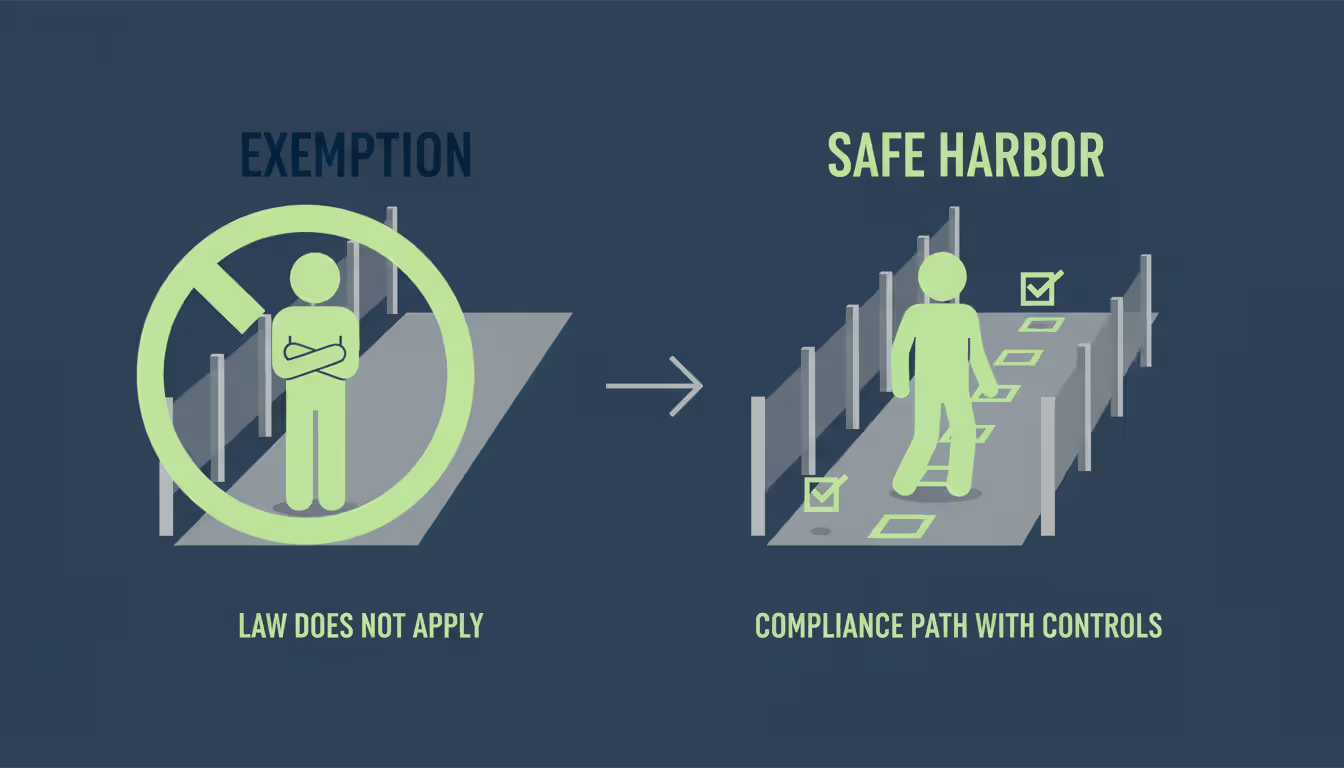
An exemption pulls you outside a regulation's scope. If you're exempt from the Fair Labor Standards Act's overtime rules because you meet the executive exemption criteria, those overtime requirements simply don't apply to you. You're not within the law's coverage.
Safe harbor assumes the law applies to you but gives you a guaranteed compliance method. You're subject to the regulation—you've just chosen a pre-approved way to satisfy it that eliminates discretion or fact-finding.
Consider minimum wage. Certain workers are exempt: independent contractors, some agricultural employees, executives earning above threshold salaries. The law doesn't cover them. There's no safe harbor for minimum wage—you either pay $7.25 per hour (or applicable state minimum) or you don't.
Compare that to vehicle expense deductions. The general rule requires tracking actual costs: gas, maintenance, insurance, depreciation. Tedious and dispute-prone. The IRS offers the standard mileage rate as a safe harbor—65.5 cents per business mile in 2023. You're still required to account for vehicle expenses; the safe harbor just provides an accepted calculation method instead of tracking receipts.
This distinction shapes compliance strategy. Exemptions are status-based and often permanent unless circumstances change. You prove you qualify, document it, and move on. Safe harbors are choice-based—you elect them each year or for each transaction. The question becomes whether the safe harbor's requirements cost more than the alternative.
Some situations offer both. Certain small businesses are exempt from ADA requirements entirely. Larger businesses covered by ADA can use safe harbor specifications for accessibility features—if you build exactly to these measurements, you've complied.
Author: Olivia Farnsworth;
Source: craftydeb.com
Safe Harbor Compliance Requirements
Qualifying for safe harbor protection requires affirmative action—you don't get it automatically just because you could meet the requirements.
DMCA safe harbor demands registering a designated agent with the Copyright Office and publishing takedown procedures on your website. Simply having internal procedures doesn't qualify. The registration and publication requirements ensure copyright holders know how to report infringement.
The 401(k) safe harbor requires specific plan language and distributing annual notices to employees before each plan year explaining their rights and the employer's contribution formula. Skip the notice, and you're not operating a safe harbor plan even if you make the contributions.
Documentation proves compliance when questioned later. The IRS might not challenge your home office deduction when filed, but three years later during an audit, you'll need records showing your office measured 200 square feet and your home totaled 2,000. For rental property material participation, you need contemporaneous logs—not reconstructed estimates created during the audit.
Timing destroys more safe harbor claims than any other factor. The qualified intermediary for a 1031 exchange must hold sale proceeds from day one. If you receive funds personally then transfer them to the intermediary, you've triggered taxable recognition. The 45-day identification period starts when you transfer the relinquished property, weekends and holidays included. Courts have rejected extensions for any reason.
Ongoing compliance matters for many safe harbors. DMCA requires responding promptly to takedown notices and implementing a repeat infringer policy. A platform qualifying today loses protection tomorrow if it stops following procedures. The Trans-Atlantic Data Privacy Framework requires annual recertification and breach notifications.
Some safe harbors impose substantive requirements beyond procedures. The 401(k) safe harbor contribution must go to all eligible employees, not just those who ask. Payment deadlines are firm. Vesting must be immediate—you can't layer graduated vesting schedules on safe harbor contributions.
Failing to meet conditions often means you never had safe harbor protection, not just that you lost it going forward. A website claiming DMCA safe harbor without a repeat infringer policy can't retroactively gain protection for past infringement by implementing one during litigation.
Consequences vary by context. Estimated tax safe harbor failures result in underpayment penalties but nothing beyond that. 401(k) safe harbor failures mean performing the nondiscrimination testing you hoped to avoid, potentially requiring contribution refunds. DMCA failures expose platforms to massive statutory damages for thousands of infringements.
Common Mistakes When Applying Safe Harbor Protection
The biggest error? Assuming safe harbor provisions protect more broadly than they actually do.
Platforms implement DMCA takedown procedures and assume they're shielded from all liability for user content. DMCA safe harbor addresses copyright infringement only—not trademark violations, defamation, privacy claims, right of publicity issues, or the platform's own infringement. YouTube can't copy movies to its servers and claim safe harbor; the protection covers users' uploads, not YouTube's actions.
Incomplete documentation sinks otherwise valid claims. A taxpayer legitimately qualifies for the home office safe harbor—they used 200 square feet exclusively for business—but never measured and documented it. During an audit, the IRS disallows the deduction. The safe harbor was available; the taxpayer just couldn't prove qualification.
Relying on outdated provisions creates catastrophic problems in fast-moving areas. Companies that continued using Privacy Shield after Schrems II invalidated it in July 2020 lost their legal basis for EU-to-US data transfers, risking enforcement actions and lawsuits. Safe harbors aren't permanent fixtures—they can collapse.
Some businesses cherry-pick safe harbor requirements, following easy ones while ignoring inconvenient parts. A 401(k) sponsor makes the required 3% contribution but doesn't send annual participant notices. The notice isn't optional—it's a condition of safe harbor status. Without it, the plan doesn't qualify, and contributions don't excuse testing.
The business judgment rule in corporate law gets misinterpreted frequently. Directors think holding a board meeting before approving a transaction guarantees protection. The safe harbor requires informed decision-making—reviewing relevant materials, asking questions, considering alternatives. Rubber-stamping management recommendations after cursory discussion doesn't qualify.
Timing errors often prove fatal despite perfect compliance otherwise. Real estate investors identify replacement property within 45 days but describe it vaguely: "an apartment building in Brooklyn." The identification rules require unambiguous descriptions, typically street addresses or legal descriptions. Vague identifications fail, making exchanges taxable.
A subtle mistake: assuming one safe harbor triggers related protections. A company qualifies for securities law safe harbor on forward-looking statements and assumes this protects all their disclosures. Safe harbors are narrow—protection covers only what the provision explicitly addresses. Statements about historical facts don't get forward-looking statement protection even if they're in the same press release.
Frequently Asked Questions About Safe Harbor Codes
What does safe harbor mean in legal terms?
Safe harbor provisions create guaranteed legal protection when you meet specific conditions. Instead of applying general standards that require case-by-case analysis, these rules establish checklists: satisfy requirements A, B, and C, and you're protected from consequence X. They eliminate discretion and fact-finding for covered situations. The term comes from maritime law, where safe harbors protected ships from storms—now it describes regulatory provisions that protect businesses from legal exposure.
Do safe harbor provisions eliminate all liability?
No—they're targeted protections addressing specific legal risks. DMCA safe harbor shields platforms from copyright infringement by users but offers zero protection against the platform's own infringement, trademark issues, defamation claims, privacy violations, or contract disputes. Each safe harbor provision specifies exactly what it protects against. Reading those boundaries carefully prevents dangerous assumptions about coverage scope.
How do I know if my business qualifies for safe harbor protection?
Start by identifying which safe harbor might apply—tax, employment, copyright, data privacy, securities law, or another area. Pull the actual statute or regulation (not summaries) and review the specific requirements. Most safe harbors include procedural requirements (registrations, notices), substantive conditions (contribution amounts, response timeframes), and documentation obligations. Create a compliance checklist. When requirements are technical or stakes are high, consult specialists—tax attorneys for tax safe harbors, employment counsel for 401(k) provisions, copyright lawyers for DMCA.
What is the difference between a safe harbor and a legal exemption?
Exemptions remove you from a law's coverage entirely—the regulation doesn't apply to you at all. Safe harbors assume the law covers you but provide a pre-approved compliance method guaranteeing a specific outcome. Think of exemptions as "you're not playing this game" and safe harbors as "here's exactly how to win this game." Small businesses might be exempt from certain ADA requirements completely. Larger businesses covered by ADA can use safe harbor specifications showing compliant accessibility features. Exemptions are status-based; safe harbors are choice-based.
Can safe harbor status be revoked?
Yes, when you stop meeting requirements. Many safe harbors require ongoing compliance, not just initial qualification. DMCA safe harbor requires continuing to respond to takedown notices and maintaining repeat infringer policies. Trans-Atlantic Data Privacy Framework requires annual recertification. Stop meeting conditions, and you lose protection—sometimes retroactively depending on the provision and your failure. A platform that stops responding to DMCA takedown notices doesn't just lose future protection; past infringements it ignored might become actionable too.
Are safe harbor rules the same in every state?
Not even close. Federal law creates many safe harbors—tax codes, copyright, securities regulations, ERISA—that apply nationwide. But states create their own safe harbors for matters under state jurisdiction. Delaware's business judgment rule differs from California's corporate governance rules. Employment law safe harbors vary by state. Data breach notification safe harbors differ across all 50 states. Even within federal programs, states sometimes add requirements. Always verify which jurisdiction's rules apply. Multi-state businesses often face the challenge of complying with different safe harbor frameworks simultaneously.
Safe harbor codes transform regulatory compliance from guesswork into checklist-following. When you're calculating taxes, managing retirement plans, hosting user content, or transferring data internationally, these provisions replace ambiguous standards with concrete requirements.
The price of certainty is precision. Safe harbors aren't flexible guidelines—they're technical specifications where missing one element eliminates protection entirely. A 45-day deadline means 45 days, not 46. A registered agent means registered, not planning to register. Immediate vesting means immediate, not after 90 days.
Documentation separates companies that successfully claim safe harbor protection from those that lose it during audits or litigation. You might have genuinely qualified, but if you can't prove it three years later when questioned, the safe harbor does you no good.
As regulations proliferate across tax, employment, technology, and privacy domains, safe harbor provisions become increasingly valuable. They let you focus resources on growing your business rather than debating compliance interpretations with regulators. The cost—higher contribution requirements, stricter procedures, detailed record-keeping—usually beats the alternative of uncertain outcomes and potential penalties.
Before relying on any safe harbor, verify you understand all requirements and confirm the provision remains valid. Regulatory frameworks shift, and protections considered settled law can vanish (ask companies that relied on Privacy Shield). When stakes are substantial or requirements unclear, spending money on specialist guidance prevents expensive mistakes that undermine your protection.
The broader lesson: safe harbors work because you follow them exactly, not approximately. Close doesn't count—either you're in the harbor or you're exposed to the storm.
Commercial use refers to employing copyrighted material for business purposes or financial gain. Understanding these boundaries prevents costly legal disputes and ensures compliance with licensing requirements for images, software, and creative content
The Sarbanes-Oxley Act transformed corporate accountability by making executives personally responsible for financial reporting accuracy. This comprehensive guide explains who must comply, key requirements under Sections 302 and 404, internal control frameworks, audit standards, penalties for violations, and practical implementation steps
Financial institutions rely on sanctions and PEP screening to prevent money laundering and meet AML compliance obligations. This guide explains how sanctions list screening and politically exposed person checks work, regulatory requirements, implementation challenges, and best practices for building effective programs
US companies processing EU residents' data face full GDPR obligations regardless of location. This guide explains when GDPR applies to American businesses, key requirements including consent and data subject rights, compliance steps from data mapping to vendor assessment, and how GDPR differs from US privacy laws
The content on this website is provided for general informational and educational purposes only. It is intended to explain concepts related to business and corporate law, contracts, compliance, disputes, M&A, and taxation for companies.
All information on this website, including articles, guides, and examples, is presented for general educational purposes. Legal outcomes may vary depending on jurisdiction, company structure, and individual circumstances.
This website does not provide legal advice, and the information presented should not be used as a substitute for consultation with qualified corporate attorneys or legal professionals.
The website and its authors are not responsible for any errors or omissions, or for any outcomes resulting from decisions made based on the information provided on this website.