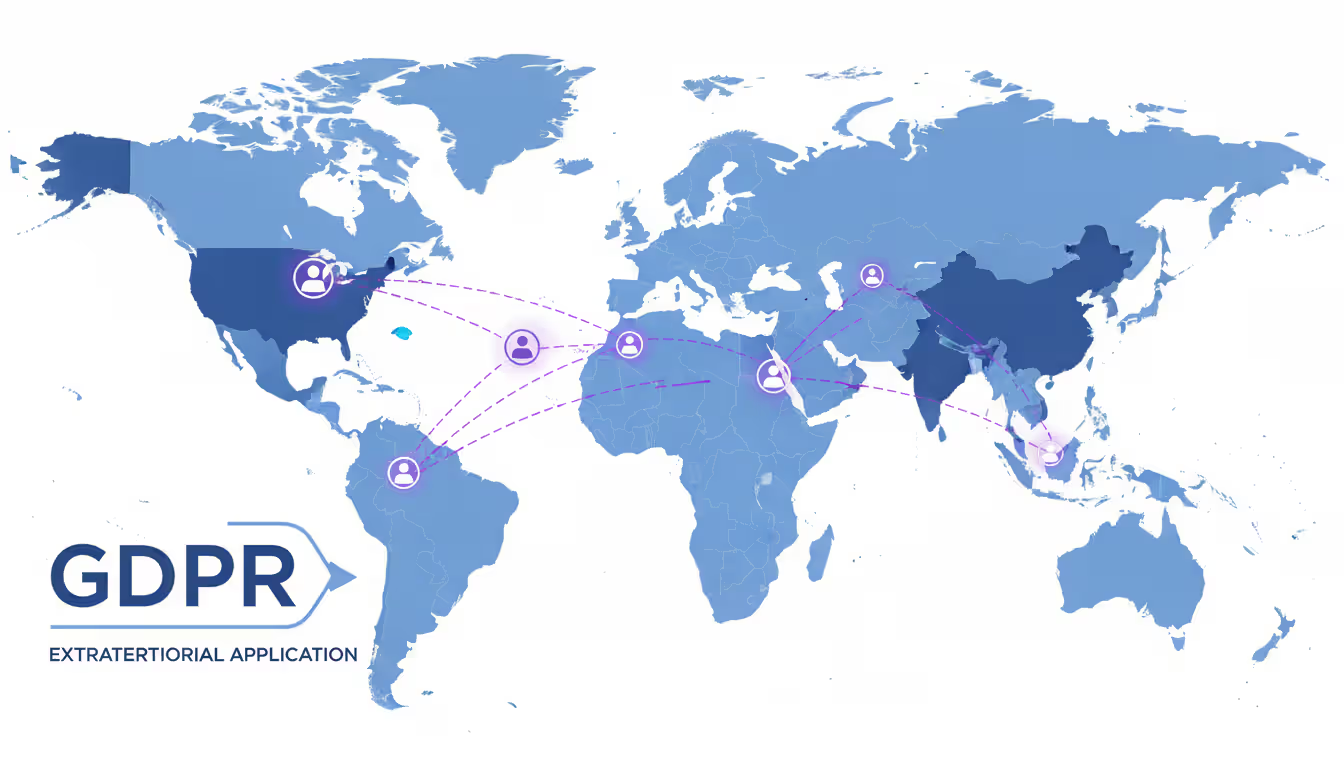
The General Data Protection Regulation (GDPR) remains one of the most comprehensive data protection frameworks globally, and its reach extends far beyond the European Union's borders. American businesses that assume they're exempt simply because they operate from US soil often face a rude awakening when enforcement actions arrive. Understanding when and how GDPR obligations apply to your US-based operation isn't just a legal checkbox—it's a business necessity that affects vendor relationships, customer trust, and your bottom line.
Does GDPR Apply to US Companies?
The territorial scope of GDPR is deliberately extraterritorial, meaning geography alone doesn't determine applicability. Article 3 of the regulation establishes two primary triggers that bring US companies under GDPR jurisdiction, regardless of where they're incorporated or where their servers sit.
First, if your company has an "establishment" in the EU—even a small sales office or a single employee working remotely from an EU member state—and that establishment processes personal data, GDPR applies to all processing activities of that establishment. The threshold here is surprisingly low. A US software company with one customer success manager working from Berlin would likely trigger this provision.
Second, and more commonly for purely US-based operations, GDPR applies when you offer goods or services to individuals in the EU or monitor their behavior. The "offering" test doesn't require completed transactions. A US e-commerce site that ships to EU addresses, displays prices in euros, or provides customer service in European languages signals intent to serve the EU market. Similarly, using tracking technologies to monitor EU residents' online behavior—even for behavioral advertising purposes—triggers GDPR obligations.
Consider a mid-sized US marketing agency that never opened an EU office but runs Facebook ad campaigns targeting German consumers for their clients. That agency processes personal data (audience demographics, engagement metrics) of EU residents and monitors their behavior. GDPR applies. Or take a US-based SaaS company offering free trials without geographic restrictions. When EU residents sign up, the company becomes subject to gdpr requirements for us businesses.
Author: Marcus Ellwood;
Source: craftydeb.com
The regulation explicitly excludes purely personal or household activities, but the commercial threshold is low. Even nonprofits, government contractors, and B2B companies processing employee data of EU-based staff or clients fall within scope. One common misconception: believing that simply adding "not available in the EU" to your terms of service creates a safe harbor. If you don't implement technical measures to actually block EU traffic and your service remains accessible, that disclaimer provides minimal protection.
Key GDPR Requirements for US Businesses
Once GDPR applies, US companies face the same obligations as their European counterparts. The regulation establishes six lawful bases for processing personal data: consent, contract, legal obligation, vital interests, public task, and legitimate interests. Unlike US data privacy frameworks that often default to opt-out mechanisms, GDPR requires identifying a specific lawful basis before processing begins.
Consent under GDPR means freely given, specific, informed, and unambiguous agreement, typically through a clear affirmative action. Pre-ticked boxes don't qualify. Consent must be granular—you can't bundle consent for marketing emails with consent to use your core service. For US businesses accustomed to broad terms of service that users rarely read, this represents a significant shift. Many American companies default to "legitimate interests" as their lawful basis for processing, which requires balancing your business needs against individual privacy rights and documenting that assessment.
Data subject rights form another pillar of gdpr privacy requirements. Individuals can request access to their data, correction of inaccuracies, erasure ("right to be forgotten"), restriction of processing, data portability, and objection to processing. You must respond to these requests within one month, extending to three months only in complex cases with proper notification. US companies without established request workflows often struggle here—a manual, ad-hoc approach doesn't scale when requests arrive.
Privacy notices must be concise, transparent, and written in plain language. You need to disclose what data you collect, why you're collecting it, your lawful basis, how long you'll retain it, who you'll share it with, and what rights individuals have. These notices should be layered: a short, accessible summary at the point of collection with links to more detailed information. The dense, legal-jargon-heavy privacy policies common among US companies typically fail GDPR's transparency standards.
Data processing agreements (DPAs) are mandatory whenever you engage a vendor or service provider that processes personal data on your behalf. These contracts must include specific GDPR-mandated clauses covering processing instructions, confidentiality, security measures, sub-processor management, and assistance with data subject requests. Your cloud hosting provider, email marketing platform, customer support tool, and analytics service all require compliant DPAs. Many US vendors now offer standard GDPR-compliant DPAs, but you need to execute them—they don't apply automatically.
Data Protection Officer Requirements
Not every US company needs a Data Protection Officer (DPO), but the requirement catches more businesses than expected. You must appoint a DPO if your core activities involve large-scale systematic monitoring of individuals or large-scale processing of special categories of data (health information, biometric data, racial or ethnic origin, political opinions, etc.).
"Large-scale" lacks a precise definition, but regulatory guidance suggests considering the number of data subjects, volume of data, duration of processing, and geographic scope. A US health tech startup processing patient data from 10,000 EU users likely needs a DPO. An e-commerce site with 50,000 EU customers using extensive behavioral tracking probably does too.
The DPO must have expert knowledge of data protection law and practices, though this doesn't require a law degree. Critically, the DPO must be independent—they can't receive instructions regarding their data protection tasks and can't be dismissed for performing their duties. Many US companies try to add DPO responsibilities to an existing compliance officer's plate without ensuring proper independence or expertise, creating compliance gaps.
Records of Processing Activities
Article 30 requires maintaining detailed records of processing activities—essentially an internal inventory of what data you process, why, how long you keep it, who you share it with, and what security measures protect it. This requirement applies to companies with 250+ employees, but also to smaller organizations if their processing isn't occasional, poses risks to rights and freedoms, or includes special categories of data.
In practice, most US companies subject to GDPR need these records. They should cover data flows across your organization: customer data in your CRM, employee data in HR systems, website visitor data in analytics tools, and prospect data in marketing automation platforms. The records must be in writing (electronic format is fine) and available to supervisory authorities upon request.
Creating these records forces you to actually understand your data ecosystem—a valuable exercise beyond mere compliance. Many US companies discover shadow IT systems, unnecessary data retention, or excessive vendor access when completing this mapping. The records also become the foundation for data protection impact assessments, breach notification procedures, and responding to data subject requests.
GDPR Compliance Steps for American Companies
Achieving gdpr compliance steps requires a structured approach rather than scattered efforts. Start with data mapping to understand what personal data you collect, where it comes from, how it moves through your systems, where it's stored, who accesses it, and when it's deleted. This mapping should be concrete: not "we collect customer information" but "we collect email addresses, billing addresses, IP addresses, and device identifiers through our checkout form, which flows to Stripe for payment processing, Mailchimp for marketing, and AWS for storage."
Next, conduct a gap analysis comparing your current practices against GDPR requirements. Do your privacy notices include all mandatory elements? Can you fulfill data subject requests within required timeframes? Do you have DPAs with all processors? Is your lawful basis for each processing activity documented and defensible? This analysis typically reveals 15-30 specific gaps for mid-sized US companies new to GDPR.
Policy updates come next. You'll likely need to revise your privacy notice, terms of service, employee handbook, vendor agreements, and internal data handling procedures. Many US companies also create new policies: a data retention schedule specifying how long different data categories are kept, a data breach response plan, and procedures for handling data subject requests.
Vendor assessment is particularly time-consuming. List every third-party service that processes personal data on your behalf, then verify each has a compliant DPA in place, adequate security measures, and proper sub-processor disclosures. For vendors who can't meet GDPR standards, you'll need to find alternatives or implement additional safeguards. One US retailer discovered they used 47 different services processing customer data—far more than leadership realized.
Training shouldn't be a one-time compliance video everyone clicks through without watching. Staff who interact with personal data need practical guidance: how to recognize data subject requests (they don't always arrive labeled as such), when to escalate potential data breaches, how to verify identity before disclosing personal data, and what to do when a customer asks to be deleted from your systems. Role-specific training works better than generic modules—your sales team needs different knowledge than your engineering team.
Documentation ties everything together. Beyond the records of processing activities, document your lawful basis assessments, data protection impact assessments for high-risk processing, data breach incidents and responses, data subject requests and how you handled them, and training completion records. European supervisory authorities expect to see evidence of your compliance program, not just assurances.
Implementation timelines vary, but most US companies need three to six months for initial compliance, assuming dedicated resources. A common mistake: treating GDPR as a one-time project rather than ongoing operational practice. Privacy laws evolve, your business changes, new vendors get added, and new products launch. Compliance requires continuous attention.
Author: Marcus Ellwood;
Source: craftydeb.com
GDPR and US Data Privacy Law Differences
The relationship between gdpr and us data law is complex because the US lacks a comprehensive federal privacy statute comparable to GDPR. Instead, American companies navigate a patchwork of state laws, sector-specific federal regulations, and industry standards.
The California Consumer Privacy Act (CCPA) and its successor, the California Privacy Rights Act (CPRA), represent the closest US analogue to GDPR. Both establish consumer rights, require privacy notices, and impose obligations on businesses processing California residents' data. However, significant differences remain in scope, substance, and enforcement.
GDPR applies based on offering services to EU residents or monitoring their behavior, regardless of company size. CCPA/CPRA apply only to larger businesses: those with $25 million+ in annual revenue, those that process data of 100,000+ California residents or households, or those deriving 50%+ of revenue from selling personal information. A small US startup with 500 EU customers faces full GDPR obligations but might fall entirely outside CCPA scope.
The definition of personal data differs subtly but importantly. GDPR covers any information relating to an identified or identifiable person—a broad standard that includes IP addresses, cookie identifiers, and device fingerprints. US state laws often use similar definitions but with varying interpretations and exemptions. B2B contact information generally receives more protection under GDPR than under most US laws.
Consent requirements diverge sharply. GDPR requires opt-in consent for many processing activities and prohibits making service access conditional on consent for non-essential processing (the "consent or pay" model faces restrictions). CCPA/CPRA use an opt-out model for data sales and sharing, allowing businesses to process data unless consumers affirmatively object. This fundamental difference means CCPA compliance doesn't automatically satisfy GDPR's consent requirements.
Individual rights overlap but aren't identical. Both frameworks provide access, correction, and deletion rights, but GDPR adds data portability, restriction of processing, and objection rights with fewer exceptions. GDPR's right to erasure is broader than CCPA's deletion right—US laws include more exemptions for business purposes.
Here's a practical comparison:
Element
GDPR
CCPA/CPRA
Other US State Laws
Territorial Scope
Applies to any company offering goods/services to EU residents or monitoring their behavior
Applies to larger businesses processing California residents' data
Varies by state; generally applies to businesses meeting revenue/volume thresholds processing state residents' data
Consent Model
Opt-in required for many processing activities; consent must be freely given, specific, informed, and unambiguous
Opt-out model for sales/sharing; opt-in for sensitive data and minors under 16
Most use opt-out models; some require opt-in for sensitive data
Access, deletion, correction, opt-out of sales/sharing, limit use of sensitive data
Typically access, deletion, and opt-out rights; specifics vary
Penalties
Up to €20 million or 4% of global annual revenue, whichever is higher
Up to $7,500 per intentional violation; $2,500 per other violation
Varies; typically $2,500-$7,500 per violation
Enforcement
EU supervisory authorities; private right of action limited to data breaches
California Privacy Protection Agency; private right of action for data breaches
State attorneys general; some allow private rights of action
Data Transfer Rules
Strict requirements for transfers outside EU; adequacy decisions, SCCs, or other mechanisms required
No specific restrictions on data transfers
Generally no restrictions, though some states require reasonable security for out-of-state transfers
The enforcement landscape also differs dramatically. European supervisory authorities actively investigate GDPR violations, issue substantial fines, and coordinate cross-border enforcement. US state privacy laws rely primarily on attorney general enforcement, with private rights of action limited mainly to data breach scenarios. This means GDPR violations often carry more immediate financial risk.
One critical point: meeting CCPA requirements doesn't automatically achieve GDPR compliance. The stricter consent standards, broader individual rights, mandatory DPAs, cross-border transfer restrictions, and different lawful basis framework mean separate compliance efforts are necessary for companies subject to both regimes.
Penalties and Enforcement for Non-Compliance
The gdpr penalties for non-compliance structure uses a two-tier system. Less severe violations—such as failing to maintain records of processing activities, not notifying a breach to the supervisory authority, or inadequate DPO designation—carry maximum fines of €10 million or 2% of global annual revenue, whichever is higher. More serious violations—processing without a lawful basis, violating data subject rights, or making unauthorized international data transfers—face maximum fines of €20 million or 4% of global annual revenue.
These aren't theoretical maximums. European supervisory authorities have issued hundreds of millions in fines since GDPR took effect. Amazon received a €746 million penalty in 2021 for behavioral advertising practices. Meta faced multiple fines totaling over €1 billion for various violations including improper data transfers. While most penalties target large tech companies, smaller businesses aren't immune—a German company with €11 million in annual revenue received a €10.4 million fine for excessive data retention.
Author: Marcus Ellwood;
Source: craftydeb.com
US companies specifically have faced enforcement actions. In 2024, a US-based data broker paid €5.1 million for unlawfully processing EU residents' data. Several US healthcare and marketing technology companies received penalties ranging from €100,000 to €2 million for violations including inadequate data security, improper consent mechanisms, and failure to honor deletion requests.
Beyond fines, supervisory authorities can impose corrective measures: ordering specific processing activities to cease, requiring data deletion, suspending data transfers to third countries, or mandating compliance audits. These operational restrictions often prove more disruptive than monetary penalties. A US SaaS company ordered to stop processing EU customer data until achieving compliance faces immediate revenue loss and customer relationship damage.
Enforcement typically begins with a complaint. Data subjects can file complaints with any EU supervisory authority, though usually with the authority in their country of residence. Complaints might allege inadequate privacy notices, ignored deletion requests, lack of consent, excessive data collection, or security incidents. Supervisory authorities also conduct proactive investigations and audits, particularly of high-risk processing or following data breaches.
The complaint process is accessible—individuals can file complaints directly through supervisory authority websites without legal representation or fees. Processing times vary, but authorities must inform complainants about progress. If the authority finds violations, it can impose fines and corrective measures. Companies have appeal rights through administrative and judicial channels, though appeals don't suspend fines in all jurisdictions.
Cross-border enforcement coordination through the "one-stop-shop" mechanism means a US company with customers across multiple EU countries typically deals with a single lead supervisory authority. However, this doesn't prevent other authorities from taking action in certain circumstances, particularly for processing that only affects their jurisdiction.
Risk factors that increase enforcement likelihood include: high-profile data breaches, processing special categories of data, targeting children, using dark patterns to manipulate consent, ignoring data subject requests, and complaints from privacy advocacy organizations. US companies sometimes assume they're "under the radar," but supervisory authorities increasingly prioritize international enforcement, particularly in sectors like ad tech, social media, and data brokerage where cross-border data flows are substantial.
International Data Transfers Under GDPR
Transferring personal data from the EU to the US represents one of the most complex aspects of gdpr data protection rules. The regulation restricts transfers to countries outside the European Economic Area unless adequate safeguards protect the data. The US doesn't have an adequacy decision covering all commercial transfers, making transfer mechanisms critical for US companies.
Standard Contractual Clauses (SCCs) are pre-approved contract terms issued by the European Commission that provide appropriate safeguards for international transfers. When a US company receives personal data from an EU entity, they typically execute SCCs as part of their data processing agreement. The current SCC templates, adopted in 2021, include four modules covering different transfer scenarios: controller-to-controller, controller-to-processor, processor-to-processor, and processor-to-controller.
SCCs aren't just boilerplate you can sign and forget. Following the Schrems II decision, companies must conduct transfer impact assessments (TIAs) evaluating whether the destination country's laws might undermine the protections SCCs provide. For US transfers, this means assessing whether US surveillance laws like FISA 702 or Executive Order 12333 might enable government access to the transferred data in ways incompatible with EU fundamental rights.
Author: Marcus Ellwood;
Source: craftydeb.com
The TIA should be specific to your situation: what data you're transferring, whether it's likely to interest US intelligence agencies, whether you're subject to US surveillance obligations, what supplementary measures you can implement to strengthen protection, and whether those measures effectively address identified risks. Generic TIAs don't satisfy the requirement—regulators expect individualized assessments.
The EU-U.S. Data Privacy Framework (DPF), which replaced the invalidated Privacy Shield, provides an adequacy mechanism for participating US companies. Organizations can self-certify their compliance with DPF principles through the Department of Commerce, after which they benefit from adequacy for data transfers from the EU. However, DPF participation requires ongoing compliance with specific requirements, annual recertification, and subjecting yourself to Federal Trade Commission enforcement.
DPF isn't a universal solution. It only covers data transfers from the EU to participating US organizations—it doesn't address onward transfers to non-participating third parties without additional safeguards. Legal challenges to the DPF continue, creating uncertainty about its long-term viability. Many privacy practitioners recommend implementing SCCs even when relying on DPF, creating a backup transfer mechanism if the framework faces invalidation.
Supplementary measures strengthen transfer protections beyond SCCs or DPF. Technical measures might include end-to-end encryption where the EU entity holds keys, pseudonymization, or data minimization. Organizational measures could include policies limiting data access, contractual commitments from the US company not to disclose data in response to government requests without challenging them, or transparency reporting about government data requests received.
Practical transfer scenarios for US companies vary. A US processor receiving EU customer data from an EU controller client needs SCCs (likely Module 2: controller-to-processor) and must conduct a TIA. A US company with an EU subsidiary that centralizes data in US servers is making an intra-company transfer requiring SCCs (Module 1: controller-to-controller) or Binding Corporate Rules. A US business collecting data directly from EU residents through its website might argue it's not making a "transfer" since it collects data directly in the US, though this position carries risks if the company has any EU establishment.
One common mistake: assuming that storing data with a US cloud provider that has EU data centers avoids transfer issues. If the US provider can access data from the US—even for technical support purposes—that constitutes a transfer requiring safeguards. Many US companies discover their cloud architecture inadvertently creates transfers they haven't properly safeguarded.
International data protection law continues evolving. The UK has its own transfer regime post-Brexit, largely mirroring GDPR but with independent adequacy decisions and potential future divergence. Other jurisdictions like Switzerland have similar transfer restrictions. US companies serving global markets often need multiple transfer mechanisms tailored to different data flows.
US companies often underestimate GDPR's reach until they receive their first data subject request or supervisory authority inquiry. By then, scrambling to achieve compliance is far more expensive and disruptive than proactive preparation. The regulation isn't going away, enforcement is increasing, and the reputational cost of privacy failures continues rising. Companies that invest in genuine compliance rather than minimum viable efforts position themselves for long-term success in global markets
— Sarah Mitchell
Frequently Asked Questions About GDPR for US Companies
Do I need a GDPR representative if I'm a US company?
Article 27 requires companies without an EU establishment to appoint an EU-based representative if they process data of EU residents on a large scale or their core activities involve large-scale systematic monitoring or processing of special categories of data. The representative acts as a contact point for supervisory authorities and data subjects on GDPR matters. Many mid-sized and larger US companies subject to GDPR need representatives. Exemptions exist for occasional processing unlikely to risk individual rights or for public authorities. The representative must be established in an EU member state where your data subjects are located—if you serve customers across multiple EU countries, you typically choose one country where you have significant activity. Several services provide GDPR representative services for US companies, typically charging annual fees of $1,000-$5,000 depending on your processing activities.
What counts as "offering goods or services" to EU residents?
The key is intent to serve the EU market, not whether transactions actually occur. Indicators include: displaying prices in euros or other EU currencies, offering EU language options beyond English, mentioning EU customers in marketing materials, providing EU-specific customer service, using EU-focused domain names (.de, .fr, etc.), offering shipping to EU addresses, or targeting EU audiences in advertising campaigns. Simply having a website accessible from the EU isn't sufficient if you're clearly targeting only US customers—using only USD pricing, US-specific references, and shipping exclusively within the US suggests no intent to serve EU residents. However, if you accept orders from EU customers without blocking them, you're moving into risky territory. Courts consider the overall circumstances rather than any single factor.
Can US companies be fined under GDPR?
Yes, absolutely. GDPR applies extraterritorially to companies offering services to EU residents or monitoring their behavior, regardless of where the company is located. European supervisory authorities have issued fines to numerous US companies, from large tech platforms to smaller specialized services. Enforcement mechanisms include cooperation with US authorities under mutual legal assistance treaties, enforcement through EU subsidiaries or assets, and potential difficulties for company representatives traveling to the EU. Some US companies mistakenly believe they're judgment-proof, but supervisory authorities have proven willing and able to enforce penalties against foreign companies. The reputational damage and operational disruption from enforcement actions often exceeds the direct financial penalty.
Is CCPA compliance enough to cover GDPR requirements?
No, CCPA compliance doesn't automatically satisfy GDPR obligations. While both frameworks share some common elements—privacy notices, individual rights, security requirements—significant differences exist. GDPR requires opt-in consent for many processing activities; CCPA uses opt-out for sales and sharing. GDPR mandates data processing agreements with all processors; CCPA has less prescriptive vendor requirements. GDPR restricts international data transfers; CCPA doesn't. GDPR requires documenting lawful basis for processing; CCPA focuses on disclosure and choice. GDPR's data subject rights are broader and have fewer exceptions. A company fully compliant with CCPA still needs substantial additional measures to achieve GDPR compliance. However, CCPA compliance provides a foundation—your privacy notice framework, data subject request procedures, and vendor management processes can often be adapted for GDPR rather than built from scratch.
How do I handle data transfer from the EU to the US?
First, determine if you're actually making a transfer—if you collect data directly from EU residents to US servers without an EU intermediary, the transfer analysis differs. For clear transfers (such as receiving data from an EU client or subsidiary), implement Standard Contractual Clauses appropriate to your relationship (controller-to-controller or controller-to-processor). Conduct a transfer impact assessment evaluating whether US surveillance laws pose risks to the specific data you're transferring and document what supplementary measures you're implementing. Consider DPF certification if your business model involves substantial EU-US data flows. Implement technical measures like encryption where feasible. Document everything—your transfer mechanisms, TIA, supplementary measures, and decision-making process. Review your transfer safeguards periodically as legal frameworks evolve. Avoid making transfers you can't adequately safeguard—sometimes the right answer is not to transfer data or to implement EU-based processing.
What's the difference between a data controller and data processor under GDPR?
A controller determines the purposes and means of processing personal data—they decide why and how data gets processed. A processor processes data on behalf of and according to the controller's instructions. If you collect customer data through your website to fulfill orders, market your products, and improve your services, you're the controller of that data. If you hire a cloud hosting provider to store that data or an email service to send marketing campaigns, those vendors are processors acting on your instructions. The distinction matters because controllers and processors have different obligations. Controllers must establish lawful basis, provide privacy notices, respond to data subject rights, and ensure processors provide sufficient guarantees. Processors must only process according to controller instructions, implement appropriate security, assist with data subject requests and compliance obligations, and notify controllers of breaches. The same company can be a controller for some data (their own customer or employee data) and a processor for other data (client data they process according to client instructions). When negotiating contracts, clarify whether you're acting as controller or processor—this determines what obligations you're accepting.
GDPR compliance for US companies isn't optional when you process EU residents' data—it's a legal obligation with real enforcement consequences. The regulation's extraterritorial reach means geography provides no immunity, and supervisory authorities have demonstrated willingness to pursue non-European companies. Understanding whether GDPR applies to your business, implementing required safeguards, establishing proper transfer mechanisms, and maintaining ongoing compliance procedures protects you from penalties while building customer trust in how you handle personal information.
The compliance journey requires investment—time to map your data flows, resources to update policies and procedures, budget for tools and potentially representatives, and organizational commitment to privacy as an operational priority rather than a checkbox exercise. However, companies that treat GDPR as a framework for responsible data handling rather than merely a regulatory burden often find benefits beyond avoiding fines: clearer data governance, reduced security risks, stronger vendor relationships, and competitive advantages in privacy-conscious markets.
Starting with the fundamentals—understanding your obligations, documenting your processing activities, implementing data protection agreements, and establishing procedures for data subject requests—creates a foundation you can build on as your business grows and privacy regulations continue evolving globally. The US regulatory landscape is moving toward more comprehensive privacy requirements, making GDPR compliance efforts increasingly relevant even for purely domestic operations.
Commercial use refers to employing copyrighted material for business purposes or financial gain. Understanding these boundaries prevents costly legal disputes and ensures compliance with licensing requirements for images, software, and creative content
The Sarbanes-Oxley Act transformed corporate accountability by making executives personally responsible for financial reporting accuracy. This comprehensive guide explains who must comply, key requirements under Sections 302 and 404, internal control frameworks, audit standards, penalties for violations, and practical implementation steps
Financial institutions rely on sanctions and PEP screening to prevent money laundering and meet AML compliance obligations. This guide explains how sanctions list screening and politically exposed person checks work, regulatory requirements, implementation challenges, and best practices for building effective programs
Safe harbor codes provide legal protection when businesses meet specific compliance requirements. This comprehensive guide explains how these provisions work across tax law, employment regulations, copyright, and data privacy—plus common mistakes that can eliminate your protection
The content on this website is provided for general informational and educational purposes only. It is intended to explain concepts related to business and corporate law, contracts, compliance, disputes, M&A, and taxation for companies.
All information on this website, including articles, guides, and examples, is presented for general educational purposes. Legal outcomes may vary depending on jurisdiction, company structure, and individual circumstances.
This website does not provide legal advice, and the information presented should not be used as a substitute for consultation with qualified corporate attorneys or legal professionals.
The website and its authors are not responsible for any errors or omissions, or for any outcomes resulting from decisions made based on the information provided on this website.