The European Union's Digital Markets Act represents one of the most aggressive regulatory frameworks targeting Big Tech companies in modern history. Since its enforcement began in March 2024, the regulation has forced fundamental changes to how American technology giants operate in Europe—and those changes are increasingly affecting US consumers.
Understanding the Digital Markets Act
The Digital Markets Act emerged from years of European frustration with the market dominance of large technology platforms. EU lawmakers observed that a handful of companies controlled essential digital infrastructure—app stores, search engines, social networks, and cloud services—creating bottlenecks that stifled competition and innovation.
The legislative process began in December 2020 when the European Commission proposed the DMA alongside the Digital Services Act. After negotiations between the European Parliament and Council, the final text was adopted in September 2022 and entered into force in November 2022. The regulation became enforceable on March 7, 2024, giving designated companies six months to comply.
The DMA regulation explained in simple terms: it's a pre-emptive rulebook that prohibits specific behaviors by "gatekeeper" platforms before harm occurs, rather than waiting to investigate and prosecute antitrust violations after the fact. This ex-ante approach differs sharply from traditional competition law, which typically responds to complaints about past conduct.
The core objectives include ensuring contestable and fair markets in the digital sector, preventing gatekeepers from imposing unfair conditions on businesses and users, and enabling multi-homing (users and businesses being active on multiple platforms simultaneously). The regulation aims to lower barriers for new entrants and ensure that companies controlling essential digital infrastructure cannot leverage that position to disadvantage competitors.
By 2026, the DMA has evolved beyond its initial implementation. The European Commission has refined its enforcement approach based on early compliance challenges, and several gatekeepers have undergone multiple rounds of adjustments to meet obligations.
Who Must Comply with DMA Requirements
Author: Andrew Bellamy;
Source: craftydeb.com
The Digital Markets Act doesn't apply to all technology companies—only those designated as "gatekeepers" of "core platform services." The European Commission uses specific quantitative thresholds to identify these companies, though it retains discretion for borderline cases.
A company qualifies for gatekeeper designation when it meets three cumulative criteria across at least one core platform service. The designation process occurs at the level of individual services, not entire companies. For example, a company might be designated as a gatekeeper for its search engine but not for its cloud services.
DMA Gatekeeper Designation Criteria
Criterion
Threshold
Purpose
Examples of Companies Meeting This
Size Impact on Internal Market
Annual EEA turnover ≥ €7.5 billion in each of last 3 years OR market capitalization/equivalent fair market value ≥ €75 billion in last year
Ensures only economically significant platforms are designated
Provides core platform service to ≥ 45 million monthly active end users in EU AND ≥ 10,000 yearly active business users in EU
Identifies platforms with substantial user bases on both sides of the market
iOS App Store, Google Search, Facebook, Amazon Marketplace
Entrenched and Durable Position
Met the above thresholds in each of last 3 years
Distinguishes temporary success from structural market power
All currently designated gatekeepers have met this consistently
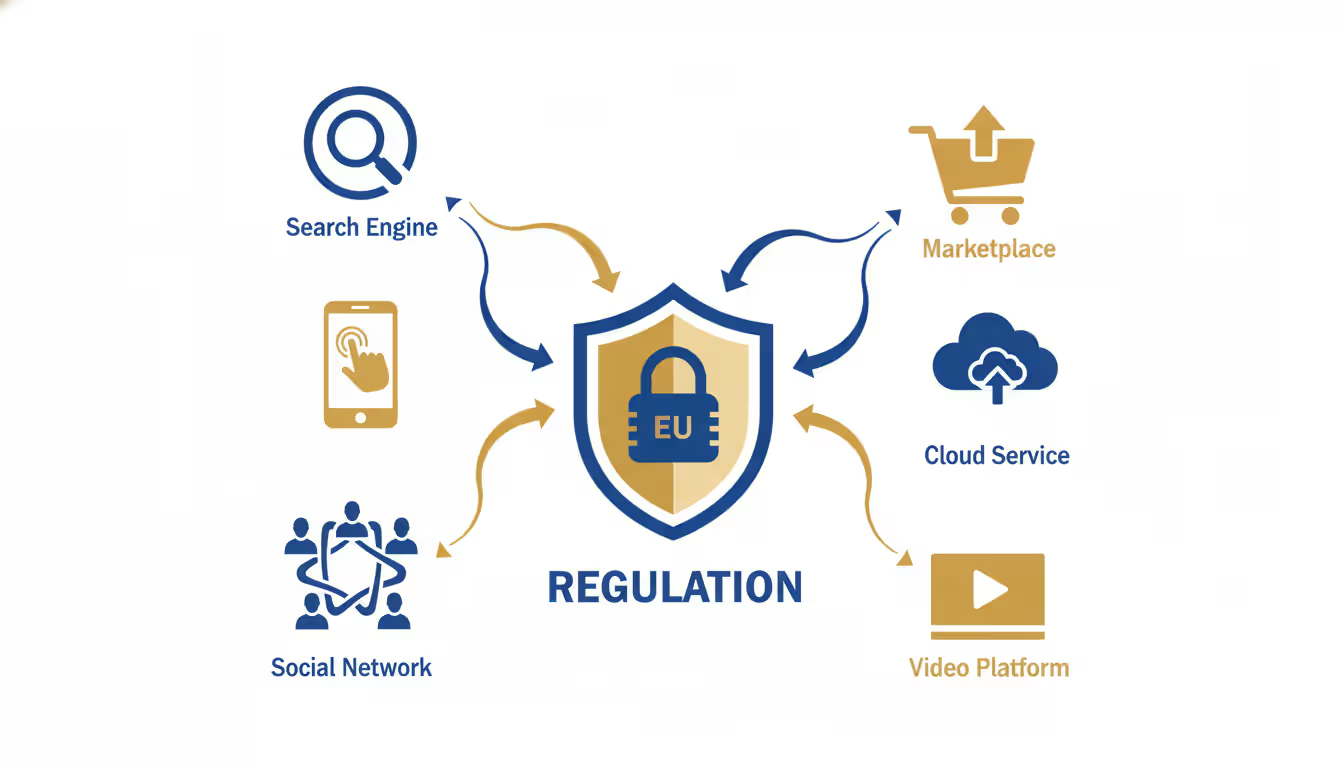
Core platform services subject to designation include online intermediation services (marketplaces), online search engines, social networking services, video-sharing platforms, number-independent interpersonal communications services, operating systems, web browsers, virtual assistants, cloud computing services, and online advertising services.
As of 2026, the European Commission has designated the following gatekeepers: Alphabet (Google Search, Google Shopping, Google Maps, Google Play, YouTube, Android, Chrome, Google Ads), Apple (iOS, App Store, Safari), Meta (Facebook, Instagram, WhatsApp, Messenger, Meta Marketplace), Amazon (Amazon Marketplace), Microsoft (Windows, LinkedIn, Bing, Microsoft Advertising), and ByteDance (TikTok). Booking.com was initially investigated but ultimately not designated for certain services.
The Commission reviews gatekeeper designations at least every two years and can designate new gatekeepers or remove the designation if thresholds are no longer met. Companies can also be designated through qualitative assessment if they exhibit gatekeeper characteristics despite falling slightly below numerical thresholds.
Author: Andrew Bellamy;
Source: craftydeb.com
Key Obligations Under the Digital Markets Act
Designated gatekeepers face 18 specific obligations and prohibitions. These digital markets act provisions fall into several categories, each addressing different competitive concerns.
Data and Interoperability Requirements
Gatekeepers must ensure interoperability of their platforms with third-party services. This means messaging services like WhatsApp must allow users to send messages to users on competing platforms like Signal or Telegram. By 2026, the technical standards for this interoperability have been developed, though implementation remains complex—particularly around encryption and security features.
Data portability represents another critical obligation. Users must be able to download their data in a structured, commonly used format and transfer it to competing services. Business users on platforms like Amazon Marketplace must have real-time access to the data they generate through their use of the platform, including transaction data and customer interactions.
Gatekeepers cannot combine personal data across different services without explicit user consent. This prohibition directly challenged Meta's business model of creating unified user profiles across Facebook, Instagram, and WhatsApp for advertising purposes. Meta responded by implementing separate consent mechanisms, though critics argue the implementation creates pressure to consent through design choices.
Advertising transparency requirements mandate that gatekeepers provide advertisers and publishers with access to performance metrics and tools necessary to conduct independent verification. This addresses long-standing complaints about the "black box" nature of platforms like Google Ads, where advertisers struggled to verify whether they received value for their spending.
Self-Preferencing and Competition Rules
The DMA prohibits gatekeepers from treating their own services more favorably than third-party services in rankings. Google, for instance, can no longer automatically place its own shopping service, flight search, or map results above competitors in search results based solely on its ownership of the search engine.
Gatekeepers cannot restrict business users from offering different prices or conditions through alternative channels. This "most-favored-nation" ban means Amazon cannot penalize sellers who offer lower prices on their own websites or competing marketplaces. The practical effect has been significant: many sellers now openly advertise better deals outside Amazon.
Pre-installation and default settings face new restrictions. Operating system providers like Apple and Google must allow users to easily uninstall pre-installed apps (except those essential for device functionality) and choose default applications for common functions like web browsing, maps, and email.
Platform operators cannot require app developers to use their payment systems exclusively. This obligation directly targets Apple's App Store policies, which previously mandated use of Apple's in-app purchase system with its 15-30% commission. By 2026, alternative payment systems have proliferated, though Apple has implemented complex compliance mechanisms that critics argue undermine the spirit of the requirement.
User Choice and Transparency Provisions
Choice screens represent a visible DMA impact. Users in the EU now encounter screens when setting up devices or browsers asking them to select their preferred search engine, browser, or other default services from a list of options. The design of these screens has been contentious—gatekeepers naturally prefer implementations that nudge users toward their own services.
Gatekeepers must allow business users to communicate and promote offers to customers acquired through the platform, including for purposes of concluding contracts through alternative channels. This prevents platforms from blocking sellers who try to establish direct relationships with customers.
Transparency in ranking has increased. Platforms must clearly explain the main parameters determining ranking in their intermediation services and provide clear, accessible descriptions of any differentiated treatment they give their own services.
The Digital Markets Act is not about punishing success. It's about ensuring that success comes from competing on merits rather than from controlling the infrastructure that everyone else depends on. We're seeing that when platforms can't lock in users and businesses, innovation accelerates
— Dr. Margrethe Vestager
DMA Enforcement and Penalties
The European Commission holds exclusive enforcement authority for the DMA, though national competition authorities can support investigations. The Commission can initiate proceedings on its own initiative or following complaints from affected parties.
The investigation process begins with a preliminary assessment. If the Commission suspects non-compliance, it can conduct inspections, request information, and interview relevant parties. Gatekeepers must respond to information requests within specified deadlines, typically 30 days with possible extensions.
Market investigations allow the Commission to update obligations if it finds that gatekeepers are circumventing requirements or if new practices emerge that undermine DMA objectives. These investigations can lead to additional tailored obligations for specific gatekeepers.
Fine structures are substantial. For infringements, the Commission can impose fines up to 10% of the company's total worldwide turnover in the preceding financial year. For repeated infringements, fines can reach 20% of worldwide turnover. Systematic infringements can result in behavioral or structural remedies, including potentially forcing the divestiture of certain business units.
Periodic penalty payments can be imposed to compel compliance, up to 5% of average daily worldwide turnover for each day of non-compliance. These are designed to be painful enough to motivate even the largest companies to comply rather than simply budgeting fines as a cost of doing business.
By 2026, the Commission has opened multiple non-compliance proceedings. Apple faced investigations regarding its App Store compliance mechanisms, which critics argued imposed alternative fees that essentially replicated the old commission structure. Google's implementation of choice screens and search result displays has undergone scrutiny. Meta's consent mechanisms for data combination have been challenged as insufficiently granular.
Enforcement timelines vary. Simple cases might conclude within months, while complex investigations involving novel interpretations of obligations can extend beyond a year. The Commission has added staff dedicated to DMA enforcement, but the resource demands of overseeing multiple gatekeepers across numerous obligations remain substantial.
How US Tech Companies Are Adapting to DMA Compliance
American technology companies designated as gatekeepers have undertaken significant operational changes, though their approaches vary considerably.
Apple's response has been among the most contentious. For iOS and the App Store, Apple introduced alternative app distribution methods in the EU, allowing users to download apps from sources other than the App Store—a practice called "sideloading" that Apple had previously resisted globally. However, Apple implemented a "Core Technology Fee" of €0.50 per install after one million downloads annually, arguing this compensates for security and platform maintenance costs. Critics claim this fee structure makes alternative distribution economically unviable for many developers.
Apple also modified its payment processing requirements, allowing developers to use alternative payment systems but implementing a complex fee structure that reduces but doesn't eliminate Apple's commission. The company justified this as compensation for intellectual property and app discovery services. By 2026, multiple developers have filed complaints arguing Apple's compliance measures don't genuinely fulfill DMA obligations.
Google has taken a different approach for Android and Google Play. The company already permitted sideloading globally, but enhanced user choice mechanisms in the EU. Google implemented more prominent choice screens for default services and modified its search results display to reduce self-preferencing. For Google Shopping, the company created separate auction mechanisms for its own shopping service versus competitors.
Google's advertising business faced substantial changes. The company provided enhanced transparency tools showing advertisers detailed performance breakdowns and enabling independent verification. Google also modified data usage policies to ensure clearer separation between data from different services, though the company maintains that some integration is necessary for functionality rather than competitive advantage.
Meta's adjustments centered on data practices and interoperability. The company implemented granular consent mechanisms allowing users to decline data combination across Facebook, Instagram, and WhatsApp while still using the services. Meta also began developing interoperability for Messenger and WhatsApp with third-party messaging services, starting with one-to-one text messages and gradually expanding to include images, voice, and video.
Meta argued that interoperability creates security and privacy challenges, particularly for end-to-end encrypted services. The company implemented an architecture where third-party services must meet specific security standards to connect, a requirement that smaller competitors claim creates barriers.
Amazon modified Marketplace policies to eliminate most-favored-nation clauses and provide sellers with enhanced data access. The company also adjusted how it displays search results and product recommendations to reduce preferential treatment for Amazon-branded products and products enrolled in Fulfillment by Amazon.
Microsoft, designated as a gatekeeper for Windows, LinkedIn, and certain advertising services, has generally faced fewer compliance challenges than other gatekeepers. The company's business model relies less on ecosystem lock-in than Apple's or Google's, making some DMA obligations less disruptive. Microsoft enhanced default app selection mechanisms in Windows and provided additional data portability for LinkedIn users.
Author: Andrew Bellamy;
Source: craftydeb.com
Compliance costs have been substantial. Companies have invested hundreds of millions of dollars in technical implementations, legal analysis, and compliance personnel. Apple disclosed in 2025 that DMA compliance required over 600 engineering years of work. These costs are more manageable for the largest companies but create concerns about whether the regulatory burden might actually strengthen existing gatekeepers by raising barriers to potential future competitors.
Why the Digital Markets Act Matters for American Consumers
The DMA's geographic scope is limited to the European Economic Area, but its effects increasingly reach American users through several mechanisms.
App store changes represent the most visible impact. While Apple maintains different App Store policies in the US versus EU, developers who create alternative payment systems or distribution methods for Europe sometimes extend those options to US users. Epic Games, for example, launched its Epic Games Store on iOS in Europe and subsequently explored bringing similar functionality to the US despite Apple's resistance.
Some apps now offer features in the US that were developed primarily to comply with DMA requirements in the EU. Enhanced data portability tools, for instance, often work globally even though only required in Europe because building region-specific functionality is more complex than implementing features universally.
Interoperability between messaging platforms will likely expand beyond the EU. Once WhatsApp builds the technical infrastructure to communicate with competing services, extending that capability to other markets becomes relatively straightforward. American users may eventually benefit from the ability to message across platforms that currently operate as walled gardens.
US regulatory momentum has accelerated partly due to the DMA's example. Several proposed American bills draw inspiration from the DMA's approach, including the American Innovation and Choice Online Act and the Open App Markets Act. While none have passed as of 2026, the DMA demonstrates that comprehensive platform regulation is practically feasible, not merely theoretical.
Author: Andrew Bellamy;
Source: craftydeb.com
The DMA has also influenced state-level initiatives. Several states have proposed or enacted legislation targeting specific platform practices, and regulators cite the EU's experience as evidence that such rules can be implemented without breaking the internet or destroying innovation.
Product development priorities have shifted. Technology companies now consider regulatory compliance earlier in the design process rather than treating it as an afterthought. This means features built with DMA compliance in mind may be designed more modularly and with greater user control from the outset—characteristics that benefit users globally.
There are trade-offs. Some companies have delayed or limited feature rollouts in the EU due to regulatory uncertainty, meaning European users sometimes receive new products later than American users. Apple Intelligence, for example, faced delayed EU availability while Apple assessed DMA implications. If similar regulations expand in the US, American users might experience comparable delays.
Privacy and security represent another consideration. Interoperability and data portability can create new vulnerabilities if implemented poorly. American users benefit from the EU serving as a testing ground where these challenges are identified and addressed before similar requirements potentially apply in the US.
Frequently Asked Questions About the DMA
What companies are designated as gatekeepers under the Digital Markets Act?
As of 2026, six companies hold gatekeeper designations: Alphabet (for Google Search, Google Shopping, Google Maps, Google Play, YouTube, Android, Chrome, and Google Ads), Apple (iOS, App Store, Safari), Meta (Facebook, Instagram, WhatsApp, Messenger, Meta Marketplace), Amazon (Amazon Marketplace), Microsoft (Windows, LinkedIn, Bing, Microsoft Advertising), and ByteDance (TikTok). The designation applies to specific services rather than entire companies, and the European Commission reviews designations at least every two years.
How is the DMA different from US antitrust laws?
The DMA takes an ex-ante approach, establishing rules that apply to designated gatekeepers before harm occurs, while US antitrust law is primarily ex-post, requiring regulators to prove that specific conduct caused competitive harm after it happened. The DMA also uses clear quantitative thresholds to identify regulated companies, whereas US antitrust cases require fact-intensive analysis of market definition and market power. Additionally, DMA obligations are specific and prescriptive (like requiring interoperability), while US antitrust remedies are typically crafted to address particular proven violations.
When did the Digital Markets Act go into effect?
The DMA entered into force on November 1, 2022, and became enforceable on March 7, 2024. Gatekeepers designated in the first round received their designations in September 2023 and had until March 7, 2024, to comply with obligations. The Commission continues to evaluate additional potential gatekeepers and can update designations every two years or when companies meet the thresholds.
What happens if a company violates DMA requirements?
The European Commission can impose fines up to 10% of a company's total worldwide annual turnover for violations, and up to 20% for repeated violations. The Commission can also impose periodic penalty payments of up to 5% of average daily worldwide turnover for each day of continued non-compliance. For systematic infringements, the Commission can mandate behavioral or structural remedies, potentially including forced divestiture of business units. Beyond financial penalties, non-compliance damages a company's reputation and invites increased regulatory scrutiny.
Can the DMA apply to companies outside the EU?
Yes. The DMA applies based on where services are provided, not where companies are headquartered. If a company meets the gatekeeper thresholds for users and business users in the European Economic Area, it must comply regardless of its location. This is why American companies like Apple, Google, Meta, and Amazon are subject to DMA obligations. The regulation's extraterritorial effect is similar to GDPR, which applies to any company processing personal data of EU residents.
Does the Digital Markets Act affect small businesses?
The DMA doesn't directly regulate small businesses—only designated gatekeepers face obligations. However, small businesses benefit from the DMA as business users of gatekeeper platforms. They gain rights to access their own data, communicate directly with customers, offer different prices through alternative channels, and avoid certain restrictive contract terms. Small app developers benefit from alternative payment systems and app distribution methods. The DMA aims to create more contestable markets where smaller competitors can challenge gatekeepers on merits rather than being disadvantaged by platform control.
The Digital Markets Act represents a fundamental shift in how democratic governments regulate digital platforms. Rather than waiting for monopolistic harm to accumulate and then attempting to unwind it through lengthy antitrust litigation, the EU has established clear rules that prevent gatekeepers from leveraging control of essential infrastructure to disadvantage competitors.
For American technology companies, the DMA has required substantial operational changes in Europe and influenced global product development. The regulation demonstrates that comprehensive platform rules can be enforced without collapsing the technology sector, providing a model that US federal and state lawmakers continue to reference.
American consumers increasingly experience DMA effects through enhanced features, greater choice, and improved data portability—even though the regulation doesn't formally apply in the United States. As enforcement matures and companies refine their compliance approaches, the DMA's influence on the global technology landscape will likely deepen.
The coming years will reveal whether the DMA achieves its goals of increasing competition and innovation in digital markets, or whether gatekeepers find ways to comply with the letter of the law while preserving the substance of their market power. Early results show both genuine changes and creative compliance strategies that test the regulation's limits. The European Commission's willingness to aggressively enforce obligations and close loopholes will determine whether the DMA becomes a model for effective platform regulation or a cautionary tale about the limits of prescriptive rules in rapidly evolving markets.
Commercial use refers to employing copyrighted material for business purposes or financial gain. Understanding these boundaries prevents costly legal disputes and ensures compliance with licensing requirements for images, software, and creative content
The Sarbanes-Oxley Act transformed corporate accountability by making executives personally responsible for financial reporting accuracy. This comprehensive guide explains who must comply, key requirements under Sections 302 and 404, internal control frameworks, audit standards, penalties for violations, and practical implementation steps
Financial institutions rely on sanctions and PEP screening to prevent money laundering and meet AML compliance obligations. This guide explains how sanctions list screening and politically exposed person checks work, regulatory requirements, implementation challenges, and best practices for building effective programs
Safe harbor codes provide legal protection when businesses meet specific compliance requirements. This comprehensive guide explains how these provisions work across tax law, employment regulations, copyright, and data privacy—plus common mistakes that can eliminate your protection
The content on this website is provided for general informational and educational purposes only. It is intended to explain concepts related to business and corporate law, contracts, compliance, disputes, M&A, and taxation for companies.
All information on this website, including articles, guides, and examples, is presented for general educational purposes. Legal outcomes may vary depending on jurisdiction, company structure, and individual circumstances.
This website does not provide legal advice, and the information presented should not be used as a substitute for consultation with qualified corporate attorneys or legal professionals.
The website and its authors are not responsible for any errors or omissions, or for any outcomes resulting from decisions made based on the information provided on this website.